Skip to content
You can now search across every topic, entity and event.What's new
Iran Conflict 2026
21JUN

CENTCOM rewrites blockade scope before enforcement begins

2 min read
17:51UTC

Someone between the presidential bedroom and Central Command headquarters rewrote the blockade from a full-strait closure to an Iranian-port restriction before a single vessel was turned away.

ConflictDeveloping
Key takeaway

The military narrowed the president's order before enforcing it, creating two competing legal frameworks.

CENTCOM (US Central Command) began enforcing the blockade at 2pm GMT, but its operational order does not match the president's words. Trump ordered a blockade of "any and all Ships" in the strait. CENTCOM restricted enforcement to vessels entering or departing Iranian ports, with an explicit carve-out for non-Iranian-port traffic. The two positions are irreconcilable.

The narrowing reflects a legal calculation. Blocking an international strait without formal authority or allied consent violates UNCLOS in ways The Administration cannot easily defend. Blocking Iranian ports is closer to the 1962 Cuban quarantine precedent, though Kennedy's quarantine had a formal presidential proclamation.

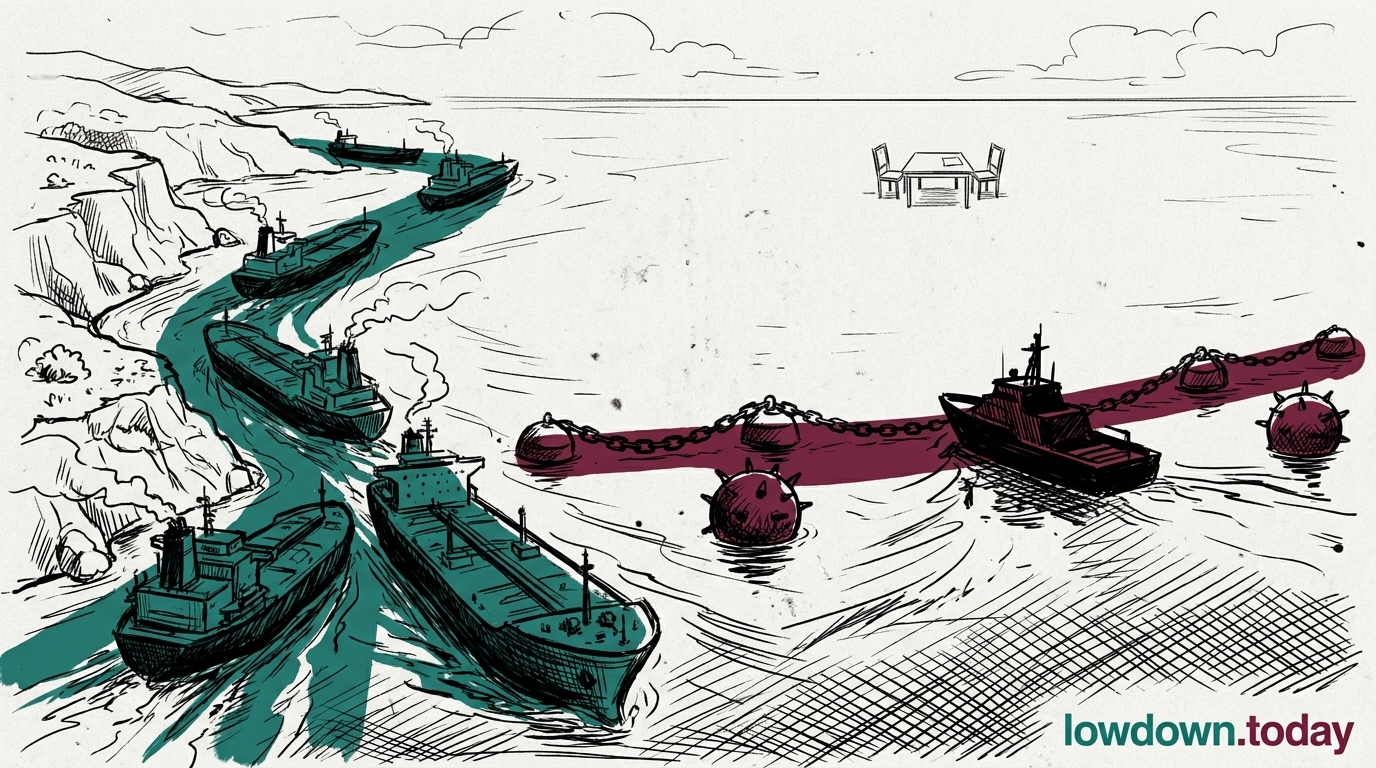
The practical distinction may not matter. IRGC (Islamic Revolutionary Guard Corps) mine corridors control who transits the strait , and CENTCOM's blockade controls what arrives at Iranian ports. Commercial shippers face competing jurisdictional claims over the same chokepoint. Hormuz traffic had recovered from single digits to double digits by Saturday . It fell back toward zero once enforcement began. The IRGC called the blockade "an illegal act" and "piracy."


Deep Analysis

In plain English

Trump's social media post said the US Navy would stop all ships entering or leaving the entire Strait of Hormuz , the narrow waterway through which a fifth of the world's oil travels. That would mean stopping ships from Japan, China, France, and dozens of other countries that have nothing to do with Iran. By the time the military actually put the order into effect, they had rewritten it to only cover ships going to and from Iranian ports , a much narrower scope. A Japanese oil tanker heading for Kuwait could still technically pass through. The problem: no one officially announced this change. Trump's post still says one thing; the military is enforcing something different. Shipping companies, flag states, and allied governments do not know which version is operational.

Deep Analysis
Root Causes

The CENTCOM narrowing reflects a specific structural tension in US civil-military relations: the military can execute, but it also has independent legal obligations under the Uniform Code of Military Justice and international law of armed conflict. A flag officer who enforces an order that constitutes a manifest violation of international law has personal legal exposure.

The strait-to-port narrowing is the minimum modification required to move the blockade from 'clear UNCLOS violation' to 'legally arguable.' Port blockades have some precedent under the 1909 Declaration of London and the customary law of naval warfare. Transit-passage prohibition in an international strait does not.

What could happen next?
  • Risk

    Any CENTCOM officer who intercepts a vessel under the tweet's full-strait order, or any officer who declines to intercept under the same tweet, is acting without clear authority , creating individual legal exposure and command confusion at sea.

    Immediate · 0.85
  • Consequence

    The gap between presidential order and military execution will be cited by allied governments as evidence that the US command structure is unreliable , compounding the diplomatic damage of the blockade itself.

    Short term · 0.78
  • Meaning

    CENTCOM's narrowing is the fourth instance of the military modifying a presidential Hormuz ultimatum before enforcement, establishing a durable pattern of operational restraint within a rhetorically escalatory posture.

    Medium term · 0.8
First Reported In

Update #67 · Trump blockades Iran on a tweet

CENTCOM / Al Jazeera· 13 Apr 2026
Read original
Causes and effects
This Event
CENTCOM rewrites blockade scope before enforcement begins
The gap between presidential order and military execution leaves commercial shippers unable to determine which authority governs their passage through Hormuz.
Different Perspectives
Hengaw
Hengaw
The Norway-based monitoring group reported the Urmia executions of Omid Behzad and Pouria Safvat, the only source to do so, consistent with its documented pattern of recording far more executions than the Iranian state acknowledges. Iran's government has not confirmed either execution.
Shipping and insurance underwriters
War-risk premiums price the Houthi campaign because the group announces its targets in advance, but a reopening Trump has promised without a published text gives underwriters no benchmark to reprice Hormuz cover against. Insurers want a text before they move rates, not a promise.
Houthi movement
Houthi movement
Spokesman Yahya Saree claimed strikes on two tankers in the Red Sea and Gulf of Aden on 5 August, only one of which UKMTO could confirm. The group's campaign against shipping continues on its own schedule, independent of any Hormuz arrangement further north.
Oman
Oman
Muscat has brokered the coordinates both Tehran and Washington's wire sources now describe differently, but has published no account of its own. Oman's position depends on treating Hormuz as a shared route, which is not what Iran is currently describing.
United States Central Command
CENTCOM raised its interdiction tally from 35 to 44 redirected vessels and disclosed its first boardings on 3 August, the day before Trump promised a reopening. The command's own enforcement record does not yet reflect the release the President has described.
Iran's Foreign Ministry
Spokesman Esmaeil Baghaei described the agreed Hormuz coordinates as a wholly new corridor under Iranian management, not a split of the existing route, days after his own deputy rejected Oman's lane proposal. Tehran wants the arrangement read as a change of ownership, not a compromise on access.



