Skip to content
You can now search across every topic, entity and event.What's new
Iran Conflict 2026
17JUN

OFAC hits Oman as Iran relief stalls

2 min read
09:37UTC

OFAC designated a Muscat financial firm on 18 June for Hezbollah links, and through 21 June issued no Iran general licence and delisted no Iranian entity. The MOU promised relief within 48 hours.

ConflictDeveloping
Key takeaway

OFAC sanctioned an Oman firm while issuing no Iran relief five days after the MOU promised it.

The Office of Foreign Assets Control (OFAC) designated Globe International SPC of Muscat on 18 June, naming the firm as a financial node in the network of Hezbollah facilitator Alaa Hamieh 1. The action was a counter-terrorism designation, not Iran sanctions relief, and it accompanied OFAC's same-day move against Hezbollah figures Sleiman Frangieh and Mahmoud Qamati . Through 21 June, OFAC issued no Iran general licence and delisted no Iranian entity 2.

Oman is mediating the Islamabad Memorandum of Understanding (MoU), hosting the territorial-waters lane that now carries the strait's traffic, and now hosting an entity Washington has just sanctioned. The same week Muscat became the strait's practical gatekeeper, it also became a sanctions target's registered address.

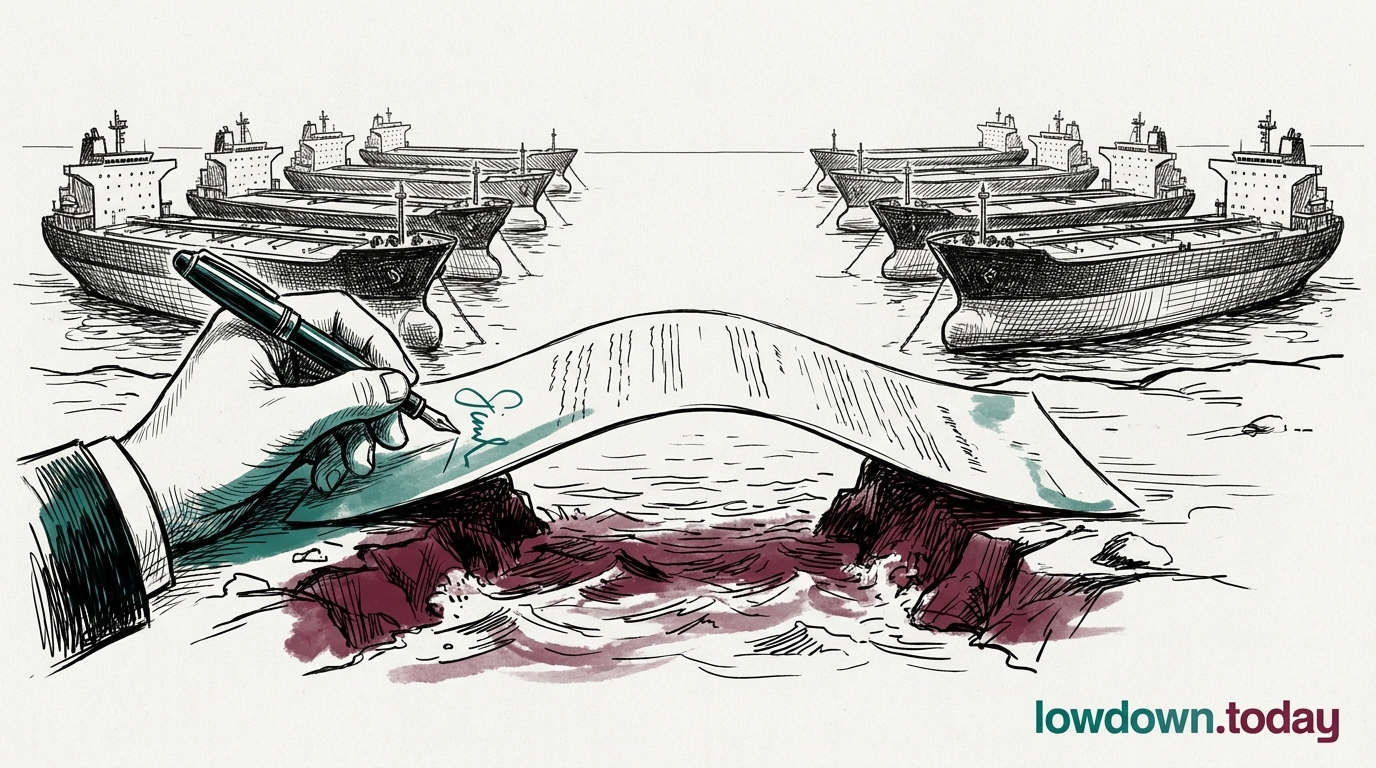
For Iran itself, OFAC has issued no instrument at all. the MOU's sanctions-relief and blockade provisions were meant to land within 48 hours of the 16 June signing . Five days on, The White House Presidential Actions register carries nothing on Iran 3. Washington ended its 66-day naval blockade on 18 June as promised , the cheapest of its obligations to fulfil, and left every costly one to a final agreement it has not drafted.

OFAC can move fast when it wants to designate, as the Globe International action shows, yet has issued not a single licence to deliver the relief Iran was promised. That gap, action against Iran's allies but no action for Iran, hangs over the Switzerland table and gives Tehran its argument that the deal runs one way.


Deep Analysis

In plain English

When Iran and the US signed the Islamabad peace memorandum on 15-16 June, one of the commitments was that the US Treasury's sanctions office, called OFAC, would ease some financial restrictions on Iran almost immediately. Five days later, through 21 June, OFAC had not done this. It had not removed any Iranian entities from its blacklist. It had not issued any licence allowing previously banned transactions. Instead, on 18 June, OFAC designated a new company, Globe International SPC, based in Oman, as a financial node connected to Hezbollah. This is the opposite of sanctions relief. Oman is the country whose waters are now the only operating Hormuz shipping lane and whose government is co-mediating the Iran-US talks. The awkwardness of OFAC sanctioning an Oman-based entity while Oman mediates a peace deal illustrates how disconnected the sanctions bureaucracy and the diplomatic track are.

Deep Analysis
Root Causes

OFAC sanctions on Iran operate under multiple executive orders (E.O. 13224, E.O. 13902) that require specific revocation or general-licence issuance to create exemptions. A verbal MOU commitment by the Vice President does not automatically trigger OFAC action; Treasury must separately publish the waiver.

The Trump administration's pattern throughout the conflict, zero signed Iran executive instruments through Day 80 on 18 May, and continuing through 21 June, reflects a deliberate choice to maintain executive flexibility rather than bind itself with signed legal instruments.

The Globe International SPC designation on 18 June compounds the signal: OFAC's counter-terrorism team continued its routine enforcement cycle against the Hezbollah financial network while the diplomacy team was in Geneva. There is no evidence the two tracks coordinated to avoid the optics of designating an entity in the same 48-hour window the MOU required sanctions relief.

What could happen next?
  • Risk

    If OFAC issues no oil-transaction waiver before the next round of Geneva talks, Iran's delegation will arrive with a concrete unfulfilled US obligation as its opening leverage.

    Immediate · Assessed
  • Consequence

    The Lloyd's-Chubb $400m war-risk consortium cannot underwrite Hormuz cargoes without OFAC sanctions screening clearance, the same clearance OFAC has not issued. The consortium's practical utility depends entirely on a waiver the MOU promised and Treasury has not delivered.

    Short term · Assessed
  • Risk

    Oman's simultaneous roles, mediating Iran-US talks, hosting the operative Hormuz lane, and now hosting an OFAC-designated entity, create a political liability that could force Muscat to distance itself from the mediation architecture.

    Medium term · Suggested
First Reported In

Update #134 · Hormuz shuts as Vance flies to Geneva

OFAC· 21 Jun 2026
Read original
Different Perspectives
Lloyd's Market Association
War-risk underwriters price the Houthis' Red Sea attacks because the group announces its targets in advance, but the unclaimed Damietta drone gives insurers a hit with no author to price against. An attack nobody claims costs shipping more than one that is claimed, since premiums are set against a known pattern, not raw damage.
US Central Command
US Central Command
CENTCOM has announced no strike on Iran since resuming bombing on 30 July within hours of an IRGC salvo on Jordan, and centcom.mil did not respond to requests to confirm any pause. The command has gone quiet before while a larger operation was being weighed, so silence alone proves nothing about what it has or has not done.
Hengaw
Hengaw
Hengaw recorded at least 67 executions in Iran during July, of which the state acknowledged only eight, and reported the 1 August execution of protest detainee Arvin Kheirkhahan at Shahrud with no advance notice to his family. A family's first notice of a death sentence is now usually the instruction to collect a body.
Egypt
Egypt
Egypt's government asked media on 2 August to report the Damietta attack accurately, named no author, and said no findings will be published before its own investigation concludes. Cairo holds the debris and jurisdiction over an attack on its own soil, and naming a culprit now would pull it into a dispute it has avoided for five months.
Iran's Foreign Ministry
Araghchi called the Hormuz talks with Oman final-stage on 2 August, four days after his own deputy rejected Oman's lane proposal, and denied the Damietta drone strike as an Israeli false flag while two Iranian officials privately claimed it for Tehran. Iran's public position now contradicts itself on both files at once.
Bahrain and Kuwait
Bahrain and Kuwait
Bahraini and Kuwaiti aircraft flew their own strikes on Iranian depots in July with Emirati air cover behind them, and Ynetnews reports some Gulf capitals wanted the 2 August strike to proceed rather than stop. States that have already taken fire see a closing window on Iranian weakness, not a reason to pause.



