Skip to content
You can now search across every topic, entity and event.What's new
Iran Conflict 2026
9JUN

Trump calls NATO a paper tiger

3 min read
10:36UTC

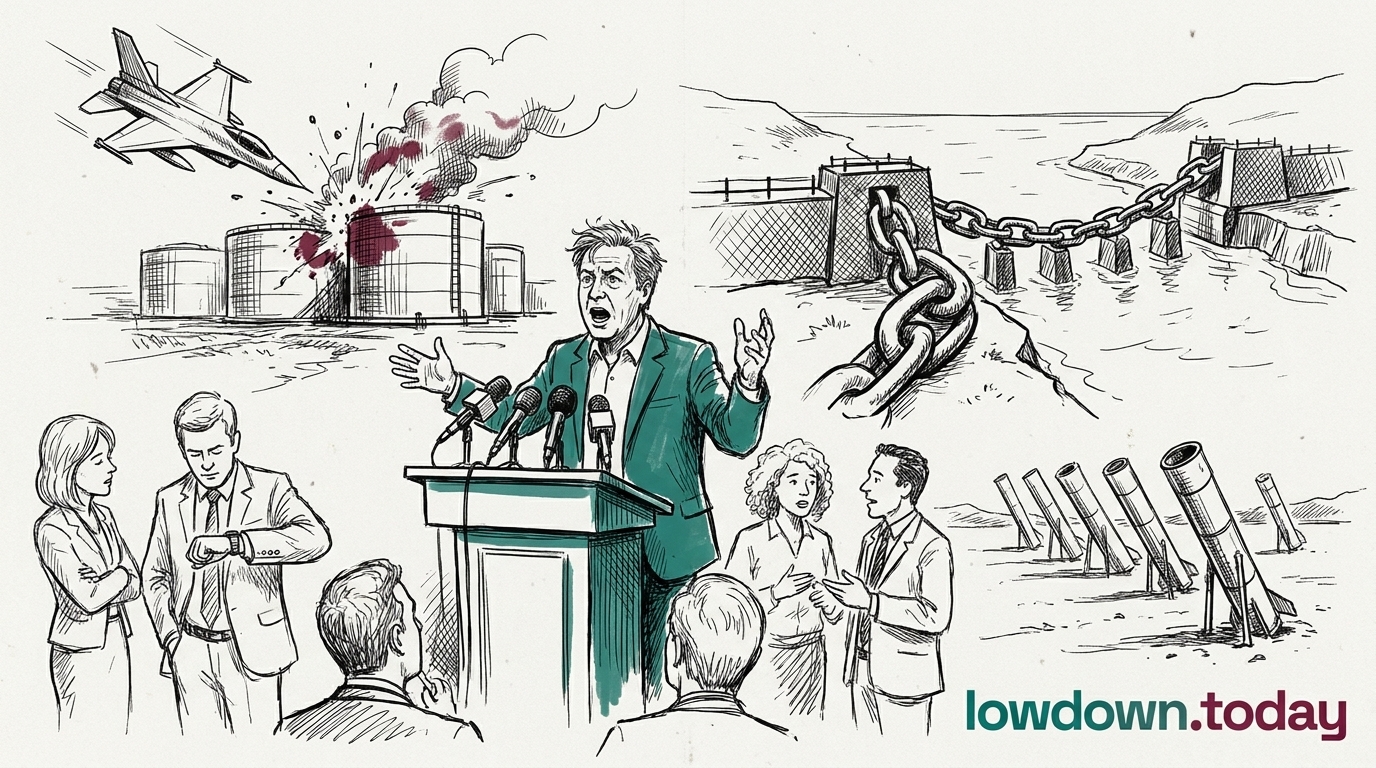
After every named ally refused to send warships to the Strait, the president moved from requesting coalition partners to publicly denouncing the alliance that has anchored Western defence since 1949.

ConflictDeveloping
Key takeaway

Calling allies cowards permanently raises the political cost of future NATO cooperation.

Trump posted on Truth Social calling NATO allies "COWARDS" and the Alliance "A PAPER TIGER" without the United States. The statement capped a week in which every country he named for a Strait of Hormuz escort Coalition — Australia, Japan, the United Kingdom, Germany, and France — formally declined to send warships . No country committed vessels within 48 hours of his initial call . By 16 March, he had floated leaving NATO entirely .

The proximate trigger was a 19 March joint statement from seven allied nations — the UK, France, Germany, Italy, the Netherlands, Japan, and Canada — expressing "readiness to contribute to appropriate efforts" for Hormuz safe passage. The statement committed no forces, set no timeline, and named no specific contributions . Switzerland, on the same day, drew a harder line than any treaty ally: halting all arms export licences to the United States and closing its airspace to US military flights linked to the war.

The allied refusals rest on a structural basis. NATO governments are being asked to join a war none endorsed, without a UN Security Council mandate, and without the parliamentary authorisations most European constitutions require before deploying forces into a combat zone. The 2001 invocation of Article 5 and the 1991 Gulf War Coalition both rested on collective decision-making frameworks that preceded military action. This war was presented to potential partners after the fact.

The isolation runs both ways. The United States fights without allied military support. Allied governments watch Gulf Energy infrastructure they depend on — Kuwait's Mina Al-Ahmadi, Qatar's Ras Laffan — absorb Iranian strikes they lack the political mandate to prevent. Public denunciation raises the domestic cost for any allied leader who might later seek parliamentary approval for a deployment: no government finds it easier to send warships after being called a coward.

Deep Analysis

In plain English

NATO was built on the understanding that members consult before acting and support each other's security in defined circumstances. The Hormuz escort operation was not a NATO mission — it was a US-led ad hoc coalition that allies were invited to join but had no treaty obligation to support. Allies declining to join were following their own constitutional and parliamentary frameworks, not violating the NATO treaty's actual text. By publicly calling them cowards, Trump is redefining alliance membership as unconditional support for any US unilateral action — a standard no NATO treaty has ever required. For citizens in member states, this matters because an alliance with degraded cohesion provides less deterrence against threats in Europe, potentially increasing the defence spending demands placed on member governments and the tax burdens that fund them.

Deep Analysis
Synthesis

The 'Paper Tiger' formulation is borrowed from Maoist political rhetoric — specifically Mao Zedong's characterisation of the United States in the 1950s as a power appearing strong but fundamentally weak. Applying it to NATO publicly hands China and Russia a propaganda instrument requiring no fabrication: the US president has himself declared the Western alliance hollow. This is a strategic gift to Beijing, which has sought to demonstrate Western alliance fragility as a core element of its global influence operations since at least 2008.

Root Causes

NATO's founding Washington Treaty applies to collective self-defence under Article 5, not to collective power projection in third-party conflicts. The alliance has no mechanism to compel members to join offensive operations outside Article 5's scope. Trump's expectation that allies would join the Hormuz coalition reflects either a deliberate redefinition of alliance obligations or a structural misunderstanding of what the treaty actually requires — a mismatch predating this administration but now acutely and publicly exposed.

What could happen next?
  • Consequence

    European allies denied diplomatic cover of US reassurance may accelerate autonomous defence procurement, reducing long-term demand for US defence exports.

    Medium term · Assessed
  • Risk

    Public delegitimisation of NATO by the US president hands adversarial powers propaganda validating their narrative of Western alliance collapse without requiring any fabrication.

    Immediate · Assessed
  • Precedent

    This is the first instance of a sitting US president publicly calling NATO allies cowards during active hostilities — establishing a precedent for transatlantic rupture under operational stress.

    Long term · Assessed
  • Risk

    Intelligence-sharing arrangements and joint operational planning may be quietly degraded by aggrieved allies even if formal alliance structures nominally remain intact.

    Short term · Suggested
First Reported In

Update #43 · Trump floats wind-down, deploys 2,200 more

Axios· 21 Mar 2026
Read original
Causes and effects
This Event
Trump calls NATO a paper tiger
Trump's public denunciation of NATO allies as 'cowards' formalises the diplomatic isolation of a war the United States is fighting with only Israel as a committed military partner. The shift from bilateral requests to public insults narrows the political space for allied governments to reverse course.
Different Perspectives
Oil markets / Lloyd's of London
Brent fell to near $87.33 on 80 per cent deal-probability pricing, but Lloyd's has not de-listed Hormuz from its war-risk register and shipping diversions continue at 139 vessels. Insurance markets are lagging futures: physical risk remains while financial markets have spent the good news before the paper exists.
India
India
Modi is expected to raise the deaths of three Indian sailors in the 11 June CENTCOM strike on the MT Settebello with Trump at G7 sidelines, the first non-party leader to put the blockade's human cost into a formal bilateral. New Delhi is also a major Iranian oil buyer whose import volumes the sanctions-relief terms will govern.
Israel (Netanyahu)
Israel (Netanyahu)
Netanyahu stated Israel is not party to the deal on 12 June; Defence Minister Katz ruled out the Lebanon withdrawal Iran's draft demands, inserting a third blocker the US-Iran negotiating channel cannot resolve. Israel's position tethers Hormuz reopening to a Lebanon settlement Washington has not brokered.
Pakistan (mediator, Sharif/Naqvi)
Sharif declared a final agreed text on 12 June before either principal confirmed it, running two Tehran visits in under a week without securing a written IRGC or Khamenei response. Islamabad's incentive to claim a diplomatic win outpaces its standing to deliver either capital's signature.
Iran foreign ministry (Araghchi)
Araghchi declared digital signing within days while setting dilute-in-Iran as a non-negotiable red line on the 440.9 kg HEU stockpile, a standing Tehran position he cannot override without authorisation from Khamenei, reachable only by courier. The FM track is sprinting to close before the IRGC reasserts control.
Trump administration / CENTCOM
Vance called the deal still TBD on 12 June while CENTCOM downed Iranian drones over Hormuz for a second consecutive night and the White House register stayed blank. Washington holds the ship-out position on HEU and has not signed an Iran instrument in over 100 days of conflict.