Skip to content
Briefings are running a touch slower this week while we rebuild the foundations.See roadmap
Iran Conflict 2026
4JUN

War powers clock outlasts the House

4 min read
11:25UTC

House leadership pulled its war-powers vote before the Memorial Day recess; the chamber does not return until 2 June, one day after the 1 June deadline it was meant to act on.

ConflictDeveloping
Key takeaway

The executive wins the war-powers fight by doing nothing while the recess runs the 1 June clock out.

House leadership pulled its war-powers vote before the Memorial Day recess and rescheduled it to early June, so the chamber stays out of the building until Tuesday 2 June 2026 . The 30-day wind-down clock under the War Powers Resolution, the 1973 statute that is meant to force a congressional vote on undeclared wars, lapses on Monday 1 June. For the reader that means the war on Iran runs on with no congressional authorisation and no realistic route to one before mid-June.

A war-powers measure reaches the President only after both chambers pass matching text. The Senate is set to hold its floor vote on 1 June on the resolution sponsored by Senator Tim Kaine, the Virginia Democrat, advanced from committee 50-47 on 20 May . The absent House supplies no matching version, so the Senate vote produces a half-measure the President never has to receive. Leadership cancelled the House vote as Republicans neared losing it , and the calendar finished the job.

This repeats the pattern set on 29 April, when the first 60-day clock ran out with no third floor vote . The Administration argues the wind-down clock never started at all: Pete Hegseth, the US Secretary of War, told the Senate that Article 2 of the Constitution overrides any authorisation requirement. Kaine and the four Republicans who crossed reject that reading and hold the 1973 statute to a fixed clock regardless of how the White House labels the conflict 1.

The War Powers Resolution clock binds the executive, yet only Congress can stop the clock, and Congress controls its own calendar. Scheduling a recess across the 1 June expiry is the statute working as written for a body that does not want to act. Any House vote after 2 June governs a period already spent, which makes it a statement rather than a constraint.

Deep Analysis

In plain English

After the second World War, US presidents started sending troops into conflicts without asking Congress to formally declare war. In 1973, Congress passed the War Powers Resolution (WPR) to limit that: if the president commits forces to combat, Congress has 60 days to approve, or the troops must come home. After that 60-day window there is a further 30-day wind-down period, which is set to expire on 1 June 2026. Congress has to take a vote to stop the war, and Congress controls its own calendar. House Speaker Mike Johnson scheduled the chamber to be on holiday until 2 June, one day after the deadline. The Senate is set to vote that Monday on Senator Tim Kaine's resolution, but stopping a war legally requires both chambers to pass identical text. With the House absent on 1 June, the clock runs out before any matching vote. President Trump wins the war-powers fight not by arguing but by waiting.

Deep Analysis
Root Causes

The WPR's enforcement gap runs through a structural contradiction Congress built into the statute in 1973. Section 1544(c) allows Congress to pass a concurrent resolution (not requiring presidential signature) ordering withdrawal; the Supreme Court's 1983 ruling in INS v. Chadha invalidated the legislative-veto mechanism on which concurrent resolutions rest, stripping the statute of its one self-executing remedy.

The second structural cause is the recess-calendar asymmetry: the WPR clock runs continuously, but Congress controls its own schedule. House leaders who prefer not to hold a recorded vote can avoid one indefinitely by timing recesses across statutory deadlines.

The 29 April lapse and the 1 June wind-down now set to expire the same way are not errors in the WPR; they are its institutional logic operating exactly as designed for a legislature whose leadership cannot hold a majority for a recorded constraint.

What could happen next?
  • Precedent

    The 29 April lapse and the 1 June wind-down due to expire the same way, neither met by a House vote, would establish a replicable template: schedule a recess across a statutory deadline and the executive inherits the field.

    Long term · Assessed
  • Risk

    Any post-2 June House action would be legally symbolic, not operative; a lawsuit challenging the sanctions programme's authority would face the argument that the operative 30-day window passed ungoverned by any chamber vote.

    Short term · Assessed
  • Consequence

    The Senate's 50-47 advance on 20 May leaves the Kaine resolution live for the next legislative session, but it requires a matching House passage before it reaches a presidential desk for potential veto.

    Medium term · Assessed
First Reported In

Update #109 · War Powers clock outlasts Congress by a day

White House· 27 May 2026
Read original
Different Perspectives
China
China
Beijing's MOFCOM Blocking Rules constrain OFAC enforcement on the mainland; China has not corroborated Trump's verbal account of any bilateral summit, and the rial's failure to hold its Rubio bounce, combined with the IRGC's stablecoin rail closure, increases Chinese yuan-denominated oil-payment exposure through Hormuz.
Israel
Israel
IDF Chief Zamir said on 3 June there is no ceasefire for his forces even as Israel signed the Washington Lebanon framework requiring Hezbollah withdrawal south of the Litani; a UNIFIL peacekeeper was killed by mortar near Marjayoun on the same day, exposing the gap between the diplomatic framework and a ground advance that has not stopped.
Bahrain
Bahrain
The IRGC struck Bahrain on 3 June as its sirens sounded and its PAC-3 magazine neared exhaustion; excluded from Rubio's 2 May emergency resupply, Bahrain received a 50-round Federal Register notice on 1 June on an 18-month delivery timeline, meaning it is defending the US Fifth Fleet headquarters on the last rounds it has.
Qatar
Qatar
Qatar offered $6bn under OFAC Licence L-2 restrictions and sent Ghalibaf's delegation home empty-handed; the $6bn ceiling is a legal constraint, not a negotiating floor, and Rubio's no-sanctions-relief testimony means Qatar cannot revise it without White House action that has not been requested.
Kuwait
Kuwait
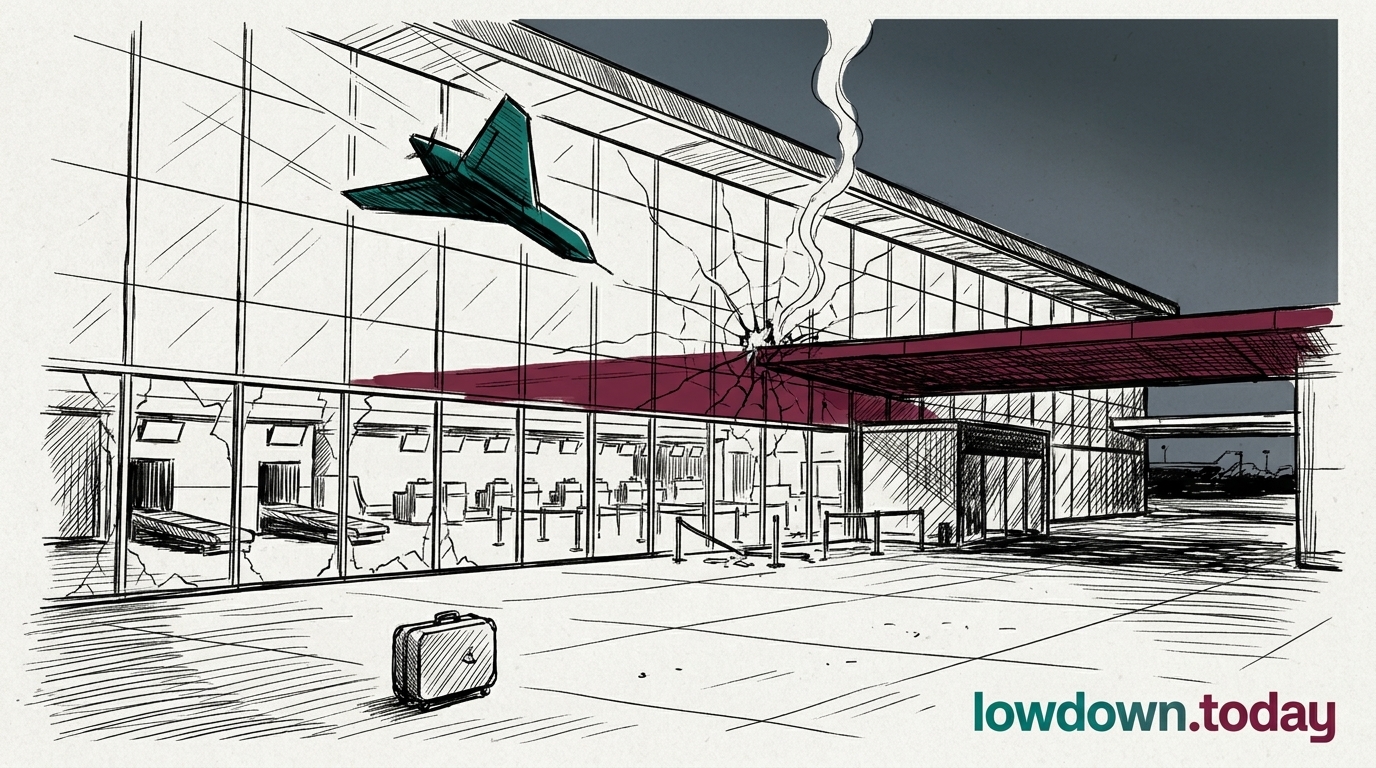
Kuwait expelled two Iranian diplomats within 24 hours of the airport strike, the strongest and fastest Kuwaiti diplomatic move of the conflict, while keeping the full mission in place to preserve a communication channel; it has now invoked Article 51 self-defence, filed a formal protest, and expelled diplomats, exhausting its formal toolkit short of full rupture.
United States
United States
Trump narrated a weekend deal while the channel Rubio described under oath, Khamenei's written-only couriers with a 3-to-5-day lag, cannot answer at that speed; CENTCOM called the airport strike deliberate, calculated and unjustified. The House 215-208 vote gave Congress its first on-record war-powers position against the deployment Trump has run without a signed instrument for 96 days.