Skip to content
Briefings are running a touch slower this week while we rebuild the foundations.See roadmap
Iran Conflict 2026
4JUN

IRGC claims US Qatar radar 'dismantled'

2 min read
11:25UTC

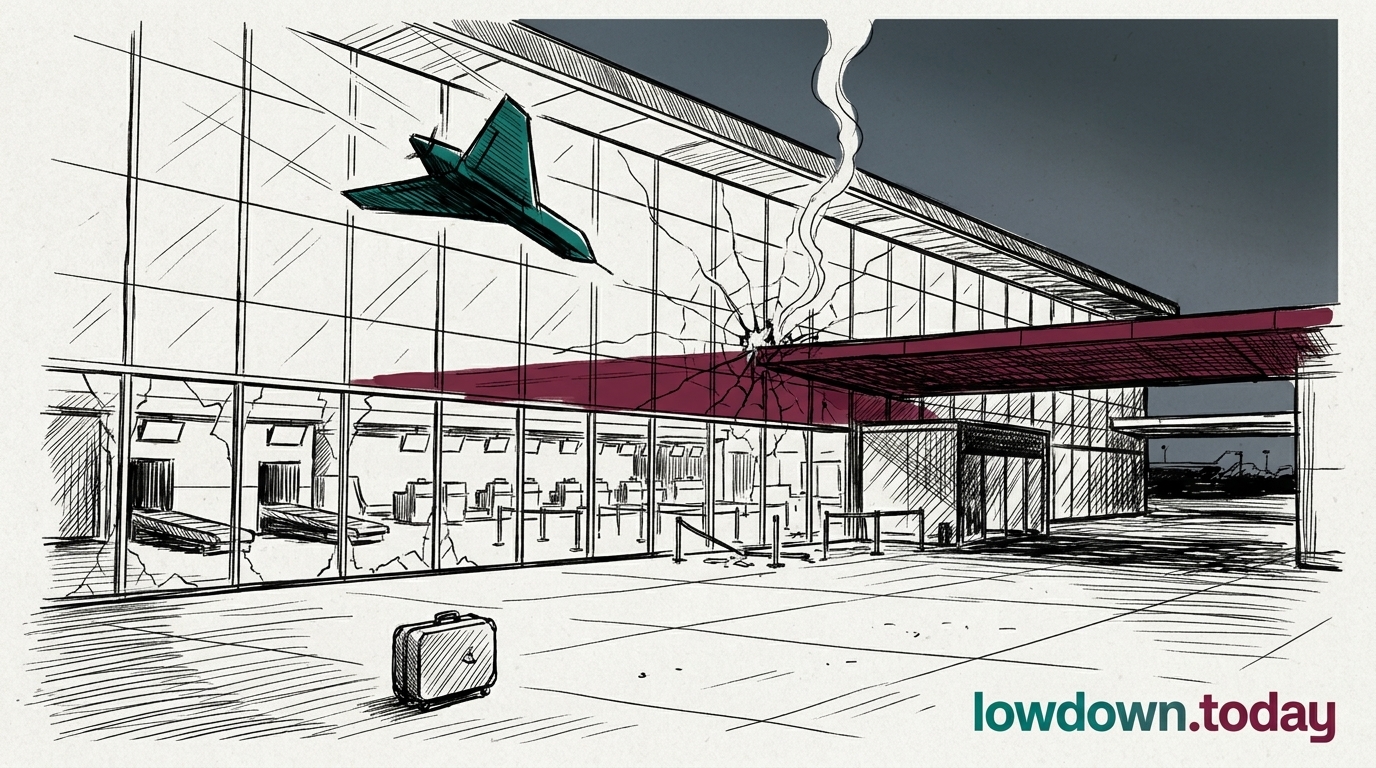
Iran says it destroyed an American radar installation in Qatar — home to the command centre directing the air campaign. Washington, Doha, and NATO have said nothing.

ConflictDeveloping
Key takeaway

Even if fabricated, the Qatar radar claim achieves a strategic objective by signalling to Gulf host nations that US basing makes them Iranian targets — potentially chilling basing offers that US operations in the region depend upon.

The IRGC claimed Wednesday it had "dismantled a US radar installation in Qatar." No US, Qatari, or NATO official has addressed the claim in any forum.

The likeliest target would be infrastructure associated with Al Udeid Air Base, south-west of Doha, which houses the Combined Air Operations Centre coordinating all Coalition air sorties across the Middle East. Approximately 10,000 US personnel are stationed there. A successful strike on radar systems at or near Al Udeid would mean Iran hit the operational nerve centre directing the campaign that has now struck more than 2,000 targets inside its own territory.

The IRGC's track record during this conflict makes the claim neither dismissible nor credible on its own. Its formal claim for the drone strike on the US consulate in Dubai was issued and confirmed within 24 hours . Its claim of striking a US destroyer in the Indian Ocean, made on the same day, remains unaddressed by the Pentagon. The pattern — a mix of confirmed strikes and unanswered assertions — means each new claim occupies an information vacuum the US appears content to maintain.

Qatar is caught in overlapping pressures that make the silence itself consequential. Iranian drones struck its Ras Laffan LNG facility days earlier . Qatari jets shot down two Iranian Su-24 aircraft in the defensive response . China entered direct negotiations with Tehran specifically to protect Qatari LNG infrastructure, on which Beijing depends for roughly 30% of its imported gas . A confirmed Iranian strike on a US military installation on Qatari soil would collapse whatever remains of Doha's room to function as a diplomatic intermediary with Tehran — a role no other Gulf capital can replicate.


Deep Analysis

In plain English

Iran is claiming it destroyed a US military radar system in Qatar. Qatar hosts the largest American military base in the Middle East — the facility from which the US coordinates all its air operations across the region. Neither the US nor Qatar has said anything in response, which is notable given how quickly both normally rebut false Iranian claims. The silence is unusual enough to leave the claim unresolved.

Deep Analysis
Synthesis

If Gulf states begin calculating that hosting US assets makes them Iranian targets, the US loses forward presence in the Gulf that is operationally irreplaceable — Al Udeid cannot be substituted from outside the region without adding hours to strike cycles and degrading real-time command coordination. The information operation succeeds even without a physical strike.

Root Causes

Iran's strategic logic in targeting Qatar-hosted US assets — even through information operations rather than confirmed kinetic action — is to impose costs on Gulf basing relationships, separating US operational reach from Gulf state territory by raising the price Gulf states pay for hosting US forces.

Escalation

Qatar's silence alongside the US is itself a diplomatic management signal — Doha cannot confirm Iranian success without appearing vulnerable and inviting further strikes, nor deny without appearing to coordinate with Washington against Iran, risking both its non-belligerent status and its indispensable ceasefire mediation role. The ambiguity serves Qatari interests regardless of what actually occurred.

What could happen next?
  • Risk

    If the radar claim is even partially accurate, the regional missile defence sensor network has exploitable gaps that Iran can use in subsequent salvo campaigns.

    Immediate · Suggested
  • Meaning

    Qatar's enforced silence removes it from active ceasefire mediation — a country absorbing Iranian strikes on its territory cannot simultaneously broker a ceasefire between Iran and the US without appearing to be acting under duress.

    Short term · Assessed
  • Consequence

    Gulf states will reassess the cost-benefit of hosting US military infrastructure if Iran credibly demonstrates the ability to strike those installations, potentially reshaping US basing access in the medium term.

    Medium term · Suggested
  • Risk

    An Iranian pattern of targeting Gulf-hosted US assets creates pressure on US Major Non-NATO Ally obligations to Qatar that are less binding than Article 5 but politically difficult to ignore.

    Short term · Suggested
First Reported In

Update #19 · First US torpedo kill since 1945

Al Jazeera· 4 Mar 2026
Read original
Causes and effects
This Event
IRGC claims US Qatar radar 'dismantled'
If confirmed, a strike on US radar infrastructure in Qatar would represent a direct hit on the command-and-control architecture coordinating the coalition air campaign against Iran. The total silence from all three parties — the US, Qatar, and NATO — leaves the claim in deliberate ambiguity during active operations.
Different Perspectives
Israel
Israel
IDF Chief Eyal Zamir declared on 3 June there was no ceasefire for his forces, and strikes killed at least 10 civilians and one Israeli soldier on 4 June. The IDF killed Hezbollah's chief engineer and warned three south Lebanon villages to evacuate on 5 June, advancing into ground the unsigned Washington framework has not caught.
Hezbollah / Lebanon
Hezbollah / Lebanon
Naim Qassem rejected the Washington Lebanon framework on 4 June as "absurd, humiliating and insulting", blocking a ceasefire instrument that required Hezbollah to withdraw north of the Litani before any Israeli withdrawal. Over one million Lebanese remain displaced; the framework's collapse prolongs that toll.
Iran
Iran
Foreign Minister Araghchi publicly coupled the Lebanon ceasefire to the Iran-US nuclear track on 4 June, carrying IRGC authority rather than his own civilian mandate. The IRGC delegation has sent no HEU counter-proposal since Araghchi confirmed no progress that same day; Mojtaba Khamenei's 21 May order to keep the 440.9 kg stockpile inside Iran remains operative.
United States
United States
Rubio placed the Iran-US deal at 95 per cent complete on 4 June while the administration signed no Iran instrument and OFAC designated only Cuban targets. Trump separately disclosed and rejected an airlift plan to collect Iran's HEU stockpile, claiming the material is "entombed", a claim the IAEA cannot verify.
China
China
Beijing's MOFCOM Blocking Rules constrain OFAC enforcement on the mainland; China has not corroborated Trump's verbal account of any bilateral summit, and the rial's failure to hold its Rubio bounce, combined with the IRGC's stablecoin rail closure, increases Chinese yuan-denominated oil-payment exposure through Hormuz.
Bahrain
Bahrain
The IRGC struck Bahrain on 3 June as its sirens sounded and its PAC-3 magazine neared exhaustion; excluded from Rubio's 2 May emergency resupply, Bahrain received a 50-round Federal Register notice on 1 June on an 18-month delivery timeline, meaning it is defending the US Fifth Fleet headquarters on the last rounds it has.



