Skip to content
Briefings are running a touch slower this week while we rebuild the foundations.See roadmap
Iran Conflict 2026
4JUN

Rubio asks China for active Iran role; Vance claims progress

3 min read
11:25UTC

Secretary of State Marco Rubio publicly called on China to play a more active role in ending the Iran war at the Beijing summit, while Vice President JD Vance said progress was being made: both statements verbal, neither backed by a signed instrument or joint communique.

ConflictDeveloping
Key takeaway

Rubio named China as a necessary Iran partner in public; he offered no paper to hold Beijing to that role.

Secretary of State Marco Rubio told reporters at the Beijing summit on 14 May that the Iran conflict "threatens to destabilise Asia" and called on China to play a more "active" role in ending the war 1. Vice President JD Vance, present at the same summit, said "progress is being made" in Iran talks. Neither statement was accompanied by a signed instrument, a joint communique, or a written Chinese counter-commitment.

China had endorsed Pakistan's mediatory role on 13 May after a Wang Yi-Ishaq Dar call , a step that kept Beijing inside the diplomatic tent without committing to a defined deliverable. Rubio's public call for a more active role arrived the following day with no written Chinese counter-text; Beijing's Day 1 response was measured silence on Iran, not a signed undertaking. The pattern mirrors Trump's 2 May Truth Social rejection of Iran's 14-point proposal: state a position, sign nothing, wait to see what comes back.

On Day 1, the US commercial register had one signed entry: the Nvidia clearance. The US diplomatic register on Iran had none. Rubio's public framing of the conflict as an Asian stability threat was a rhetorical appeal to Xi Jinping's stated regional priorities. A public ask without a written counter-text gives Beijing no obligation to report back against, no timeline, and no metric by which its "active role" can be judged.

Deep Analysis

In plain English

At the Beijing summit on 14 May, Secretary of State Rubio and Vice President Vance both said publicly that China should do more to help end the Iran war, and that progress was being made. Neither statement came with any document to back it up. China had already said the day before that Pakistan was handling the mediation, which was China's way of keeping itself at arm's length. Both the American ask and the American claim of progress were words only, with nothing in writing.

Deep Analysis
Root Causes

The Trump administration's personal-relationship diplomacy model structurally resists institutional drafting. A written joint communique on Iran would require State Department legal review, Chinese foreign-ministry counter-text, and a shared definitional baseline for what "active role" means. The verbal format allows both sides to claim the ask was heard without either side committing to a specific deliverable.

China's own constraint reinforces this. Beijing publicly endorsed Pakistan's mediatory role one day before the summit. Issuing a written Iran commitment at the summit itself would contradict that endorsement by suggesting China had a more direct role than it had just publicly assigned to Islamabad.

Both Washington's preference for personal-relationship diplomacy and Beijing's prior written endorsement of Pakistan as channel pointed toward the same outcome: a verbal exchange that neither side needed to walk back.

What could happen next?
  • Consequence

    A verbal public ask without a written counter-text gives Beijing no obligation to report progress against, no timeline to meet, and no metric by which its active role can be held to account at Day 2 of the summit.

  • Risk

    If the summit closes with only parallel verbal statements on Iran rather than a joint communique, the Beijing model diverges from the Islamabad channel where a written MOU exists, leaving two tracks at different institutional weight.

First Reported In

Update #97 · Chips for Beijing, no paper for Iran

South China Morning Post· 14 May 2026
Read original
Causes and effects
This Event
Rubio asks China for active Iran role; Vance claims progress
Rubio's framing of the Iran conflict as a threat to Asian stability was the clearest US public acknowledgement that Washington cannot close this war without Chinese co-pressure, but the ask was delivered without a written counter-text to hold Beijing to.
Different Perspectives
China
China
Beijing's MOFCOM Blocking Rules constrain OFAC enforcement on the mainland; China has not corroborated Trump's verbal account of any bilateral summit, and the rial's failure to hold its Rubio bounce, combined with the IRGC's stablecoin rail closure, increases Chinese yuan-denominated oil-payment exposure through Hormuz.
Israel
Israel
IDF Chief Zamir said on 3 June there is no ceasefire for his forces even as Israel signed the Washington Lebanon framework requiring Hezbollah withdrawal south of the Litani; a UNIFIL peacekeeper was killed by mortar near Marjayoun on the same day, exposing the gap between the diplomatic framework and a ground advance that has not stopped.
Bahrain
Bahrain
The IRGC struck Bahrain on 3 June as its sirens sounded and its PAC-3 magazine neared exhaustion; excluded from Rubio's 2 May emergency resupply, Bahrain received a 50-round Federal Register notice on 1 June on an 18-month delivery timeline, meaning it is defending the US Fifth Fleet headquarters on the last rounds it has.
Qatar
Qatar
Qatar offered $6bn under OFAC Licence L-2 restrictions and sent Ghalibaf's delegation home empty-handed; the $6bn ceiling is a legal constraint, not a negotiating floor, and Rubio's no-sanctions-relief testimony means Qatar cannot revise it without White House action that has not been requested.
Kuwait
Kuwait
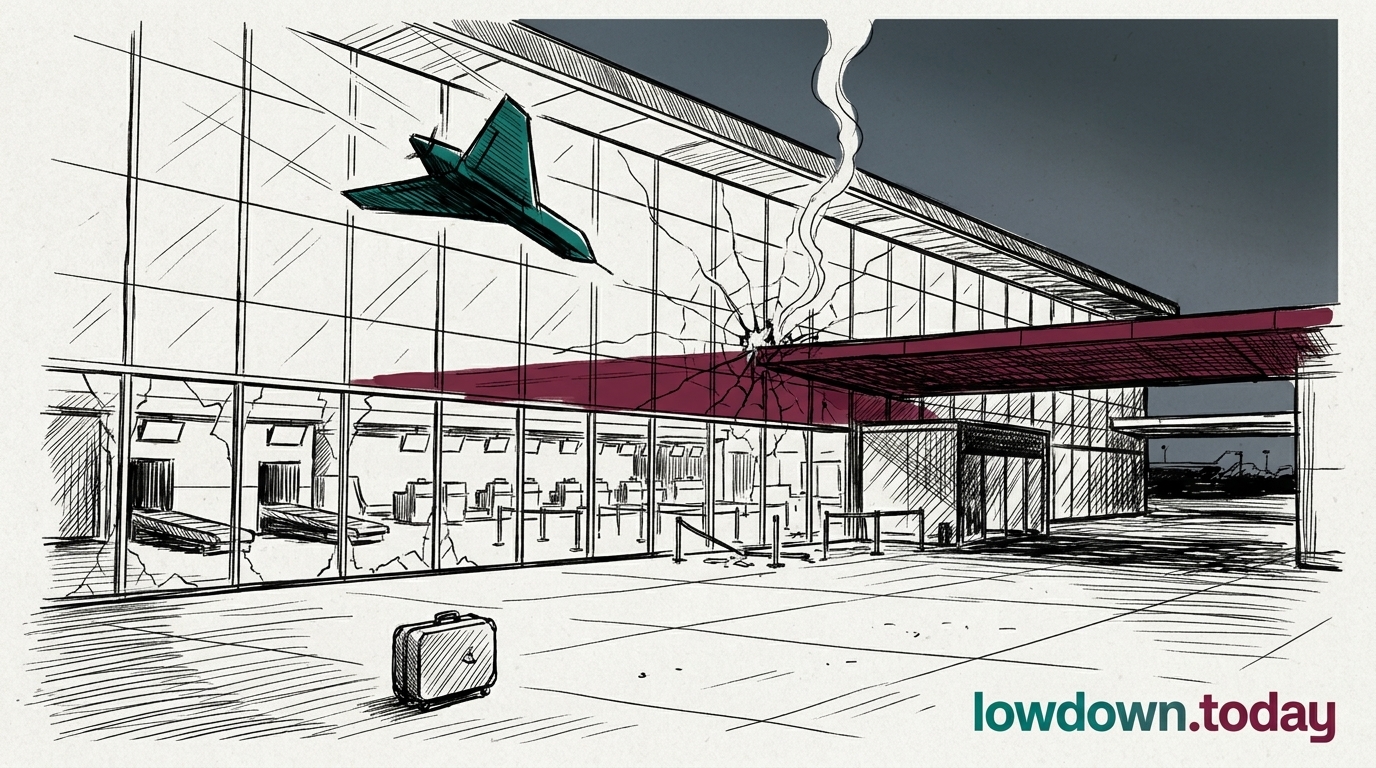
Kuwait expelled two Iranian diplomats within 24 hours of the airport strike, the strongest and fastest Kuwaiti diplomatic move of the conflict, while keeping the full mission in place to preserve a communication channel; it has now invoked Article 51 self-defence, filed a formal protest, and expelled diplomats, exhausting its formal toolkit short of full rupture.
United States
United States
Trump narrated a weekend deal while the channel Rubio described under oath, Khamenei's written-only couriers with a 3-to-5-day lag, cannot answer at that speed; CENTCOM called the airport strike deliberate, calculated and unjustified. The House 215-208 vote gave Congress its first on-record war-powers position against the deployment Trump has run without a signed instrument for 96 days.