Skip to content
Briefings are running a touch slower this week while we rebuild the foundations.See roadmap
Iran Conflict 2026
1JUN

War powers clock outlasts the House

4 min read
08:32UTC

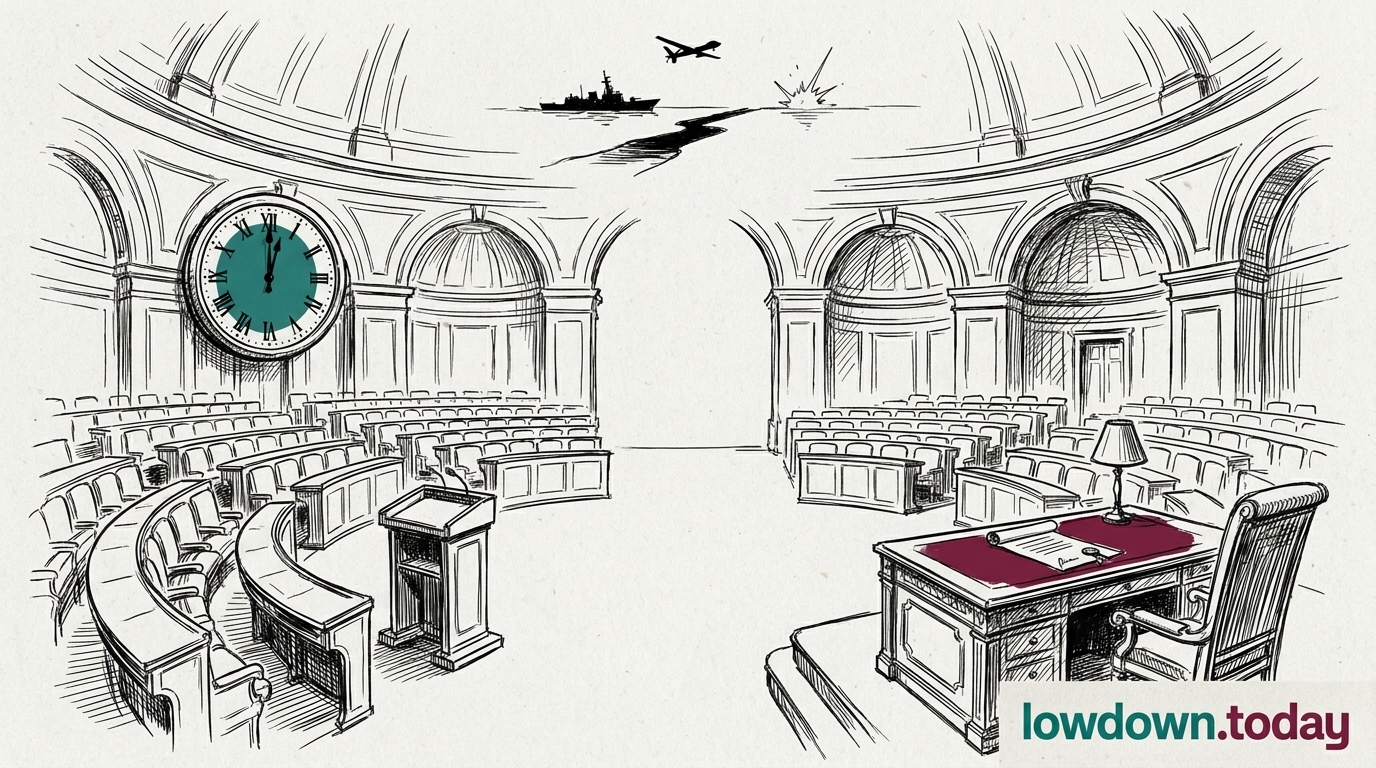
House leadership pulled its war-powers vote before the Memorial Day recess; the chamber does not return until 2 June, one day after the 1 June deadline it was meant to act on.

ConflictDeveloping
Key takeaway

The executive wins the war-powers fight by doing nothing while the recess runs the 1 June clock out.

House leadership pulled its war-powers vote before the Memorial Day recess and rescheduled it to early June, so the chamber stays out of the building until Tuesday 2 June 2026 . The 30-day wind-down clock under the War Powers Resolution, the 1973 statute that is meant to force a congressional vote on undeclared wars, lapses on Monday 1 June. For the reader that means the war on Iran runs on with no congressional authorisation and no realistic route to one before mid-June.

A war-powers measure reaches the President only after both chambers pass matching text. The Senate is set to hold its floor vote on 1 June on the resolution sponsored by Senator Tim Kaine, the Virginia Democrat, advanced from committee 50-47 on 20 May . The absent House supplies no matching version, so the Senate vote produces a half-measure the President never has to receive. Leadership cancelled the House vote as Republicans neared losing it , and the calendar finished the job.

This repeats the pattern set on 29 April, when the first 60-day clock ran out with no third floor vote . The Administration argues the wind-down clock never started at all: Pete Hegseth, the US Secretary of War, told the Senate that Article 2 of the Constitution overrides any authorisation requirement. Kaine and the four Republicans who crossed reject that reading and hold the 1973 statute to a fixed clock regardless of how the White House labels the conflict 1.

The War Powers Resolution clock binds the executive, yet only Congress can stop the clock, and Congress controls its own calendar. Scheduling a recess across the 1 June expiry is the statute working as written for a body that does not want to act. Any House vote after 2 June governs a period already spent, which makes it a statement rather than a constraint.

Deep Analysis

In plain English

After the second World War, US presidents started sending troops into conflicts without asking Congress to formally declare war. In 1973, Congress passed the War Powers Resolution (WPR) to limit that: if the president commits forces to combat, Congress has 60 days to approve, or the troops must come home. After that 60-day window there is a further 30-day wind-down period, which is set to expire on 1 June 2026. Congress has to take a vote to stop the war, and Congress controls its own calendar. House Speaker Mike Johnson scheduled the chamber to be on holiday until 2 June, one day after the deadline. The Senate is set to vote that Monday on Senator Tim Kaine's resolution, but stopping a war legally requires both chambers to pass identical text. With the House absent on 1 June, the clock runs out before any matching vote. President Trump wins the war-powers fight not by arguing but by waiting.

Deep Analysis
Root Causes

The WPR's enforcement gap runs through a structural contradiction Congress built into the statute in 1973. Section 1544(c) allows Congress to pass a concurrent resolution (not requiring presidential signature) ordering withdrawal; the Supreme Court's 1983 ruling in INS v. Chadha invalidated the legislative-veto mechanism on which concurrent resolutions rest, stripping the statute of its one self-executing remedy.

The second structural cause is the recess-calendar asymmetry: the WPR clock runs continuously, but Congress controls its own schedule. House leaders who prefer not to hold a recorded vote can avoid one indefinitely by timing recesses across statutory deadlines.

The 29 April lapse and the 1 June wind-down now set to expire the same way are not errors in the WPR; they are its institutional logic operating exactly as designed for a legislature whose leadership cannot hold a majority for a recorded constraint.

What could happen next?
  • Precedent

    The 29 April lapse and the 1 June wind-down due to expire the same way, neither met by a House vote, would establish a replicable template: schedule a recess across a statutory deadline and the executive inherits the field.

    Long term · Assessed
  • Risk

    Any post-2 June House action would be legally symbolic, not operative; a lawsuit challenging the sanctions programme's authority would face the argument that the operative 30-day window passed ungoverned by any chamber vote.

    Short term · Assessed
  • Consequence

    The Senate's 50-47 advance on 20 May leaves the Kaine resolution live for the next legislative session, but it requires a matching House passage before it reaches a presidential desk for potential veto.

    Medium term · Assessed
First Reported In

Update #109 · War Powers clock outlasts Congress by a day

White House· 27 May 2026
Read original
Different Perspectives
Human rights monitors (Hengaw, Amnesty International, Iran HRM)
Monitors documented a second death sentence for Zahra Tabari, 68, reported cemetery record deletions at Behesht-e Zahra, and a poll showing 81.5% of medical residents want to emigrate, against a background of 200+ confirmed executions since February. Iran's security courts operate at uninterrupted wartime tempo regardless of the diplomatic track.
Pakistan (mediator)
Pakistan (mediator)
Islamabad carried Trump's revised MOU demanding HEU destruction to Iranian negotiators, formally inheriting the role of sole active mediator after Oman's forced withdrawal. Pakistan lacks Oman's banking infrastructure for frozen-asset routing and carries its own regional stakes, making it a less structurally neutral broker.
Kuwait
Kuwait
Kuwait intercepted Iranian missiles and drones for a second time in days on 1 June, with air-raid sirens sounding nationwide, after invoking Article 51 self-defence on 28 May following the Ali Al Salem ballistic-missile strike. The repeated interceptions test whether Kuwait's domestic politics can sustain hosting US forces as a de facto co-belligerent.
China (PRC)
China (PRC)
Beijing sent scholars to Shangri-La rather than its defence minister and addressed Taiwan without mentioning Iran, maintaining bilateral energy corridor protection with Tehran while refusing diplomatic exposure at multilateral forums. Trump barred China as an HEU custodian on 27 May, removing Beijing from the deal architecture while China continues supplying DPI hardware that caps Iran's internet.
Lloyd's of London / war-risk underwriters
Lloyd's held its Hormuz war-risk designation at $10-14 million per voyage while Brent recovered to $93.91, maintaining the structural divergence from futures pricing that has persisted since late May. Underwriters require a UN Security Council resolution or government certification letter, not diplomatic optimism.
Gulf Cooperation Council states (Saudi Arabia, UAE, Bahrain, Qatar)
Five Gulf states wrote to the IMO on 21 May rejecting Iran's PGSA transit authority over international waters; Saudi Arabia and the UAE have not confirmed participation in the European Hormuz mission. The GCC is navigating between US security guarantees and exposure to Iranian fire, with no Gulf state formally co-belligerent except Kuwait.