Skip to content
Briefings are running a touch slower this week while we rebuild the foundations.See roadmap
Iran Conflict 2026
1JUN

Trump flies east, desk still empty

3 min read
08:32UTC

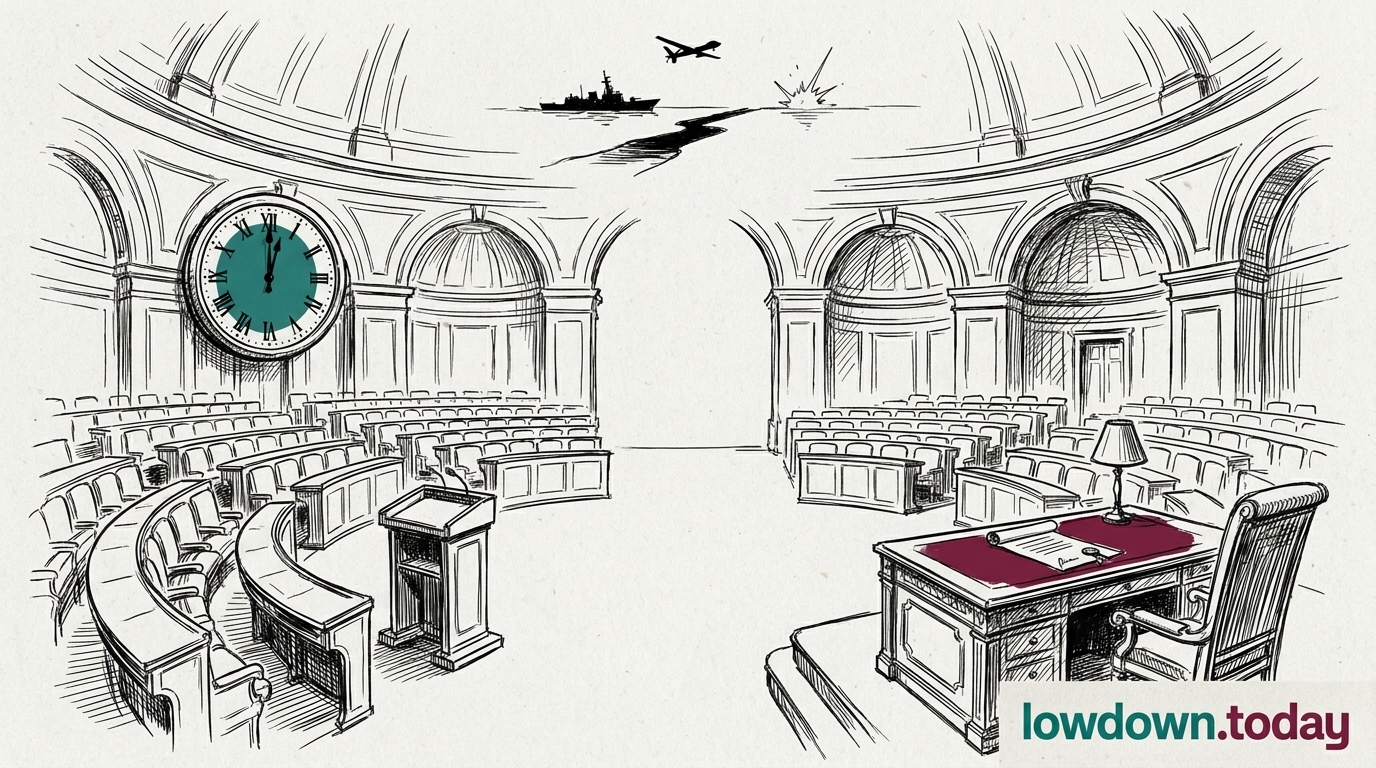
Donald Trump boarded Air Force One for Beijing on 13 May with no Iran instrument signed. The White House presidential-actions index logged zero Iran entries across 12 and 13 May, extending the unsigned streak to Day 75.

ConflictDeveloping
Key takeaway

Trump flew to Beijing on 13 May with zero Iran instruments signed across 75 days of war.

Donald Trump boarded Air Force One for Beijing on the morning of 13 May 2026 without a signed Iran instrument on his way out. The White House presidential-actions index recorded zero Iran-related entries on 12 or 13 May; the only 12 May entry was a routine "Nominations Sent to the Senate" line 1. That extends the streak of zero signed Iran instruments to Day 75, past every modern wartime precedent for an active US blockade.

The departure timing matters. Pete Hegseth's 12 May Article 2 testimony before Senate Appropriations was the legal floor; Trump's physical exit with nothing in his red folder was the operational ceiling. The final pre-departure US action on Iran was Treasury, not the Oval Office: OFAC had designated 12 entities and individuals on 11 May, six of them Hong Kong-registered, plus Universal Fortune Trading LLC as a NIOC (National Iranian Oil Company) front 2. That package was Treasury-initiated, not a presidential executive instrument. The Hong Kong target list was deliberately calibrated to fit inside the summit window : it pressures Iran's oil-logistics network without forcing Xi Jinping to publicly invoke MOFCOM's Blocking Rules during the week he hosts the American president.

Trump's 11 May Oval Office remarks listed three military options (resuming bombing of the remaining identified targets, a Special Forces seizure of Iran's enriched uranium, and a ground takeover of part of the strait), all sitting alongside zero accompanying executive orders, deployment directives, or CENTCOM operational orders. Two days later he flew east with the same blank desk. Axios sources told the outlet they did not expect any Iran kinetic decision before he returns to Washington on 15 May. The Day 75 streak is now framed at one end by a cabinet officer's sworn defence and at the other by a presidential flight to the mediator country.

Deep Analysis

In plain English

When the US president takes major military decisions, like launching a blockade or deploying tens of thousands of troops, there is normally a paper trail. The president signs executive orders, deployment directives, and formal findings that create a legal record of what was decided and why. Since the war with Iran began 75 days ago, President Trump has signed none of these documents on Iran. On 13 May he boarded Air Force One for a summit with China's president Xi Jinping in Beijing, and left with his desk still empty. The last US action on Iran before he flew was a Treasury Department sanctions package. That was a bureaucratic measure, not a presidential order. No one in the White House has explained why no paperwork exists, but a senior official told Congress the day before that the president does not need any.

Deep Analysis
Root Causes

The zero-instrument streak runs from a structural feature of how the Trump 2.0 administration has chosen to conduct the Iran campaign: verbal-track authority substituting for signed presidential instruments at every stage. Operation EPIC FURY was announced via Truth Social. Trump declared the naval blockade in a press briefing on 1 March with no accompanying executive order.

CENTCOM's escort-force order deploying 15,000 personnel to the strait was issued verbally, with no accompanying deployment directive or finding. Each decision that would normally produce an executive order, deployment directive, or finding has instead produced a press briefing or social media post.

The proximate cause of the Day 75 gap is that signing an instrument would require the administration to name specific authorities, define the scope of hostilities, and create a paper record that opposing counsel or a future administration could cite. The verbal track eliminates that record. Trump's departure for Beijing without a signed instrument is consistent with this design; the absence of paper is a structural feature, not a clerical oversight.

What could happen next?
  • Risk

    Trump's return from Beijing on 15 May without a diplomatic breakthrough resets the escalation clock with no legal brake available; Hegseth's Article 2 testimony removed the congressional constraint the same day Trump departed.

  • Opportunity

    If the Xi summit produces a framework for the Pakistan channel, Trump could sign a first Iran instrument as a ceasefire signal rather than an escalation order, converting the unsigned streak into a diplomatic asset.

First Reported In

Update #96 · Hegseth: no AUMF needed. Trump flies east

The White House· 13 May 2026
Read original
Different Perspectives
Human rights monitors (Hengaw, Amnesty International, Iran HRM)
Monitors documented a second death sentence for Zahra Tabari, 68, reported cemetery record deletions at Behesht-e Zahra, and a poll showing 81.5% of medical residents want to emigrate, against a background of 200+ confirmed executions since February. Iran's security courts operate at uninterrupted wartime tempo regardless of the diplomatic track.
Pakistan (mediator)
Pakistan (mediator)
Islamabad carried Trump's revised MOU demanding HEU destruction to Iranian negotiators, formally inheriting the role of sole active mediator after Oman's forced withdrawal. Pakistan lacks Oman's banking infrastructure for frozen-asset routing and carries its own regional stakes, making it a less structurally neutral broker.
Kuwait
Kuwait
Kuwait intercepted Iranian missiles and drones for a second time in days on 1 June, with air-raid sirens sounding nationwide, after invoking Article 51 self-defence on 28 May following the Ali Al Salem ballistic-missile strike. The repeated interceptions test whether Kuwait's domestic politics can sustain hosting US forces as a de facto co-belligerent.
China (PRC)
China (PRC)
Beijing sent scholars to Shangri-La rather than its defence minister and addressed Taiwan without mentioning Iran, maintaining bilateral energy corridor protection with Tehran while refusing diplomatic exposure at multilateral forums. Trump barred China as an HEU custodian on 27 May, removing Beijing from the deal architecture while China continues supplying DPI hardware that caps Iran's internet.
Lloyd's of London / war-risk underwriters
Lloyd's held its Hormuz war-risk designation at $10-14 million per voyage while Brent recovered to $93.91, maintaining the structural divergence from futures pricing that has persisted since late May. Underwriters require a UN Security Council resolution or government certification letter, not diplomatic optimism.
Gulf Cooperation Council states (Saudi Arabia, UAE, Bahrain, Qatar)
Five Gulf states wrote to the IMO on 21 May rejecting Iran's PGSA transit authority over international waters; Saudi Arabia and the UAE have not confirmed participation in the European Hormuz mission. The GCC is navigating between US security guarantees and exposure to Iranian fire, with no Gulf state formally co-belligerent except Kuwait.