Skip to content
Briefings are running a touch slower this week while we rebuild the foundations.See roadmap
Iran Conflict 2026
30MAY

Cooper claims halt; Kpler counts 8

4 min read
10:17UTC

Lowdown Newsroom

ConflictDeveloping
Key takeaway

A four-star commander has now voiced an over-claim the tracking data and the sanctions page both refuse to support.

Admiral Brad Cooper, commander of CENTCOM (US Central Command), told reporters on Wednesday that US forces had 'completely halted economic trade going into and out of Iran by sea' since the blockade began. Kpler and LSEG (London Stock Exchange Group) vessel-tracking data for the same window logged at least eight ships crossing the Strait of Hormuz on Day Two, including the US-sanctioned Chinese tankers Rich Starry and Elpis. Arabic Al Jazeera, citing US officials, put the Day One count above twenty. The pre-war baseline was one hundred and thirty-five transits per day.

Both statements are technically compatible only if 'Iran trade' is read as 'ships going to Iranian ports'. CENTCOM's written operational order, the document defining which vessels its patrols actually intercept, excludes from interdiction any vessel 'not engaging with Iranian ports', the same carve-out it inserted when it narrowed Trump's full-strait closure before enforcement began. Rich Starry and Elpis, Chinese-owned, Chinese-crewed and bound for non-Iranian ports, fall outside its scope. The sanctioned dark-fleet traffic the blockade was presented as halting is exactly the traffic moving freely on Day Two.

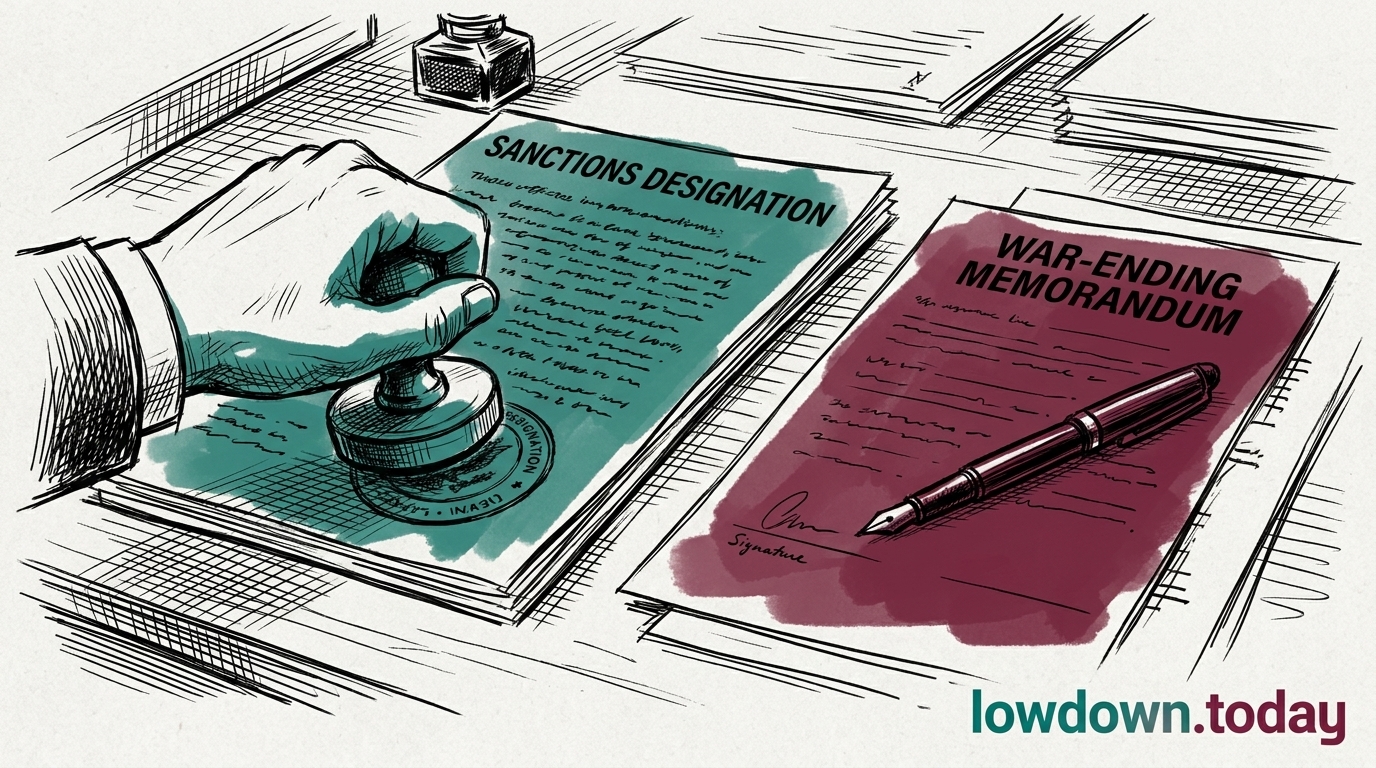
The White House presidential-actions page, audited on Tuesday, still lists zero Iran-related signed instruments since the PDVSA authorisation issued before the war . Cooper's claim is the first principal-level assertion to sit in that gap. The blockade, the ceasefire, the toll list and all five Hormuz ultimatums remain Truth Social posts . On Day Three, Rich Starry was turned back after attempting to exit the Persian Gulf, the first confirmed sanctioned-vessel reversal of the operation. Whether that marks a posture shift or a show intercept timed to the declaration will be readable later this week, when Kpler publishes the next two days of transit counts.

Deep Analysis

In plain English

The admiral running the US blockade of Iran told reporters it had stopped all sea trade in and out of Iran in less than two days. At the same moment, a ship-tracking company called Kpler counted at least eight vessels crossing the Strait of Hormuz; the narrow waterway between Iran and the Arabian peninsula that most Gulf oil passes through. Two of those ships were Chinese-owned and already under US sanctions, yet they were allowed through because the military's written order only covered ships going to Iranian ports, not all ships. So both statements are technically true in different ways: if you define 'halted' as 'stopped ships going directly to Iranian ports,' Cooper is roughly right. If you mean 'stopped all ships connected to Iran's trade network,' the data says otherwise. The dark-fleet tankers that carry Iranian oil to China were the whole point of the blockade; and they kept moving.

Deep Analysis
Root Causes

CENTCOM's order was narrower than Trump's Truth Social post by structural necessity: the post named toll-paying French and Japanese vessels as interdiction targets, which CENTCOM's lawyers assessed would trigger immediate Article 51 flag-state disputes without a presidential Finding or AUMF extension.

By limiting scope to Iranian-port traffic, CENTCOM preserved lawful authority under its existing peacetime mandate while implicitly conceding the dark-fleet sanctioned tankers it had no legal basis to stop.

The instrument gap itself; zero presidential instruments since 18 March ; is not carelessness. It reflects a White House signing-aversion pattern documented by Lawfare across Trump's second term: the preference for social-media orders over signed instruments keeps enforcement discretion at the commander level and avoids creating a reviewable document for courts or Congress. The gap is a feature, not a bug, until a commander needs to defend a declaration against ship-tracking data.

What could happen next?
  • Consequence

    Allied intelligence services gain documented evidence of a US rhetoric-reality gap at command level, weakening CENTCOM's enforcement credibility in future operational theatres

    Short term · 0.85
  • Risk

    Dark-fleet operators retain structural advantage while CENTCOM's order excludes non-Iranian-port sanctioned traffic, reducing the economic pressure on Iran that justified the blockade

    Immediate · 0.9
  • Precedent

    A principal-level declaration unsupported by verifiable enforcement data normalises over-claiming in wartime command communications, weakening the evidentiary standard for future military briefings

    Long term · 0.75
First Reported In

Update #69 · Cooper joins the instrument gap

Navy Times· 15 Apr 2026
Read original
Different Perspectives
Iran human rights monitors (Amnesty International, Iran HRM, Hengaw)
Monitors documented 30 women held on capital moharebeh charges in a basement prison ward, Benyamin Naqdi's death sentence with a forced-confession broadcast, and 39 political executions since February. Iran's security courts have processed protest cases at uninterrupted wartime tempo regardless of the diplomatic track.
Lloyd's of London (war-risk underwriters)
Lloyd's held its Hormuz war-risk designation at $10-14 million per voyage while Brent fell 19%, maintaining a structural divergence from futures pricing. Underwriters require a UN Security Council resolution or government certification letter, not diplomatic optimism, before de-listing the strait.
Oman (Sultan Haitham's government)
Muscat issued a mine alert in its own territorial waters while denying any Hormuz toll plan after US Treasury threatened sanctions. A suspected mine in Omani waters on the same weekend as US financial pressure forces Muscat to demonstrate sovereignty without appearing to choose sides.
China (PRC)
China (PRC)
Beijing sent scholars rather than its defence minister to Shangri-La for the second year running and addressed Taiwan and multilateralism without mentioning Iran. China maintains its bilateral energy corridor protection with Tehran while refusing the diplomatic exposure of a public position at multilateral forums.
Iran Supreme National Security Council
The SNSC framed the unsigned MOU as a 10-point Iranian victory with enrichment already recognised, and the foreign ministry rejected Trump's nuclear conditions within hours. Tehran treats each unsigned day as validation that Iran has retained its stockpile without surrendering it.
Trump administration (CENTCOM/White House)
Trump posted three non-negotiable public conditions while CENTCOM disabled a commercial ship and Hegseth threatened resumed strikes from Singapore. The administration treats the unsigned MOU as leverage to extract maximum Iranian concessions before any ceasefire instrument is committed to paper.