Skip to content
Briefings are running a touch slower this week while we rebuild the foundations.See roadmap
Iran Conflict 2026
29MAY

White House asserts US not at war with Iran

3 min read
08:47UTC

The Trump administration told reporters on 1 May 2026 that the United States is not at war with Iran, the day the War Powers Resolution 60-day clock expired.

ConflictDeveloping
Key takeaway

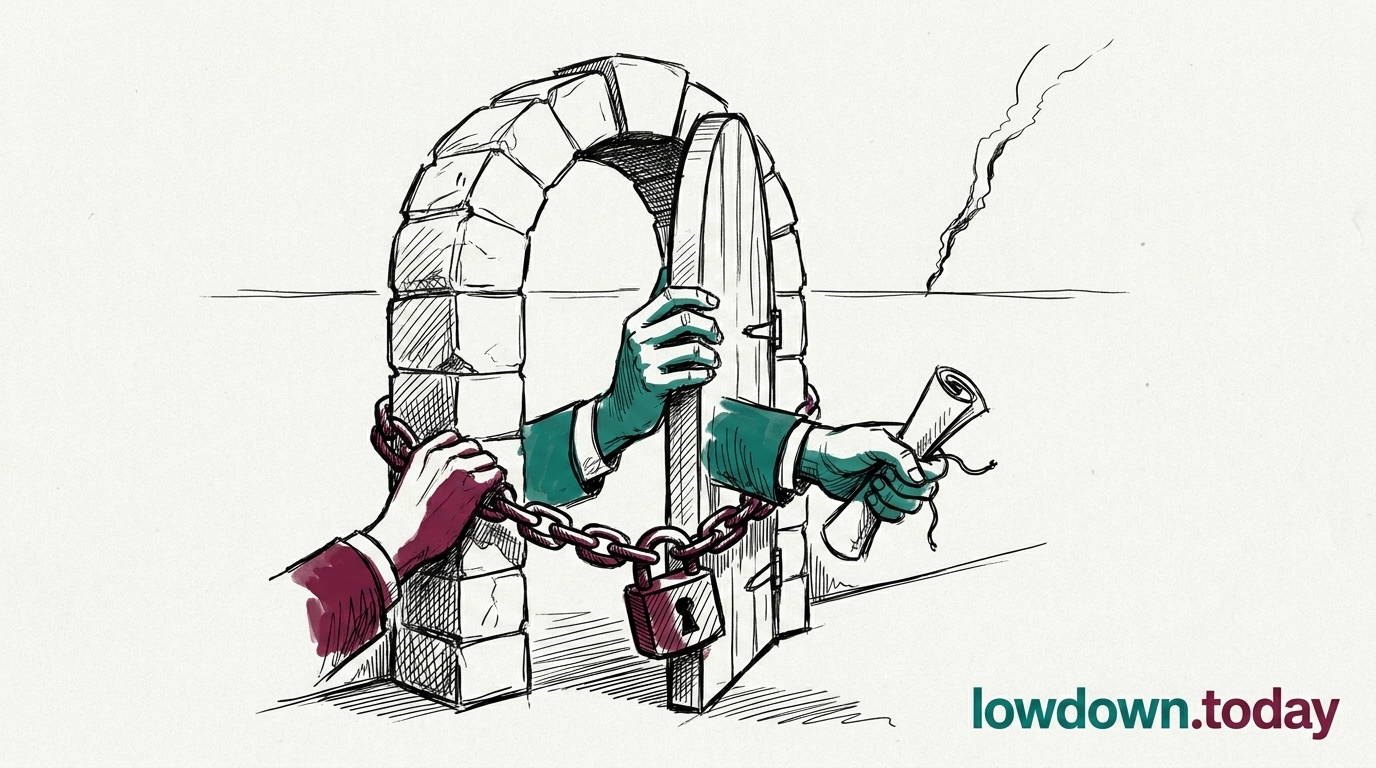
The 'not at war' claim aims to dissolve the WPR clock as a binding lever on the executive.

The Trump administration told reporters on Friday 1 May 2026 that the United States is not at war with Iran, on the day the War Powers Resolution (WPR) 60-day deadline expired 1. The WPR is the 1973 statute that requires presidential withdrawal of US forces from undeclared hostilities within 60 days unless Congress authorises the deployment. Sixty-four days of blockade, three carrier battle groups in CENTCOM (US Central Command) waters, and 44 commercial vessels redirected at sea, on this reading, do not amount to hostilities for the statute that says they do.

The formal claim moves past the position Pete Hegseth offered the Senate Armed Services Committee on Thursday, that a ceasefire merely pauses the WPR clock 2. Not at war asserts the clock never ran. Two days earlier Trump had told Axios the blockade was "somewhat more effective than the bombing" and described Iran as "choking like a stuffed pig" , language The Administration is now arguing carries no statutory weight.

Section 1544(b) of the WPR triggers an automatic 30-day wind-down once the 60-day mark passes without congressional authorisation; the operative cliff sat at 1 June . A clock that never started cannot trigger a 30-day clause downstream of it. The Office of Legal Counsel (OLC) at the Department of Justice would need to ratify the reading before OFAC (the Treasury's Office of Foreign Assets Control) and the Pentagon could realign their compliance positions; OFAC has continued sanctioning Iran on a wartime cadence the State Department now calls peacetime.

No court has been asked. Federal courts have dismissed individual senators' WPR suits on standing grounds since Kucinich v. Obama in 2011. Whether anyone with standing can force a court to rule before the 1 June Section 1544(b) cliff is the constitutional question of the next four weeks.

Deep Analysis

In plain English

The War Powers Resolution (WPR) is a 1973 US law designed to stop presidents from fighting wars without Congress's approval. It says that once US troops are in combat the president must promptly notify Congress, and then Congress has 60 days to either approve the war or the troops must be withdrawn. The Trump administration filed that notification on 2 March 2026. The 60-day clock then ran out on 1 May 2026. But instead of withdrawing forces or seeking congressional approval, the White House said: the United States is 'not at war' with Iran, so the law never applied. The distinction between Hegseth's 30 April claim (the ceasefire pauses the clock) and the 1 May 'not at war' claim matters: a paused clock can restart; a clock that was never running cannot. The second claim, if upheld by the Justice Department's legal counsel, would permanently remove Congress's ability to use the WPR as a tool against this Iran operation.

Deep Analysis
Root Causes

The WPR contains no definition of 'war' or 'hostilities' beyond the notification trigger. Every administration since Nixon has exploited this gap. The Iran case is structurally different because the 2 March congressional notification was filed (establishing the clock) before the White House developed its legal counter-theory.

The second structural cause: the OLC has never adjudicated whether a ceasefire in an ongoing operation resets or tolls the 60-day clock. The absence of precedent gives the executive branch room to construct novel interpretations. The **Just Security** project at NYU Law has tracked six distinct OLC positions on WPR applicability since 1973; none covers a mid-campaign 'not at war' retroactive claim.

What could happen next?
  • Precedent

    If OLC ratifies the 'not at war' claim, it creates a template for future administrations to conduct extended blockade operations outside WPR constraints by characterising them as something other than war.

    Long term · 0.72
  • Risk

    The June 1 Section 1544(b) cliff disappears if the 'not at war' reading holds, removing both of Congress's current statutory levers simultaneously.

    Short term · 0.81
  • Consequence

    Democratic senators lack judicial standing to challenge the OLC reading without a court accepting the case; no challenge has been filed as of 1 May 2026.

    Immediate · 0.85
First Reported In

Update #85 · "Not at war": three claims, no treaty

ANI News· 1 May 2026
Read original
Different Perspectives
Qatar
Qatar
Qatar holds approximately $12 billion in frozen Iranian assets that Tehran named as the precondition for any Hormuz reopening sequence; with Oman sidelined and no agreed HEU custodian, the asset-routing architecture that any deal requires has no operational channel and no neutral financial intermediary to run it through.
Hengaw and Iranian civilian population
Iranians face an internet capped at 40 per cent by hardware their president cannot dismantle, field killings that leave no court record, and judicial executions running in parallel; Hengaw, based in Norway, is the primary remaining monitor of a repression system the IRGC is deliberately moving beyond auditable records. The real toll is higher than any single monitor's count.
China
China
China supplied deep-packet-inspection hardware that caps Iran's internet at 40 per cent and enables an instant on-demand blackout, and was barred by Trump as a potential HEU custodian on 27 May. Beijing gains from Iran's continued non-alignment with the West while the DPI sale extends Chinese surveillance-technology exports as a geopolitical instrument.
Pakistan
Pakistan
Foreign Minister Ishaq Dar met Rubio in Washington on 29 May, formally inheriting the role of sole active mediator after Oman's forced withdrawal. Pakistan lacks Oman's banking infrastructure for frozen-asset routing and carries its own regional stakes, making it a less structurally neutral broker for the Qatar-held $12 billion sequencing.
Kuwait
Kuwait
Kuwait invoked Article 51 of the UN Charter after absorbing an Iranian ballistic-missile strike on Ali Al Salem Air Base on 28 May, becoming the first Gulf state to make a formal individual self-defence claim in the war. The invocation creates a legal record enabling a future bilateral defence-pact activation without yet triggering it.
Oman
Oman
Oman denied any Hormuz toll plan within hours of Bessent's 28 May threat, absorbing a sanctions warning from the country it has brokered for since 1981. The rapid capitulation preserved the channel formally, but Tehran now knows Washington will threaten its own mediator, which changes Muscat's calculus on how far it can lean into any joint-management architecture.