Skip to content
Briefings are running a touch slower this week while we rebuild the foundations.See roadmap
Iran Conflict 2026
26MAY

Trump posts a cancelled Iran strike

3 min read
08:44UTC

Donald Trump posted on Truth Social on 18 May that he had told Hegseth and Caine to 'hold off' a Tuesday 19 May strike on Iran at the request of the Qatari Emir, the Saudi Crown Prince and the UAE President; no Pentagon read-out, executive order or OFAC general licence has confirmed the strike was scheduled.

ConflictDeveloping
Key takeaway

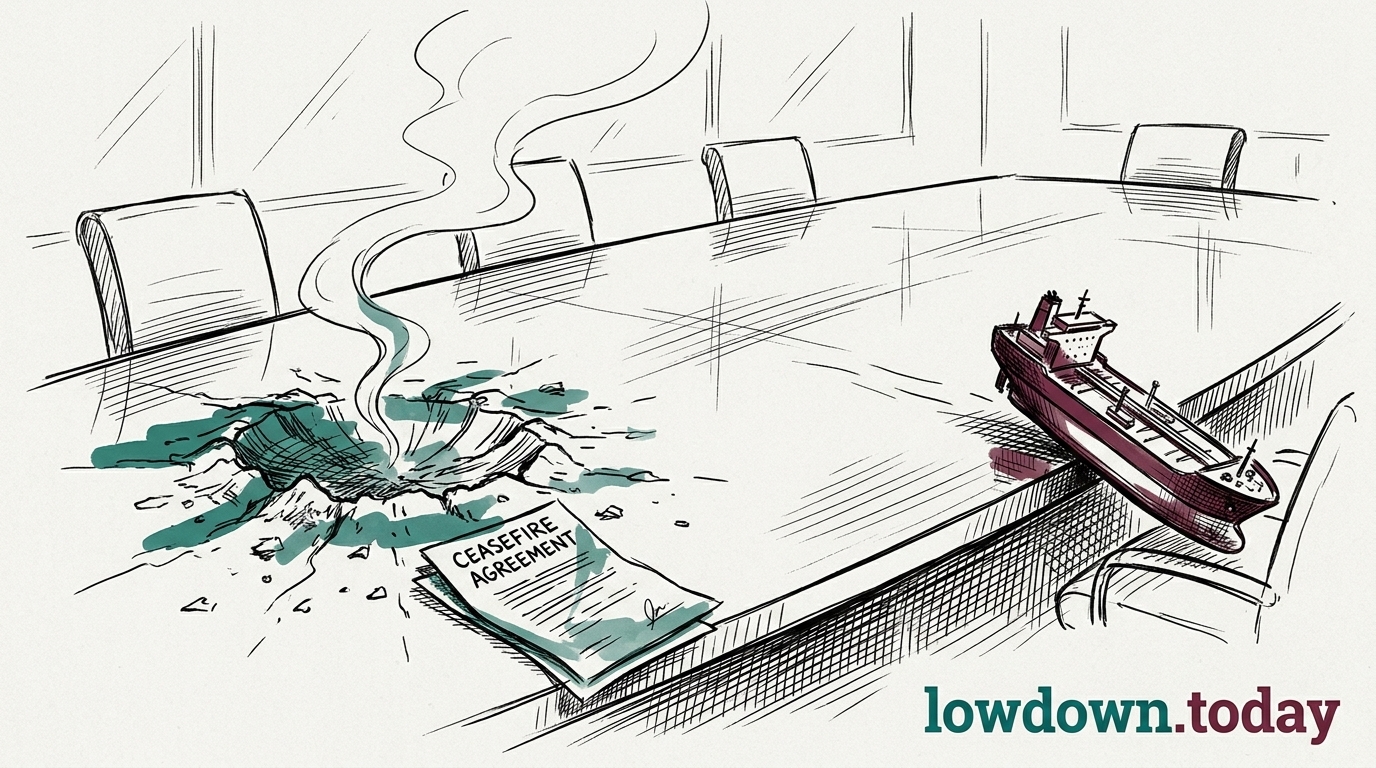
A Truth Social post is the entire public record of a strike Trump says he cancelled.

Donald Trump posted on Truth Social on 18 May 2026 that he had instructed Secretary of War Pete Hegseth and Joint Chiefs Chairman Dan Caine to 'hold off' a 'planned Military attack of the Islamic Republic of Iran' scheduled for Tuesday 19 May, at the request of the Qatari Emir, the Saudi Crown Prince and the UAE President, Euronews reported 1. The Trump post is, so far, the entirety of the public record on either the strike or its cancellation. The Pentagon has issued no read-out confirming a 19 May strike was on the schedule. The White House has published no executive order. OFAC (Office of Foreign Assets Control) has issued no general licence against the 'sanctions waiver' that Iranian state agency Tasnim reported as part of a revised five-point US proposal 2.

The White House had signed zero Iran instruments across 16-18 May despite earlier Truth Social threats . Trump's 18 May post lands in the same shape: presidential intent on a platform without confirmation through any of the institutional channels that would normally underwrite a strike order or its withdrawal. Hegseth has made no corroborating statement. Caine has made no corroborating statement. The three Gulf leaders named have neither confirmed nor denied being party to the request.

Trump's Truth Social post is a presidential utterance that moves markets and headlines, but the architecture of US military action under the War Powers Resolution runs on documents the post has not produced. That asymmetry shaped the Brent move that followed and the War Powers Resolution arithmetic running underneath: a market priced something on the post, then unpriced it when the documents did not follow.

Deep Analysis

In plain English

Trump posted on Truth Social that he had ordered his Defence Secretary and military chief to stand down a planned attack on Iran, saying Qatar, Saudi Arabia and the UAE asked him to wait. The post appeared to be the reason Brent crude hit a conflict high of $112.10 before markets reversed when no formal military orders or White House documents followed. The problem is that no other government or US agency confirmed the strike was actually planned. No Pentagon statement, no executive order, no other document backs up the post. This fits a pattern across the entire 80-day conflict: Trump makes dramatic statements about Iran on Truth Social, but signs nothing official.

Deep Analysis
Root Causes

The structural driver behind Trump's unverified strike-cancellation post is the War Powers Resolution clock: the 30-day wind-down from the 1 May expiry of the 60-day WPR period runs out 1 June, creating an institutional pressure point 14 days away that the Gulf leaders used as leverage. A strike launched after 1 June without an AUMF would face immediate legal challenge; the Gulf states' intervention gave Trump a face-saving reason to delay without acknowledging the statutory constraint.

A second driver is the absent OFAC general licence. If the strike were genuinely scheduled, OFAC would have issued a licence protecting US persons and financial institutions involved in reconstruction or humanitarian corridors a standard pre-strike administrative step. The absence of any OFAC instrument is the documentary evidence that the strike was not on the operational schedule the post implied.

Escalation

The unverified stand-down post does not represent genuine de-escalation because it lacks any institutional anchor. Its risk is asymmetric: if markets, Iran, or Gulf allies treat it as a real commitment and Trump subsequently strikes, the credibility damage to all three relationships would be severe.

What could happen next?
  • Risk

    Naming Qatar, Saudi Arabia and the UAE as requestors publicly binds Gulf mediators to the outcome: if Iran escalates now, those three states carry reputational liability for the failed intervention.

    Immediate · 0.78
  • Consequence

    The absent Pentagon read-out confirms the Truth Social post is not operational instruction to military commanders CENTCOM's rules of engagement remain unchanged.

    Immediate · 0.85
  • Precedent

    A pattern of unverified strike-cancellation posts this is Trump's third verbal reversal in the conflict progressively erodes the credibility of future strike threats as market-moving events.

    Medium term · 0.7
First Reported In

Update #102 · Iran signs Hormuz toll; Trump posts a cancelled strike

Euronews· 19 May 2026
Read original
Different Perspectives
Global shipping and insurance markets
Lloyd's Joint Hull Committee held Hormuz war-risk at $10-14 million per voyage on 26 May, requiring a signed government instrument or UNSC resolution before acting. Futures traders repriced Brent 1.63% on the Bandar Abbas strike; insurers did not move because no qualifying document has been produced in 87 days.
Pakistan
Pakistan
Pakistan's army-chief channel relayed the draft MOU to Tehran and backs Iran's framing that the ball is in Washington's court. Islamabad's general-officer corps now holds structural authority over the deal's critical text, having extracted the only substantive nuclear-monitoring concession of the war; legitimising this channel is itself a strategic choice Washington has not publicly affirmed.
China
China
Chinese DPI hardware arrived in Iran for a tiered censorship system, while China's NFRA ordered state banks to halt new lending to five sanctioned refiners after GL V expired. Beijing is simultaneously exporting surveillance infrastructure to Tehran and adjusting sanctions exposure to US pressure.
Saudi Arabia
Saudi Arabia
Riyadh signed the IMO letter rejecting Iran's Hormuz toll system and requested Trump stand down the 19 May strike alongside the Qatari Emir and UAE President. Saudi Aramco has already warned that Hormuz normalcy is delayed to 2027; at $87 per barrel as Riyadh's budget breakeven, every month of war-risk insurance premium erodes the fiscal cushion the crown prince requires.
Qatar
Qatar
Doha hosted Iranian negotiators, holds $12 billion in frozen Iranian assets Tehran has named as a Hormuz precondition, and signed the five-Gulf-state IMO letter rejecting Iran's PGSA transit route on the same week. Qatar cannot release the assets without a Washington order and cannot credibly claim neutrality after the IMO signature; it is covering both outcomes rather than bridging them.
Israel
Israel
Prime Minister Netanyahu called Trump on 24 May to object that the Lebanon war-end clause inside the draft MOU would force Israel to wind down its campaign against Hezbollah. His objection gives Jerusalem an effective veto over text Washington and Tehran had otherwise largely settled, without Israel being a party to the deal.