Skip to content
You can now search across every topic, entity and event.What's new
European Oil Markets
4JUN

Brent at $94.79: markets price the gap

3 min read
10:20UTC

Lowdown Newsroom

EconomicDeveloping
Key takeaway

Brent has priced partial enforcement and two catalysts this week can move it either way.

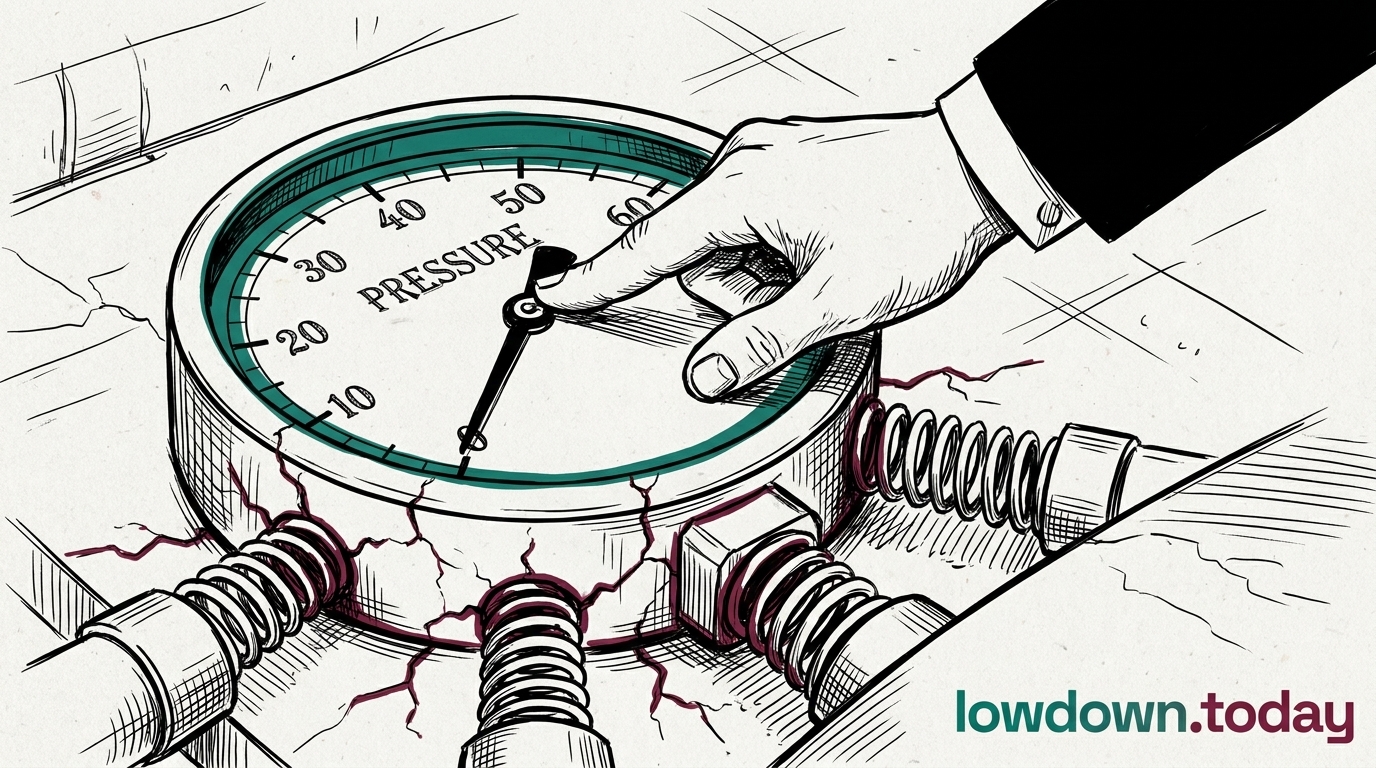
Brent Crude closed at $94.79 on Tuesday, down from the blockade-day peak in the previous session , still roughly two-fifths above the pre-war baseline. The move is consistent with traders watching the operational order rather than the admiral's lectern. Interdiction of Iranian-port traffic is priced in; the continuing carve-out for sanctioned non-Iranian-port tankers, documented when Windward tracked sanctioned dark-fleet vessels using scrapped ship identities , caps the upside by keeping partial supply flowing.

For drivers and consumers, that premium is what a partial blockade feels like at the pump. Brent has held in a narrow band this week because neither a full-closure path nor a resolution path is the base case. Two catalysts inside the coming week could shift the balance. The sanctions licence expiring mid-week, covered in the Senate vote cluster above, would tip enforcement risk sharply higher if Treasury lets it lapse without a successor; a spike back through Monday's peak is the likely response. A credible multilateral Hormuz framework published out of the Paris summit on Friday would tip the other way; a pullback towards the eighties becomes plausible.

Both catalysts arrive before the weekend. The dual-chokepoint scenario, a Houthi closure of Bab el-Mandeb on top of a continued Hormuz operation, is not priced at all. If it becomes a planning variable rather than a rhetorical threat, the repricing towards the deep triple-digit range would not be gradual.


Deep Analysis

In plain English

Brent crude; the main global price for oil; closed at about $95 on 14 April. That is 40 per cent above where it was before the Iran war started, but it has also come down from above $103 when the blockade was first announced. The price is stuck in the middle because markets are pricing a partial blockade: some ships are being stopped, some are getting through. Two things could move it significantly this week. On Sunday (19 April), a US government permit that legally allowed certain ships to deliver Iranian oil expires. If the US government does not renew it, about 325 tankers suddenly face legal problems with their cargoes; and oil prices could spike. But if France and the UK's conference on Friday produces a credible plan to reopen the strait after the war, prices could fall. The market is watching both events and has not yet committed to a direction.

Deep Analysis
Root Causes

Oil markets price the scenario they can model. The $94 band reflects a market that can see the CENTCOM operational order's carve-out (published, verifiable) but cannot see the GL-U renewal decision (unpublished, unannounced).

The 28 days of Treasury silence on Iran sanctions is the structurally anomalous element: OFAC routinely signals general licence renewals 10-15 days in advance; the absence of any signal four days before expiry is unusual enough to embed a non-renewal risk premium in Brent that has not yet fully resolved into price.

The deeper structural driver is that the blockade was announced without a sanctions architecture to match: GL-U was issued before the blockade, authorising the same oil the blockade aims to stop. The logical contradiction; a general licence enabling delivery of Iranian oil during a declared blockade; was never resolved in print, and Treasury's silence means it remains unresolved.

What could happen next?
  • Risk

    GL-U lapse without Treasury successor on 19 April triggers a $10-15 Brent spike as 325 tankers' legal cover evaporates, potentially reaching $104-109 by 20 April

    Immediate · 0.7
  • Opportunity

    A credible Macron-Starmer summit framework on 17 April provides the first post-war resolution pathway markets can price, likely pulling Brent toward $82-88 in a 60-day scenario

    Short term · 0.65
  • Risk

    Dual-chokepoint scenario; Houthi Bab el-Mandeb activation on top of partial Hormuz closure; remains entirely unpriced in the $94 band, implying catastrophic repricing to $130-150 if it materialises

    Medium term · 0.55
First Reported In

Update #69 · Cooper joins the instrument gap

Reuters Commodities· 15 Apr 2026
Read original
Different Perspectives
Kuwait
Kuwait
Kuwait absorbed the Iranian strike that knocked generating units offline at a combined power-and-desalination plant on 17 July, the event that finally moved freight and insurance in lockstep with Brent. The strike hit essential civilian infrastructure, not a trading desk's benchmark.
Asian buyers (Singapore)
Singapore's middle distillates rose 12% month-to-date to 8.91m barrels and fuel oil passed 19m barrels on a 105% net-import surge, buyers retaining barrels as the East-West arbitrage window narrows. Cargoes are being stockpiled ahead of further Hormuz-driven freight repricing rather than released west.
Austria (Coreper holdout)
Vienna is blocking the same package over roughly EUR 2bn of frozen Russian assets earmarked for Raiffeisen, a domestic banking dispute with no connection to the oil cap racing toward its 23 July expiry. The linkage forces the whole package to wait on a bilateral compensation fight.
Greece (Coreper holdout)
Athens is holding the 21st sanctions package at the 22 July Coreper vote over Russian LNG re-export rights, a condition unrelated to the oil price cap itself, leaving the $44.10 freeze one day from expiry without a deal. Greece's own tanker registry gives it a direct stake in how any shadow-fleet measures are drafted.
Marine underwriters (Gulf war-risk)
Hull war-risk cover for Hormuz transits widened to a 3-10% band on 17 July with 5% the emerging norm, up from a 3-4% baseline set in late June, the first repricing in six weeks to track a flat-price move rather than lag it. Cover resets on actuarial evidence of loss, not on diplomatic or price signals.
Money managers (CFTC-tracked)
The CFTC's week-to-14-July snapshot, released 17 July, showed WTI managed-money net long collapsing 69% to 19,783 contracts and a standalone 60,141-contract net short on Brent Last Day (NYMEX). Both readings predate the Kuwait strike and the 20 July escalation, so any covering since is not yet visible in public data.