Skip to content
Briefings are running a touch slower this week while we rebuild the foundations.See roadmap
European Oil Markets
29MAY

EIA pencils Brent at $89 by Q4 2026

4 min read
14:36UTC

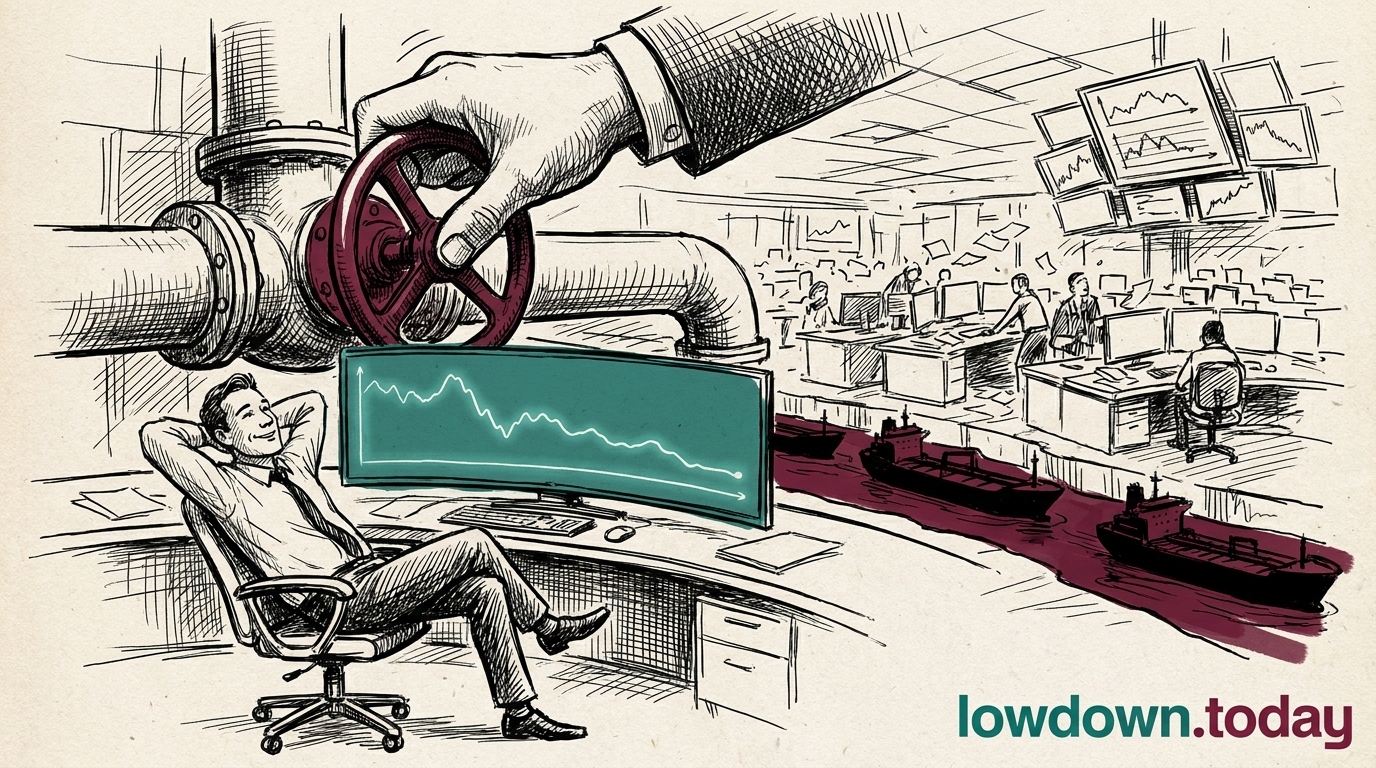
The EIA's 12 May Short-Term Energy Outlook projected Brent at roughly $106 per barrel in Q2 2026, decaying to $89 per barrel by Q4 on the assumption Hormuz partially normalises.

EconomicDeveloping
Key takeaway

The Q2-to-Q4 Brent decay is a $17 calendar trade contingent on Hormuz normalisation no print yet confirms.

The EIA Short-Term Energy Outlook published 12 May 2026 projected Brent at approximately $106 per barrel for Q2 2026, declining to $89 per barrel by Q4 2026 1. The forecast implies a $17 per barrel negative carry for anyone buying Q2 forward for Q4 delivery on the assumption Hormuz physically normalises. EIA also tagged the 2026 global supply deficit at 2.6 million barrels per day and a Q2 inventory draw rate of 8.5 million barrels per day, the highest in STEO history.

The IEA's May Oil Market Report logged the same pattern from the inventory side . Global observed inventory draws ran 246 million barrels across March and April 2026 (129 million barrels in March plus 117 million barrels in April), and 2Q26 crude throughputs were projected to decline 4.5 million barrels per day to 78.7 million barrels per day 2. Russian crude exports rose in April as Ukrainian refinery strikes cut domestic consumption, freeing barrels for export.

The IEA also noted that North Sea Dated traded in an unparalleled $50 per barrel intramonth range in April, the strongest signal that flat price has become an unreliable trading anchor for the current market environment. Both agencies are running the same conditional bet: Hormuz transit clears through Q3, OPEC+ production unwinds materialise, and inventory rebuilds happen in Q4. None of those conditions has been tested yet, and Aramco chief executive Amin Nasser warned on 12 May that the global oil market will not normalise until 2027 if the Hormuz blockade runs .

The shape of the curve carries the risk. Goldman Sachs has Q4 Brent at $90 per barrel on tighter Gulf output, broadly aligned with EIA, but the path from $106 to $89 assumes a clean normalisation that the EFS and freight prints currently dispute. Anyone trading the negative carry is exposed to the same Hormuz timing question driving the speculator positioning, just packaged as a calendar trade.


Deep Analysis

In plain English

Fujairah, in the UAE, is one of the world's biggest fuel stops for oil tankers. Ships fill up with bunker fuel (a type of heavy oil) there before crossing the ocean. In May 2026, Fujairah's storage tanks hit their lowest total inventory reading on record at 6.5 million barrels. Hormuz disruption explains most of the draw. Many tankers have been rerouting around Africa instead of through the Strait of Hormuz. That longer route burns more fuel, and the combined effect has drained Fujairah's bunker supply faster than it can be replenished.

Deep Analysis
Root Causes

Two simultaneous forces drove Fujairah's May 2026 record-low 6.5mb inventory. Hormuz disruption from late February 2026 reduced inbound crude and product flows from Gulf producers, cutting the replenishment rate for Fujairah's bunker storage tanks. At the same time, VLCC Cape rerouting paradoxically increased total marine fuel consumption globally, tightening the regional bunker fuel pool that Fujairah would normally absorb.

The residual fuel oil draw (down 27% in May versus April, below 3 million barrels) reflects that high-sulphur bunker fuel, still the primary fuel for older VLCCs, is being consumed at abnormally high rates by longer Cape voyages while replenishment logistics from Gulf refineries remain disrupted.

What could happen next?
  • Consequence

    Fujairah VLSFO prompt bunker premiums versus Rotterdam widened to $25-40/tonne in May 2026 as record-low inventory cut the regional supply buffer for vessel operators on Cape rerouting.

    Immediate · 0.75
  • Risk

    If Singapore IES weekly stocks are also drawing (not confirmed in this window), the Asia bunker market's aggregate tightness exceeds what Fujairah data alone implies, with potential for a prompt allocation squeeze.

    Short term · 0.6
  • Consequence

    Global shipping freight costs face a structural floor from elevated marine fuel costs even after Hormuz physically clears, as vessel operator risk premium on Gulf routings persists for weeks post-reopening.

    Medium term · 0.65
First Reported In

Update #1 · GL 134B out, Rotterdam dark, OPEC+ pending

Kyiv School of Economics· 18 May 2026
Read original
Different Perspectives
Energy Aspects / sell-side macro desk
The divergence between a sub-$95 Brent print and a crack holding near $54/bbl is the trade: hold the crack long against crude, with the June OFAC calendar as optionality on top; the six-extension base rate and the 17 June / 27 June deadline stack both argue for carry rather than a directional cliff bet on the flat price.
Indian downstream (Chennai refiners, Rishabh Triexim LLP)
OFAC's 28 May designation of Chennai-based Bagrecha and Rishabh Triexim is the first time a named Indian end-buyer has been placed on the SDN list in this enforcement cycle; it raises the compliance exposure of Indian financial institutions handling Iranian crude payments and is expected to recalibrate risk appetite among Indian trading houses running the discounted-crude circuit.
Rosneft / Russian export ministry
Each hull listing under the EU 21st package and each Iran SDN action tightens the grey-tonnage pool that Russian crude depends on post-GL134B; the re-flagging and hull-substitution response to prior packages has a longer lead time than the pace of new listings, so the freight premium on compliant Baltic Aframax tonnage widens before Moscow can respond.
EU Council sanctions directorate
The 21st package's choice of shadow-fleet listings and bank restrictions over a price-cap revision reflects the carry-not-cap doctrine that survived the April unanimity failure; the Brussels directorate routes pressure through freight and financing costs rather than cap arithmetic, compounding OFAC's tonnage-pool drain without requiring G7 consensus on a new cap number.
Med refiner (ISAB / Priolo Gargallo operators)
Six consecutive GL rollovers without a completed sale leave ISAB running under a sanctions-perimeter procurement overhang; no commercial buyer can meet FAQ 1224's blocked-account condition at sub-$95 Brent without sovereign backing, so the Italian complex continues processing Adriatic sour grades under contingent authorisation with no clear exit.
OFAC / US Treasury
OFAC / US Treasury
GL 131F's sixth extension and the simultaneous 28 May Iran SDN action reflect OFAC's dual-programme cadence: authorise-without-compelling on the Russian refinery track, while closing the final buyer leg on the Iranian crude circuit. The compound June calendar is the deliberate architecture, not an oversight.