Skip to content
You can now search across every topic, entity and event.What's new
European Oil Markets
10JUL

Brent jumps as Iran fires from empty coffers

4 min read
09:40UTC

Brent crude rose to $96.34 on 10 June, erasing a week of deal optimism, even as Iran's oil exports run dry below 300,000 barrels a day.

EconomicDeveloping
Key takeaway

Iran is trading military risk for coalition pressure because it can no longer break the blockade economically.

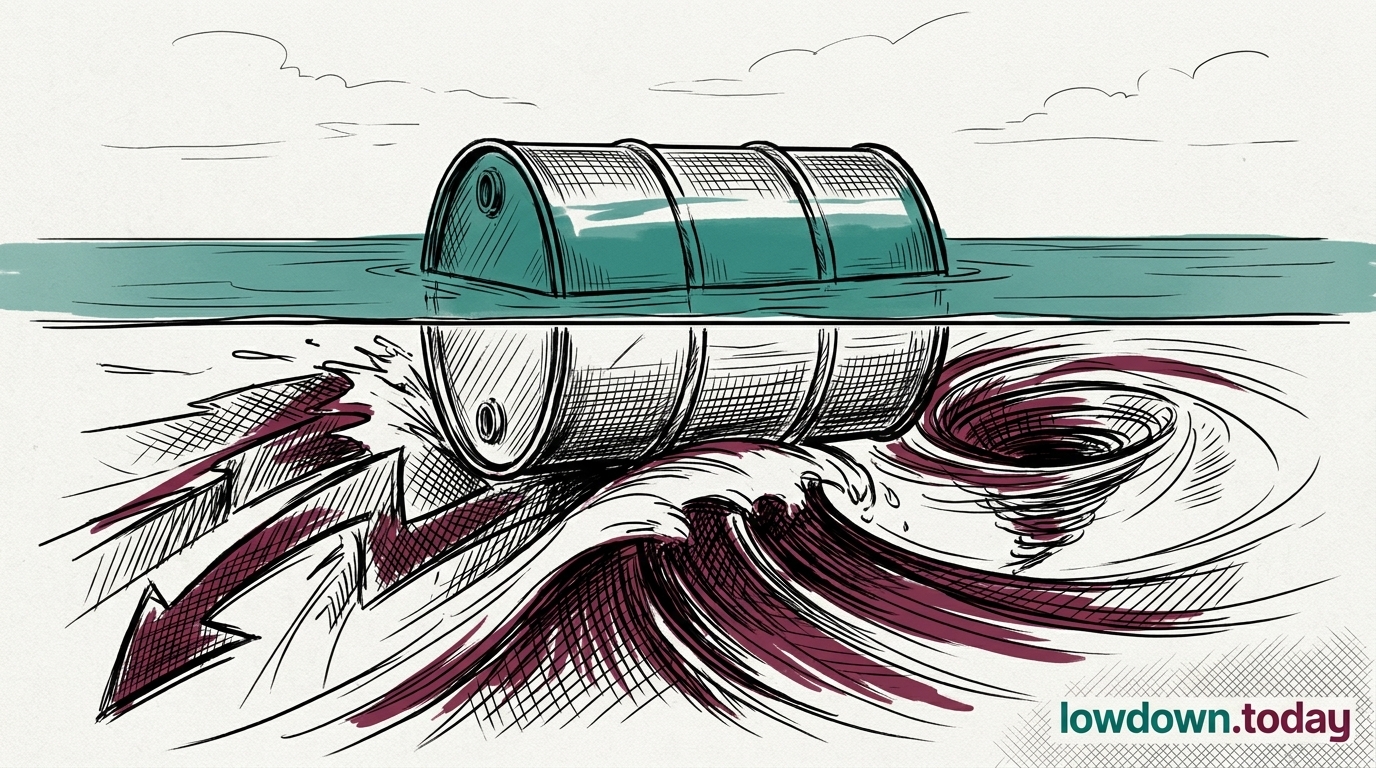
Brent Crude rose to $96.34 on 10 June, up about 2.2 per cent, after shedding more than 7 per cent across the week on optimism about a possible US deal and the Iran-Israel halt 1. The exchange of US strikes and Iranian counter-strikes wiped the week's deal-optimism discount in a single session, repricing the Strait of Hormuz risk premium overnight. Brent sets the price of roughly two-thirds of internationally traded crude, so the move ripples straight into import bills well beyond the Gulf.

Iran fired missiles across three countries this week from an empty balance sheet. The US naval blockade has cut Iranian oil exports below 300,000 barrels per day, down from 1.84 million in March, and erased roughly $5.8bn in revenue since April, with Kpler data showing a runway of weeks, not months, for the China-bound trade 2. A regime striking US bases in three countries while it cannot move its own crude is buying military leverage it has no economic means to sustain.

That weakness cuts two ways, which is where the night's contained outcome meets a darker read. Iran failed to inflict real damage, Jordan intercepted every missile aimed at it, and no US personnel were hurt, the markers of a calibrated exchange rather than the opening of a campaign. Yet a government with this little left to lose at sea may find escalation cheaper than restraint. The same empty coffers that cap Tehran's options also lower the price of crossing a threshold a second time, which is precisely what makes a cornered adversary hard to deter.


Deep Analysis

In plain English

Oil prices jumped about 2 per cent on 10 June after the US strikes on Iran. To understand why this matters, it helps to know that about one-fifth of the world's oil flows through the Strait of Hormuz, the narrow waterway near Iran. When that passage looks more dangerous, traders pay more for oil as a precaution. What makes this situation unusual is that Iran was already in serious economic trouble before the 10 June escalation. The US naval blockade had cut Iranian oil exports from about 1.84 million barrels a day before the war to below 300,000 barrels a day by June. Iran had lost roughly $5.8 billion in oil revenue since April. Iran's IRGC was firing ballistic missiles at US bases while its oil revenue had collapsed by 84 per cent since March.

What could happen next?
  • Consequence

    Iran's escalation from a position of 84 per cent export collapse and $5.8 billion in lost revenue signals the IRGC has concluded the economic cost of further military action is marginal: it cannot lose oil revenues it no longer has.

    Immediate · Assessed
  • Risk

    CENTCOM's 9 June radar suppression at Qeshm and Bandar Abbas targets the sensor layer Iran uses to identify and intercept vessels for toll collection; if the IRGC toll mechanism collapses, Tehran loses its last functioning hard-currency inflow, removing any remaining economic incentive to keep Hormuz partially open.

    Short term · Assessed
  • Opportunity

    Saudi Arabia and the UAE, as swing producers with fiscal breakeven points above current Brent levels, benefit from the Hormuz risk premium sustaining Brent above $95; both have an indirect incentive to see the conflict persist at a level of tension that supports oil prices without triggering a full strait closure.

    Medium term · Suggested
First Reported In

Update #123 · Trump orders strikes on Iranian soil

OilPrice.com· 10 Jun 2026
Read original
Different Perspectives
Greek shipping registries
Flag states dominating the tanker fleet await the EU's 15 July cap-freeze vote. A formula unlock toward $75 would loosen the ceiling squeezing insurance and crewing costs on their registered hulls.
US money managers
US money managers
NYMEX WTI managed-money net long fell 23% to +64,041 in the week to 7 July, trimming length into the rally on doubt the Hormuz premium survives without freight or war-risk confirmation.
European refiners (ARA)
ARA refiners are capturing an $80/bbl US diesel crack as Russian gasoil loadings collapsed to 234kbd before Novak's 31 July export ban even bites, widening the arbitrage straight into refining margins.
OPEC+
OPEC+
The seven-member group confirmed a fourth consecutive 188kbd August hike on 5 July, defending market share even though Saudi Arabia's $108-111/bbl breakeven means every added barrel costs Riyadh revenue it cannot recoup.
Indian refiners
Indian refiners
Refiners kept lifting discounted Urals as the India/Baltic split widened past $9-10 a barrel on 7 July. A wider Urals-Brent gap means cheaper feedstock locked in against Baltic buyers.
Russia
Russia
Urals traded $48.95-55.12 on 12-13 July, below Moscow's $59 budget floor even as Brent gained $6. Oil and gas fund roughly 30% of federal revenue, and Novak's diesel export ban is rationing a shrinking export base.