Skip to content
You can now search across every topic, entity and event.What's new
European Energy Markets
31JUL

Second tanker hit; engine fire at Hormuz

2 min read
09:44UTC

A projectile struck the tanker MKD Vyom near the Strait of Hormuz, setting its engine room on fire — the second commercial vessel hit in 72 hours in waters that carry a fifth of the world's traded oil.

EconomicDeveloping

A projectile struck the tanker MKD Vyom near the strait of Hormuz, igniting an engine room fire. The vessel is the second commercial ship hit in the strait's approaches within 72 hours, following the MV Skylight, struck off Oman with four crew injured. The weapon has not been publicly attributed, but anti-ship missiles, rockets, and explosive-laden drones are all within the arsenal Iran deploys from its southern coast.

The IRGC had broadcast on VHF Channel 16 — the international maritime distress frequency — that "no ships may pass" through the strait . Mohsen Rezai simultaneously called the waterway "officially open" while designating US warships as "legitimate targets" . The MKD Vyom's burning engine room resolves that contradiction. Commercial operators do not parse diplomatic ambiguity; they read casualty reports and war-risk advisories.

An engine room hit on a loaded tanker is among the most dangerous casualties a commercial vessel can sustain — no armour, minimal damage-control capability, and cargo measured in hundreds of thousands of barrels of flammable hydrocarbons. During the 1984–88 Tanker War, similar strikes frequently led to total vessel losses. The US Navy eventually escorted tankers through the strait under Operation Earnest Will in 1987. No comparable escort has been announced; the US Fifth Fleet's assets are committed to offensive strikes against Iranian military targets, not to protecting commercial shipping.


Deep Analysis

In plain English

The engine room is the operational heart of a ship: damage it and the vessel loses propulsion, becomes unable to manoeuvre, and is at risk of drifting into other traffic. On a loaded tanker carrying hundreds of thousands of barrels of oil, an engine room fire also carries explosion risk. A disabled vessel in the Strait of Hormuz approaches blocks or endangers other ships trying to pass through.

Deep Analysis
Synthesis

An engine room fire that cannot be rapidly contained could render MKD Vyom a drifting hazard in one of the world's most congested chokepoints, compounding disruption beyond the immediate political signal and creating a secondary humanitarian risk for the crew. A vessel with lost propulsion in Hormuz approaches — where traffic management is already severely disrupted — carries navigational risks independent of the conflict's broader trajectory.

Root Causes

The decapitation of senior Iranian military leadership may mean that some attacks are executing pre-authorised denial plans at unit level rather than from current political direction. If so, no single authority exists with the credibility to order a halt and enforce it across dispersed IRGC naval units — meaning these attacks may persist even if political will for de-escalation emerged at the top.

Escalation

Targeting the engine room rather than the cargo section or superstructure indicates deliberate intent to disable propulsion rather than warn or deter. A vessel immobilised in the strait's approaches becomes both a navigational hazard and a signal to other operators that attacks are designed to prevent transit, not merely to impose political costs.

What could happen next?
  • Consequence

    War-risk insurance premiums for Hormuz transits will rise sharply following confirmed projectile strikes, rendering many commercial voyages economically unviable without operator subsidies or naval escort.

    Immediate · Assessed
  • Risk

    An engine room fire on a laden tanker near the strait could cause an environmental catastrophe — oil spill or explosion — that compounds disruption independently of the conflict's military trajectory.

    Immediate · Assessed
  • Risk

    Flag states whose commercial vessels are being struck may seek naval protection or invoke self-defence provisions, widening the circle of direct participants in the conflict.

    Short term · Suggested
  • Precedent

    Confirmed projectile strikes on commercial tankers establish that the conflict has moved from military-to-military engagement to active targeting of civilian maritime infrastructure, with implications for international maritime law and future conflict behaviour.

    Immediate · Assessed
First Reported In

Update #7 · Hezbollah enters; tankers burn in Hormuz

gCaptain· 2 Mar 2026
Read original
Causes and effects
This Event
Second tanker hit; engine fire at Hormuz
The strike on MKD Vyom — the second tanker hit in 72 hours — demonstrates that the IRGC's Hormuz closure broadcast is being enforced with live weapons against commercial shipping, with an engine room fire that represents one of the most dangerous casualties a tanker can sustain.
Different Perspectives
Spain's LNG terminal operators
Spain's 9,145 GWh terminal inventory is the largest single stock in the EU LNG network, an option value that can reroute cargoes wherever the winter strip pays best rather than a cavern gas obligation tied to a fixed date. That flexibility matters more as Germany's cavern shortfall pushes more of the winter security question onto import infrastructure.
European Commission
European Commission
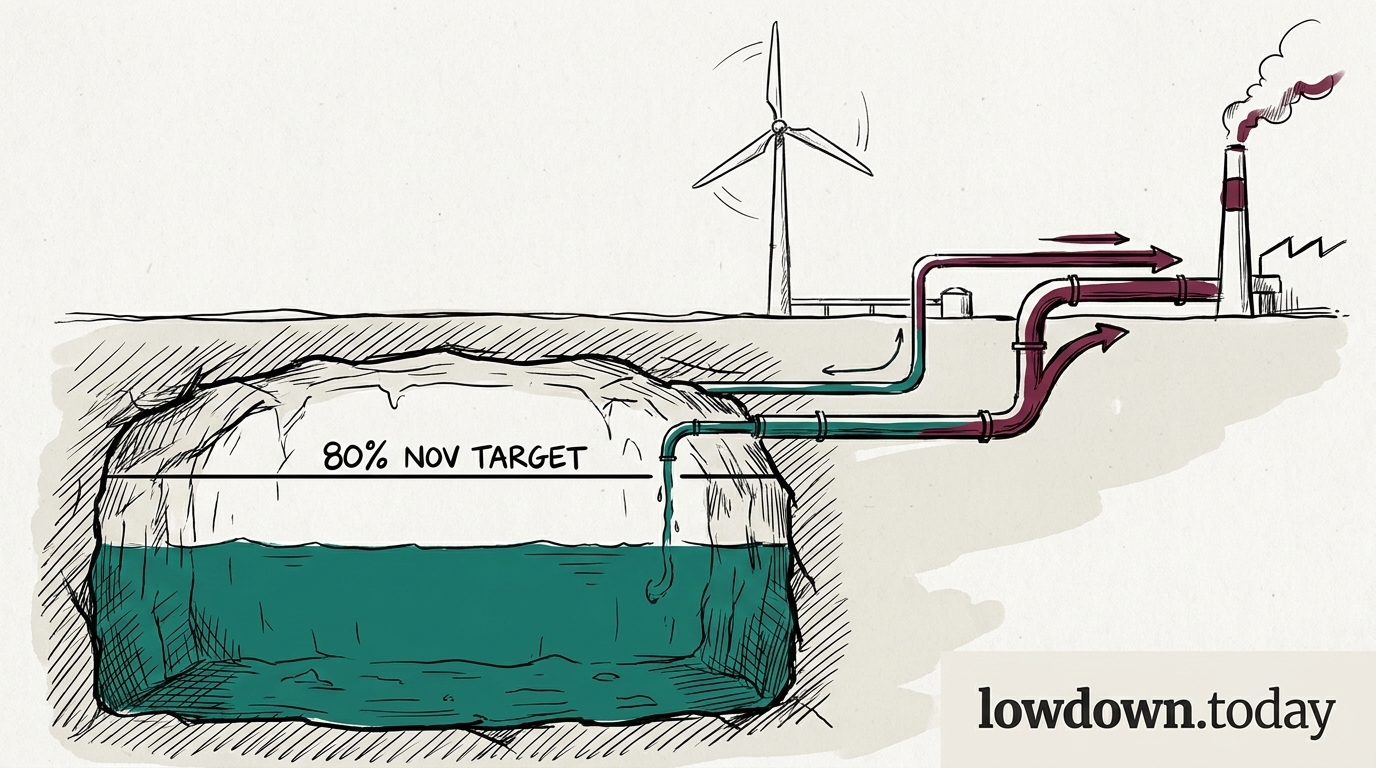
Brussels holds the bloc to 90% on a flexible window while Germany, holding roughly a quarter of EU storage capacity, tracks toward missing its own lower 80% figure by 21 points. A national shortfall this size in the anchor market matters more to bloc security than the flexible timetable alone can absorb.
French power exporters and CRE
French day-ahead rose in step with Germany but by less, reopening a EUR 7-17 premium that makes northward export flows commercially attractive again after the EUR 43.09 discount evaporated in days. CRE separately authorised RTE and Enedis to buy flexibility locally, betting the coming winter's binding constraint is grid congestion rather than a shortage of firm capacity.
TTF trading desk
TTF trading desk
A visible national shortfall like Germany's 21-point gap is a directional signal, not noise, for a desk holding the summer-winter spread. TTF's flat EUR 58-60 range through this week's German price swings says the market has not yet chosen to reprice refill risk into the front of the curve.
German cavern and CCGT operators
German caverns kept buying prompt gas at TTF near EUR 58-60 through the inversion; the wind collapse to 2.4 GW then flipped the spark spread to plus EUR 29 and put turbines back in the same queue. Every day turbines win that bid, injection at a third of the 877 GWh/day pace needed falls further behind.
Slovakia
Slovakia
Slovakia says it dropped its hold-out on the 21st sanctions package only after Ursula von der Leyen personally signed written gas-price and supply guarantees. The Council of the European Union's own 17,238-character release on the package names neither Slovakia nor any guarantee, leaving Bratislava's account unconfirmed by the institutional record.



