Skip to content
You can now search across every topic, entity and event.What's new
European Energy Markets
31JUL

Serbia intercepted 4kg TurkStream bomb plot

3 min read
09:44UTC

Serbian authorities found plastic explosives metres from the Balkan Stream pipeline on 5 April; Hungary has since deployed the army.

EconomicDeveloping
Key takeaway

The last Russian pipeline leg survived a bomb attempt ten days before the LNG leg ends.

On 5 April 2026, Serbian authorities found two backpacks containing roughly 4 kg of plastic explosives, detonator caps and cord metres from the Balkan Stream pipeline near the village of Velebit in northern Serbia, a TurkStream offshoot carrying Russian gas through the Western Balkans 1. Hungary has since deployed its army to protect the Serbia-to-Slovakia segment, and Russia, Turkey, Serbia and Hungary have agreed a joint protection framework. Ukraine denied involvement; Serbian intelligence briefed that US-made explosives were recovered and pointed to a migrant with military training.

TurkStream carries roughly 15 bcm per year to Hungary, Slovakia, Czech Republic and Austria and is the sole remaining Russian pipeline route to central Europe since Ukraine transit ended. Against a shallow aggregate storage fill and the 25 April LNG ban closing the other Russian leg, a successful attack on the 5th would have removed both Russian supply routes in the same week. The intercept is the reason the system did not run that test.

The analytical read is not that Balkan Stream is safer today than it was on 4 April. Pipeline protection on a line that runs through four jurisdictions with varied standards cannot be hardened uniformly by one national deployment. The intercepted plot shows capability and intent against one segment; the route length means the vector count is larger than the vector just addressed.

TTF pricing is not carrying that tail. Implied vol on late-April TTF options is cheap relative to the physical state of the system: a Hormuz ceasefire expiry, a Russian LNG cutoff and an intercepted pipeline sabotage plot sitting inside the same ten-day window. The counter-view is that the plot was caught and protection has been hardened; that is correct for the specific vector, not for the category.


Deep Analysis

In plain English

TurkStream is a gas pipeline that runs from Russia through Turkey and then north through Serbia and Hungary, carrying gas to central European countries that no longer receive it through Ukraine. It is the last active Russian gas pipeline into Europe after the Ukraine transit route shut down in early 2025. On 5 April, Serbian police found 4 kilograms of plastic explosives hidden near the pipeline close to a village called Velebit. That is enough to damage the pipeline significantly. Nobody has admitted placing them. In response, Hungary sent its army to protect its section of the pipeline, and Russia, Turkey, Serbia, and Hungary agreed a joint protection arrangement. The four countries involved in protecting the pipeline are a mix of NATO members and non-NATO states, which makes the arrangement politically unusual.

Deep Analysis
Root Causes

TurkStream's vulnerability is structural. The pipeline was designed and built after 2017 as a specifically NATO-circumventing route: it enters European territory through Turkey (a NATO member but one with independent energy policy) and transits Serbia, which has EU candidate status but is not a member. The Serbian and Hungarian segments have no EU-level protection framework, relying entirely on bilateral host-country arrangements.

The absence of attribution for the explosives is itself a structural indicator. Ukraine denied involvement; no other actor claimed responsibility. The 4 kg of plastic explosive is below the threshold that would guarantee pipeline destruction but above what would be needed to trigger a protection-framework demand. The incident has the operational signature of a pressure tactic rather than a genuine interdiction attempt.

What could happen next?
  • Precedent

    Hungary's army deployment to protect Russian pipeline infrastructure creates the first instance of a NATO member providing ground-force security for Russian-origin energy assets in Europe since 2022.

  • Risk

    If the explosives originated from a state actor seeking to force Hungary and Slovakia into dependency on LNG alternatives (thus removing their political leverage within the EU), further interception attempts may follow to test the protection framework's deterrence.

First Reported In

Update #2 · TTF EUR 42 as Russian LNG ban enters range

Euronews· 15 Apr 2026
Read original
Different Perspectives
Spain's LNG terminal operators
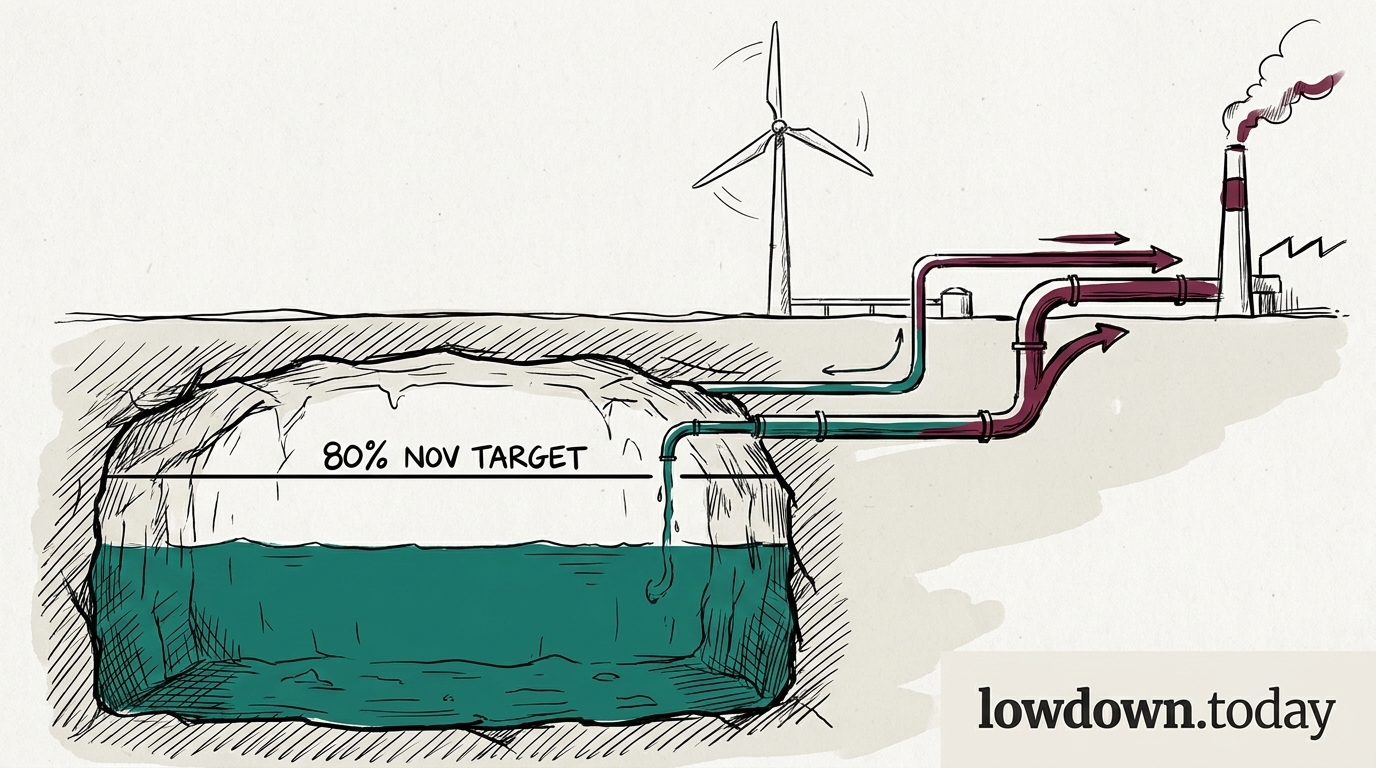
Spain's 9,145 GWh terminal inventory is the largest single stock in the EU LNG network, an option value that can reroute cargoes wherever the winter strip pays best rather than a cavern gas obligation tied to a fixed date. That flexibility matters more as Germany's cavern shortfall pushes more of the winter security question onto import infrastructure.
European Commission
European Commission
Brussels holds the bloc to 90% on a flexible window while Germany, holding roughly a quarter of EU storage capacity, tracks toward missing its own lower 80% figure by 21 points. A national shortfall this size in the anchor market matters more to bloc security than the flexible timetable alone can absorb.
French power exporters and CRE
French day-ahead rose in step with Germany but by less, reopening a EUR 7-17 premium that makes northward export flows commercially attractive again after the EUR 43.09 discount evaporated in days. CRE separately authorised RTE and Enedis to buy flexibility locally, betting the coming winter's binding constraint is grid congestion rather than a shortage of firm capacity.
TTF trading desk
TTF trading desk
A visible national shortfall like Germany's 21-point gap is a directional signal, not noise, for a desk holding the summer-winter spread. TTF's flat EUR 58-60 range through this week's German price swings says the market has not yet chosen to reprice refill risk into the front of the curve.
German cavern and CCGT operators
German caverns kept buying prompt gas at TTF near EUR 58-60 through the inversion; the wind collapse to 2.4 GW then flipped the spark spread to plus EUR 29 and put turbines back in the same queue. Every day turbines win that bid, injection at a third of the 877 GWh/day pace needed falls further behind.
Slovakia
Slovakia
Slovakia says it dropped its hold-out on the 21st sanctions package only after Ursula von der Leyen personally signed written gas-price and supply guarantees. The Council of the European Union's own 17,238-character release on the package names neither Slovakia nor any guarantee, leaving Bratislava's account unconfirmed by the institutional record.



