Skip to content
You can now search across every topic, entity and event.What's new
European Energy Markets
31JUL

Khamenei reported unconscious by US and Israeli intelligence

2 min read
09:44UTC

US and Israeli intelligence claim Iran's Supreme Leader cannot participate in decision-making.

EconomicDeveloping
Key takeaway

A single-source claim that, if true, leaves Iran's ceasefire authority vacant.

The Soufan Center reported on 9 April that Mojtaba Khamenei, Iran's Supreme Leader since March 2026, is reportedly unconscious and unable to participate in decision-making, citing US and Israeli intelligence. The claim cannot be independently verified and relies on a single source category.

Khamenei publicly authorised the ceasefire after 34 days of decisional silence . His is the constitutional authority under Iran's system: The Supreme Leader commands the armed forces, approves major foreign policy decisions, and cannot delegate that role to another official. The SNSC (Supreme National Security Council) accepted the ceasefire , but the Council acts under The Supreme Leader's authority, not independently of it.

The incapacitation claim carries specific operational consequences. If Khamenei cannot govern, the IRGC's 31 separate commands operate under the "mosaic defence architecture" without a single point of authority above them. Individual commanders can interpret ceasefire terms differently, refuse compliance without centralised countermanding, or escalate without authorisation from the top. The Soufan Center assessed the ceasefire as "hovering on the verge of collapse" in the same report.

A caveat is necessary. US and Israeli intelligence have a direct interest in destabilising Iranian decision-making structures. The claim may be accurate, partially accurate, or planted. It appeared in a single analytical outlet rather than being confirmed by multiple independent sources. Until corroborated, it belongs in the category of intelligence that shapes the environment without confirming a fact.


Deep Analysis

In plain English

Iran is a theocratic state where the Supreme Leader holds final authority over war, peace, and nuclear decisions. Think of it as a CEO whose signature is required for the company's most important contracts. The Soufan Center, a respected US intelligence research group, reported that US and Israeli intelligence believe Iran's Supreme Leader, a man called Mojtaba Khamenei, who only took the role about a month ago, is unconscious and cannot make decisions. If true, this raises an important question: who signed off on the ceasefire, and who is currently authorised to honour it or break it? There is no vice-Supreme-Leader. The Iranian constitution does not have a clear answer for what happens if the Supreme Leader is incapacitated before succession arrangements are made. This is a single-source intelligence claim, and intelligence services have been wrong about Iranian leadership before. But it is the kind of uncertainty that, if believed, could lead the US or Israel to take actions they would otherwise be more cautious about.

Deep Analysis
Root Causes

Mojtaba Khamenei's elevation to Supreme Leader in March 2026 was itself the resolution of a succession crisis. He has held the role for only weeks.

The IRGC's 'mosaic defence architecture' of 31 separate commands, which predates this conflict, means operational authority is distributed in a way that any single leader, even a fully capable one, would struggle to control in real time.

What could happen next?
  • Risk

    If the Khamenei incapacitation claim is accurate, IRGC commanders operating under the mosaic architecture have de facto operational autonomy during the ceasefire window, increasing the probability of an unauthorised incident in the Strait of Hormuz or Lebanon.

  • Consequence

    The constitutional ambiguity around Supreme Leader incapacitation means any ceasefire-related commitment made by Khamenei before his reported incapacitation has unclear legal standing within Iran's own system, potentially providing cover for factions that want to abrogate the agreement.

First Reported In

Update #66 · Islamabad collapses: 10 days to expiry

Soufan Center· 12 Apr 2026
Read original
Different Perspectives
Spain's LNG terminal operators
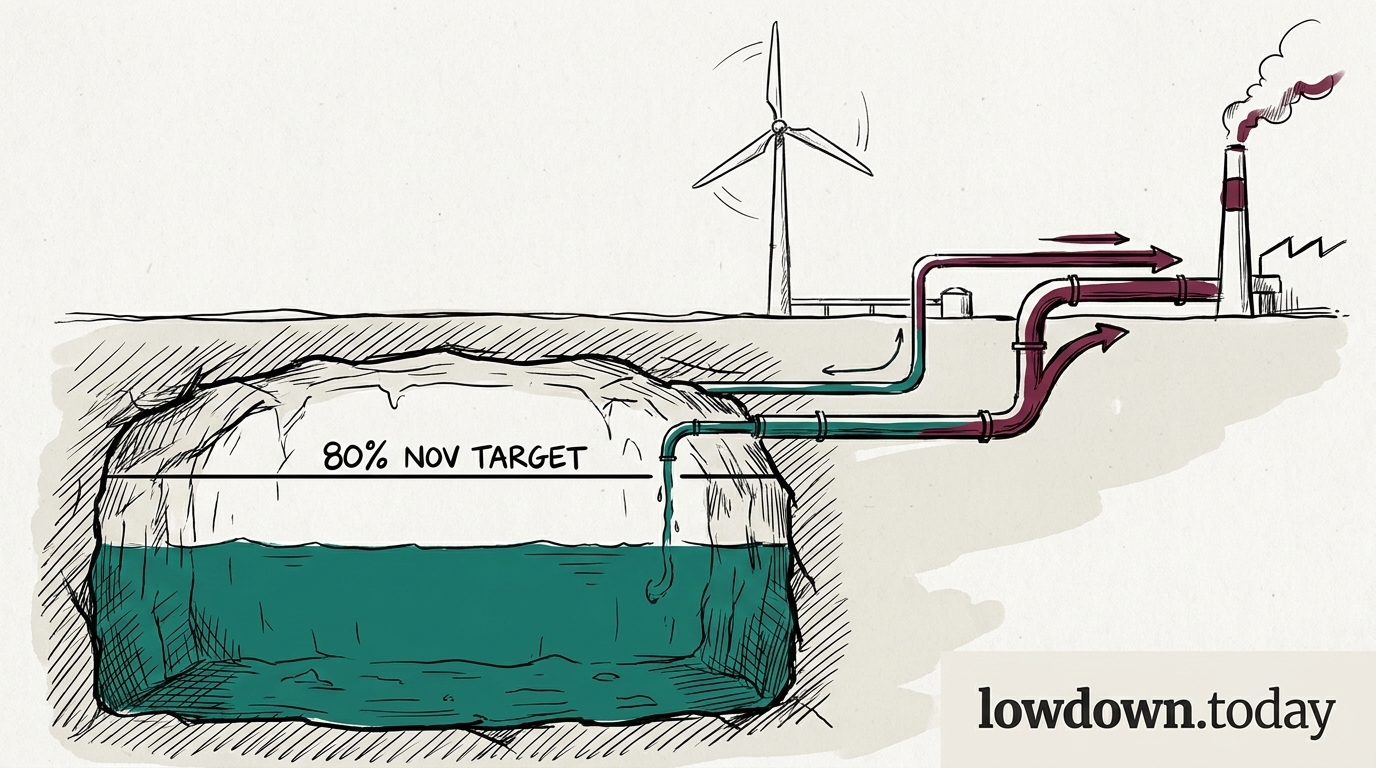
Spain's 9,145 GWh terminal inventory is the largest single stock in the EU LNG network, an option value that can reroute cargoes wherever the winter strip pays best rather than a cavern gas obligation tied to a fixed date. That flexibility matters more as Germany's cavern shortfall pushes more of the winter security question onto import infrastructure.
European Commission
European Commission
Brussels holds the bloc to 90% on a flexible window while Germany, holding roughly a quarter of EU storage capacity, tracks toward missing its own lower 80% figure by 21 points. A national shortfall this size in the anchor market matters more to bloc security than the flexible timetable alone can absorb.
French power exporters and CRE
French day-ahead rose in step with Germany but by less, reopening a EUR 7-17 premium that makes northward export flows commercially attractive again after the EUR 43.09 discount evaporated in days. CRE separately authorised RTE and Enedis to buy flexibility locally, betting the coming winter's binding constraint is grid congestion rather than a shortage of firm capacity.
TTF trading desk
TTF trading desk
A visible national shortfall like Germany's 21-point gap is a directional signal, not noise, for a desk holding the summer-winter spread. TTF's flat EUR 58-60 range through this week's German price swings says the market has not yet chosen to reprice refill risk into the front of the curve.
German cavern and CCGT operators
German caverns kept buying prompt gas at TTF near EUR 58-60 through the inversion; the wind collapse to 2.4 GW then flipped the spark spread to plus EUR 29 and put turbines back in the same queue. Every day turbines win that bid, injection at a third of the 877 GWh/day pace needed falls further behind.
Slovakia
Slovakia
Slovakia says it dropped its hold-out on the 21st sanctions package only after Ursula von der Leyen personally signed written gas-price and supply guarantees. The Council of the European Union's own 17,238-character release on the package names neither Slovakia nor any guarantee, leaving Bratislava's account unconfirmed by the institutional record.



