Skip to content
You can now search across every topic, entity and event.What's new
European Energy Markets
31JUL

IRGC hits Sirik base, vows sharper reply

3 min read
09:44UTC

The Revolutionary Guard struck an air base over a US strike on a Sirik Island telecoms tower and warned the next response will be 'completely different', as Kuwait intercepted missiles and drones with sirens nationwide.

EconomicDeveloping
Key takeaway

Kuwait intercepted projectiles a second time as the IRGC twice warned its next response will be completely different.

The Islamic Revolutionary Guard Corps (IRGC) struck an air base it said had launched a US strike on a telecoms tower at Sirik Island and warned that "if the aggression is repeated, the response will be completely different" 1. The IRGC is Iran's elite paramilitary force, answerable to the Supreme Leader rather than the elected government; Sirik is a small island off Iran's southern coast near the strait of Hormuz. Kuwait intercepted hostile missiles and drones on Monday 1 June, with air-raid sirens sounding nationwide.

Kuwait's interception is the part that should worry the wider Gulf. The same state struck Ali Al Salem Air Base days earlier and invoked UN Charter Article 51 self-defence, drawing a CENTCOM strike on Bandar Abbas in reply . A second round of projectiles over Kuwaiti territory means the fighting is no longer confined to the Iranian coast and US assets; the spillover is now routine enough to trigger national sirens.

The IRGC has now twice promised a response that will be "completely different", language that escalates the threat without committing to a timetable. Set against the disabling of the M/V Lian Star by a US Hellfire days earlier , the phrasing reads less as bluster than as a signal that Iran believes it can choose the moment, and the place, of a heavier reply.


Deep Analysis

In plain English

Iran's Revolutionary Guard responded to American air strikes by hitting the air base they say launched those strikes. The base is near Sirik Island, a small Iranian island close to the Strait of Hormuz. The IRGC also warned that the next American strike would bring a 'completely different' , and implicitly much larger , response. At the same time, Kuwait , a small Gulf country that hosts American military bases , intercepted Iranian missiles and drones. Air-raid sirens went off across the country. Kuwait has been caught in the middle of this conflict: it is a US ally but it also shares the Persian Gulf with Iran.

Deep Analysis
Root Causes

Kuwait's interception of hostile projectiles reflects the structural vulnerability of a Gulf state hosting US forces while trying to maintain nominal neutrality with Iran. Kuwait's constitution and defence agreements require it to defend against attacks, but its Article 51 invocation ties its legal position to the US military posture , making it a legitimate Iranian target under IRGC targeting logic that treats Gulf base-hosting as co-belligerency.

The Sirik Island strike reflects the IRGC's doctrine of reciprocal proportionality: the US struck a telecoms tower at Sirik, so the IRGC struck the air base that launched that strike. The doctrine requires a visible Iranian response to every uncontested US strike, regardless of military utility, to prevent the precedent of absorbing strikes without retaliation from setting in.

Escalation

Direction: sharply escalatory. The Kuwait interception is the most geographically expanded Iranian attack since the war began , Iranian projectiles reached Kuwaiti airspace as Iran simultaneously struck the Sirik air base. Two simultaneous attack vectors against two targets (US air base, Kuwaiti sovereign territory) in the same operational window suggests the IRGC activated a coordinated rather than reactive response.

What could happen next?
  • Risk

    If the IRGC's 'completely different response' refers to targeting CENTCOM carrier strike groups directly with anti-ship ballistic missiles, the conflict would transition from a land-based strike campaign to a naval war with no historical precedent in the post-1945 era.

    Short term · Suggested
  • Consequence

    Kuwait's second interception event under Article 51 conditions may push Kuwaiti domestic politics toward requesting the formal withdrawal of US forces to end Iranian targeting, a position Kuwaiti parliament has not yet debated but which polling suggests has majority support.

    Medium term · Reported
  • Precedent

    The IRGC has now struck Kuwait on multiple occasions after Kuwait invoked Article 51; if CENTCOM does not respond to the Kuwait attack directly, it signals that the Article 51 framework provides no operational deterrent.

    Immediate · Assessed
First Reported In

Update #114 · Two parliaments, one war neither can govern

Al Jazeera· 1 Jun 2026
Read original
Different Perspectives
Spain's LNG terminal operators
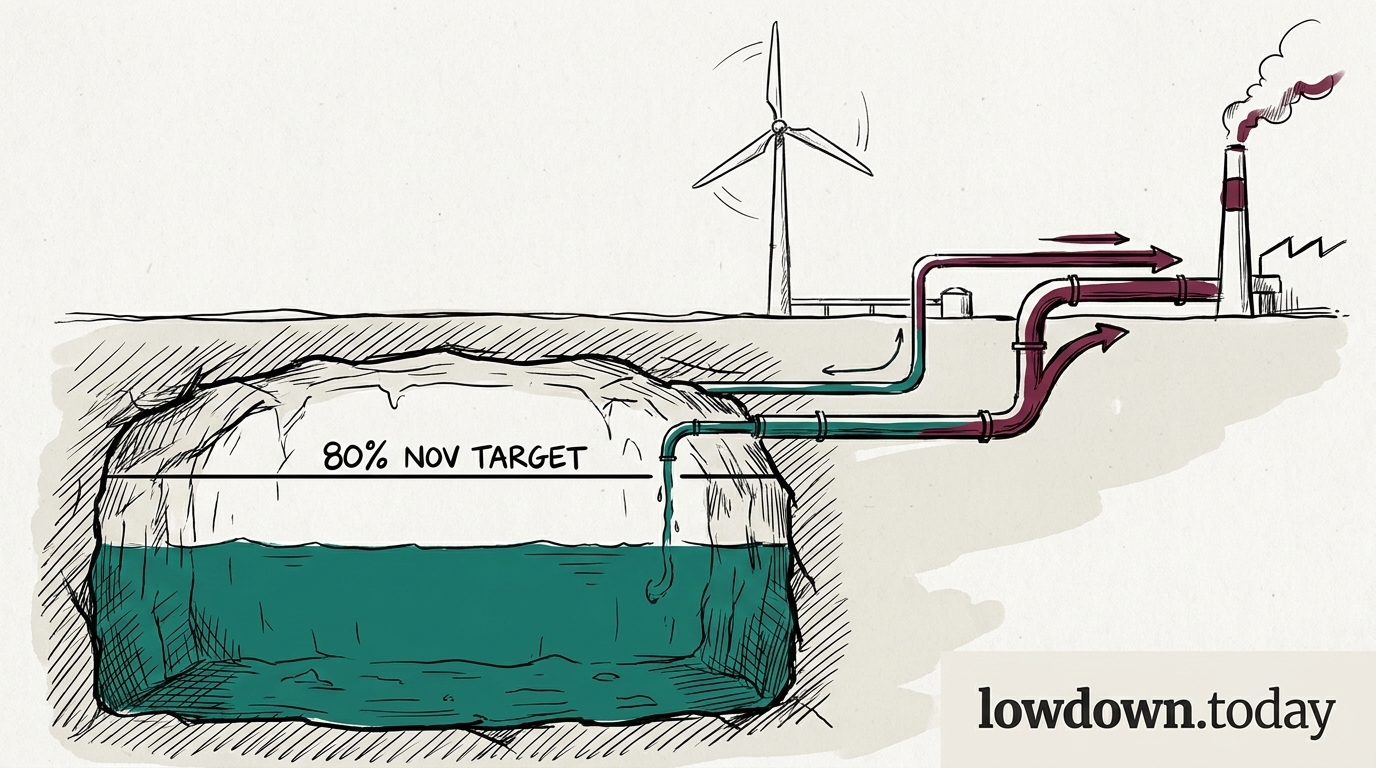
Spain's 9,145 GWh terminal inventory is the largest single stock in the EU LNG network, an option value that can reroute cargoes wherever the winter strip pays best rather than a cavern gas obligation tied to a fixed date. That flexibility matters more as Germany's cavern shortfall pushes more of the winter security question onto import infrastructure.
European Commission
European Commission
Brussels holds the bloc to 90% on a flexible window while Germany, holding roughly a quarter of EU storage capacity, tracks toward missing its own lower 80% figure by 21 points. A national shortfall this size in the anchor market matters more to bloc security than the flexible timetable alone can absorb.
French power exporters and CRE
French day-ahead rose in step with Germany but by less, reopening a EUR 7-17 premium that makes northward export flows commercially attractive again after the EUR 43.09 discount evaporated in days. CRE separately authorised RTE and Enedis to buy flexibility locally, betting the coming winter's binding constraint is grid congestion rather than a shortage of firm capacity.
TTF trading desk
TTF trading desk
A visible national shortfall like Germany's 21-point gap is a directional signal, not noise, for a desk holding the summer-winter spread. TTF's flat EUR 58-60 range through this week's German price swings says the market has not yet chosen to reprice refill risk into the front of the curve.
German cavern and CCGT operators
German caverns kept buying prompt gas at TTF near EUR 58-60 through the inversion; the wind collapse to 2.4 GW then flipped the spark spread to plus EUR 29 and put turbines back in the same queue. Every day turbines win that bid, injection at a third of the 877 GWh/day pace needed falls further behind.
Slovakia
Slovakia
Slovakia says it dropped its hold-out on the 21st sanctions package only after Ursula von der Leyen personally signed written gas-price and supply guarantees. The Council of the European Union's own 17,238-character release on the package names neither Slovakia nor any guarantee, leaving Bratislava's account unconfirmed by the institutional record.



