Skip to content
You can now search across every topic, entity and event.What's new
European Energy Markets
31JUL

IRGC declares standby, quantifies surviving fleet

3 min read
09:44UTC

Iran's Revolutionary Guard told Tasnim on 2 May it is on full standby and disclosed that roughly 60% of its small attack-boat fleet remains intact, the first wartime self-quantification of asset survival.

EconomicDeveloping
Key takeaway

The IRGC has put a number on its surviving small-boat flotilla; the negotiation must now price it in.

The Islamic Revolutionary Guard Corps told the Tehran-based wire Tasnim on 2 May that it is on 'full standby' for a return to hostilities and disclosed that roughly 60% of its small attack-boat fleet remains intact 1. The IRGC is Iran's ideological military, separate from the regular Artesh and tasked with revolutionary security; its small-boat flotilla is the harassment force that has worked the Strait of Hormuz since the opening days of the war. For 65 days the Guard has briefed only on operations, never on remaining capacity, so the survival figure marks Tehran's first wartime quantification of attrition.

Admiral Brad Cooper, the CENTCOM Commander, told reporters on 30 April that US operations had achieved a '100% halt' to Iran's seaborne economic trade . A halt of vessel intercepts is not a halt of the force that intercepts them, and the IRGC has made that distinction the basis of its negotiating posture. Roughly six in every ten of its asymmetric platforms still float; whatever ceasefire eventually arrives must price that residual capability in.

Tasnim, an IRGC-aligned outlet, ran the figure with no independent OSINT corroboration available; the precision of '60%' rather than 'most' or 'a majority' is itself the signal. Tehran is telling Washington, allies and Gulf insurers that the bargaining surface includes the standing capacity behind the 14-point text, alongside the text itself. The same logic explains the standby declaration: a force on declared standby raises the cost of any US escalation past the verbal threshold Trump set in his Florida pool spray. Together the announcement and the figure read as a single instrument of leverage delivered through state media rather than diplomatic cable.


Deep Analysis

In plain English

Iran's Revolutionary Guard, the military force that controls the Strait of Hormuz, announced on 2 May that it is on 'full standby' to resume fighting and that roughly 60% of its small fast-attack boat fleet survived the US-Israeli strikes since February. These small boats are the main tool the IRGC uses to threaten tankers and naval escorts in the narrow strait. The claim matters because the US military commander had said Iran's ability to conduct sea trade was 100% halted; the IRGC is saying its fighting capacity in the strait is far from finished.

Deep Analysis
Root Causes

The IRGC's structural doctrine after 1988 placed small attack boats in dispersed inland waterway staging areas and hardened coastal shelters, specifically to survive sustained US air campaign attrition.

By 2026, the fleet included craft storable in civilian boatyards and shallow-water inlets inaccessible to carrier-based strike aircraft. The 60% figure reflects the physical limitations of air-delivered munitions against targets designed to blend with civilian maritime infrastructure, more than any US decision to hold back.

The 'full standby' declaration is also an internal IRGC message: following the appointment of Mojtaba Khamenei under IRGC pressure and the organisation's operational sideline of the civilian government, the corps needs to demonstrate to its own rank and file that military leverage has not been surrendered in the ceasefire period.

What could happen next?
  • Risk

    If ceasefire talks collapse and the IRGC activates its surviving fleet, the 60% survival figure implies swarm capability sufficient to threaten CENTCOM escort vessels, not merely commercial tankers, representing a qualitative escalation risk above the pre-ceasefire intercept pattern.

  • Consequence

    The IRGC's public quantification of its own attrition directly undermines Admiral Cooper's '100% halt' claim before Congress, complicating the administration's ability to declare the blockade mission accomplished without IRGC capitulation.

First Reported In

Update #87 · China blocks OFAC; Iran writes; Trump tweets

Al Jazeera· 3 May 2026
Read original
Different Perspectives
Spain's LNG terminal operators
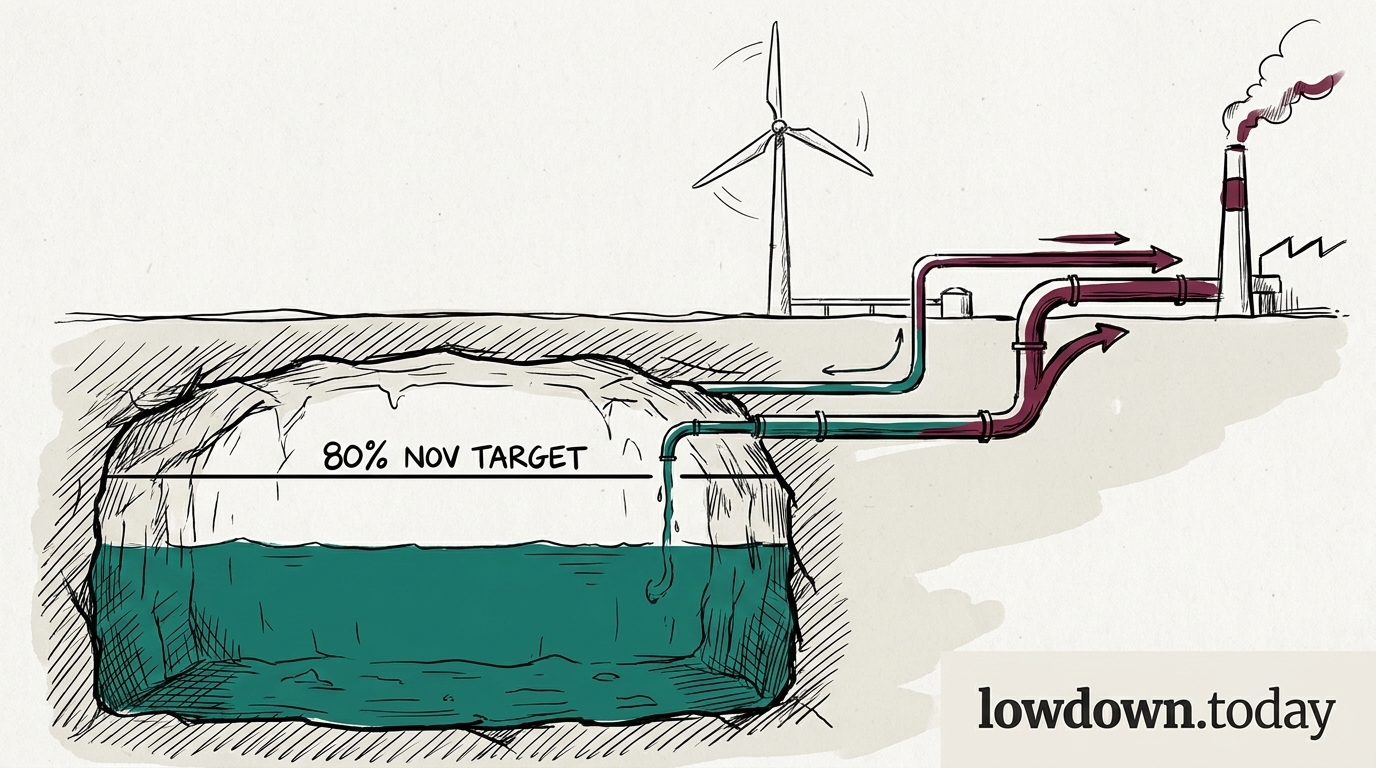
Spain's 9,145 GWh terminal inventory is the largest single stock in the EU LNG network, an option value that can reroute cargoes wherever the winter strip pays best rather than a cavern gas obligation tied to a fixed date. That flexibility matters more as Germany's cavern shortfall pushes more of the winter security question onto import infrastructure.
European Commission
European Commission
Brussels holds the bloc to 90% on a flexible window while Germany, holding roughly a quarter of EU storage capacity, tracks toward missing its own lower 80% figure by 21 points. A national shortfall this size in the anchor market matters more to bloc security than the flexible timetable alone can absorb.
French power exporters and CRE
French day-ahead rose in step with Germany but by less, reopening a EUR 7-17 premium that makes northward export flows commercially attractive again after the EUR 43.09 discount evaporated in days. CRE separately authorised RTE and Enedis to buy flexibility locally, betting the coming winter's binding constraint is grid congestion rather than a shortage of firm capacity.
TTF trading desk
TTF trading desk
A visible national shortfall like Germany's 21-point gap is a directional signal, not noise, for a desk holding the summer-winter spread. TTF's flat EUR 58-60 range through this week's German price swings says the market has not yet chosen to reprice refill risk into the front of the curve.
German cavern and CCGT operators
German caverns kept buying prompt gas at TTF near EUR 58-60 through the inversion; the wind collapse to 2.4 GW then flipped the spark spread to plus EUR 29 and put turbines back in the same queue. Every day turbines win that bid, injection at a third of the 877 GWh/day pace needed falls further behind.
Slovakia
Slovakia
Slovakia says it dropped its hold-out on the 21st sanctions package only after Ursula von der Leyen personally signed written gas-price and supply guarantees. The Council of the European Union's own 17,238-character release on the package names neither Slovakia nor any guarantee, leaving Bratislava's account unconfirmed by the institutional record.



