Skip to content
You can now search across every topic, entity and event.What's new
European Energy Markets
31JUL

Hellfire disables a cargo ship's engine

3 min read
09:44UTC

CENTCOM fired a Hellfire missile into the engine room of the Gambian-flagged M/V Lian Star in the Gulf of Oman around 30 May, the blockade's first disabling of a commercial hull by munition.

EconomicDeveloping
Key takeaway

The blockade crossed a threshold: from redirecting ships to destroying a civilian hull's ability to move.

CENTCOM (US Central Command) disabled the Gambian-flagged bulk carrier M/V Lian Star in the Gulf of Oman around Saturday 30 May, firing a Hellfire missile into its engine room after the crew ignored more than 20 blockade warnings 1. The Hellfire is a US precision air-to-ground missile. CENTCOM is the US combatant command that has run the Hormuz blockade since mid-April.

CENTCOM disabled the ship rather than seizing it, leaving its civilian crew aboard a powerless hull, and its cumulative redirection count reached 116 vessels. Every prior interdiction had turned ships away or boarded them.

This is the first time the 90-day blockade has crossed into disabling a commercial hull by munition. The rules of engagement have hardened beyond the Bandar Abbas strikes on Iranian naval targets , which hit military boats and a missile site rather than a merchant ship.

The shift changes the risk calculus for civilian shipping near the blockade zone. A disabled hull adrift with crew aboard also widens Washington's legal exposure under maritime law, where a powerless ship in a busy strait is itself a hazard to other traffic.


Deep Analysis

In plain English

US forces fired a Hellfire missile (a precision weapon normally used to destroy tanks or targeted vehicles) into the engine room of a cargo ship, leaving it unable to move. In 90 days of blockade operations, CENTCOM had previously boarded or redirected 115 vessels. This is the first time it destroyed a commercial vessel's propulsion using a missile. Lian Star's crew, stranded on a powerless hull, cannot leave under their own power. The ship is registered in Gambia, not Iran, meaning the US struck a third-country commercial vessel. Under international maritime law, firing on a non-combatant commercial vessel requires proportionality and exhaustion of lesser means; CENTCOM issued more than 20 warnings before firing.

Deep Analysis
Root Causes

The Lian Star disabling reflects a rules-of-engagement progression that began at redirection (week 1), moved to boarding (week 2), then to Iranian-hull disabling (week 3), and has now reached third-flag hull disabling (week 11). Each step was preceded by a specific compliance failure. The Lian Star's crew ignored more than 20 warnings, which CENTCOM treated as sufficient justification for escalation to munition.

The underlying structural driver is that the blockade's earlier deterrent credibility eroded: 116 cumulative redirections still produced vessels attempting to run the zone. CENTCOM needed a cost-imposing action that fell short of sinking to restore deterrence without triggering a humanitarian crisis.

What could happen next?
  • Precedent

    Third-flag commercial vessels are now subject to propulsion-kill rules of engagement if they attempt to run the blockade zone after 20 warnings, a doctrinal expansion CENTCOM has not formally published.

    Immediate · Assessed
  • Risk

    Gambia as flag state faces liability questions for its vessels in the blockade zone; smaller flag-state registries may accelerate flag-switching away from the Gulf.

    Short term · Assessed
  • Consequence

    Lloyd's of London's war-risk underwriting committee will need to price a new risk category: propulsion-destruction of insured hulls by US munition, not just mine or missile damage from hostile actors.

    Short term · Assessed
First Reported In

Update #113 · Trump signs nothing as a Hellfire hits a hull

CBS News· 31 May 2026
Read original
Different Perspectives
Spain's LNG terminal operators
Spain's 9,145 GWh terminal inventory is the largest single stock in the EU LNG network, an option value that can reroute cargoes wherever the winter strip pays best rather than a cavern gas obligation tied to a fixed date. That flexibility matters more as Germany's cavern shortfall pushes more of the winter security question onto import infrastructure.
European Commission
European Commission
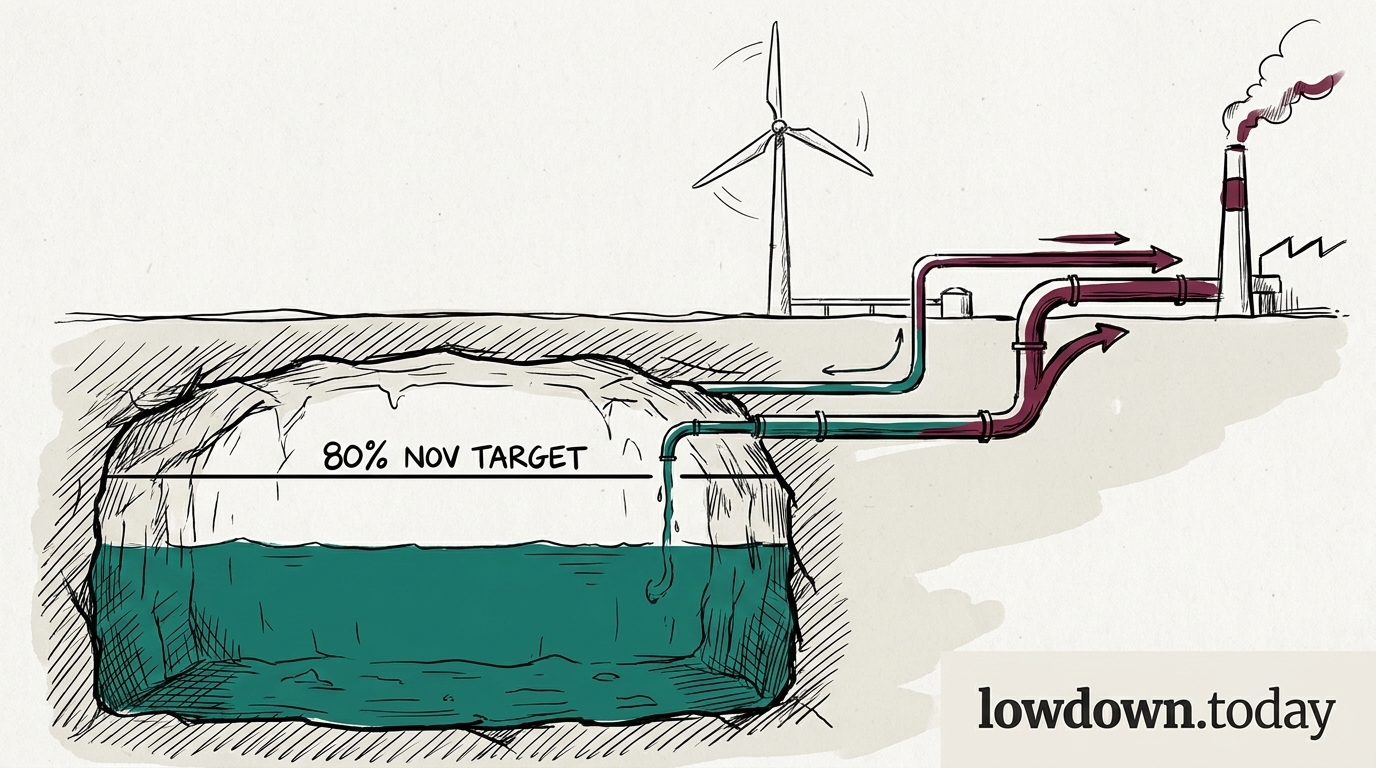
Brussels holds the bloc to 90% on a flexible window while Germany, holding roughly a quarter of EU storage capacity, tracks toward missing its own lower 80% figure by 21 points. A national shortfall this size in the anchor market matters more to bloc security than the flexible timetable alone can absorb.
French power exporters and CRE
French day-ahead rose in step with Germany but by less, reopening a EUR 7-17 premium that makes northward export flows commercially attractive again after the EUR 43.09 discount evaporated in days. CRE separately authorised RTE and Enedis to buy flexibility locally, betting the coming winter's binding constraint is grid congestion rather than a shortage of firm capacity.
TTF trading desk
TTF trading desk
A visible national shortfall like Germany's 21-point gap is a directional signal, not noise, for a desk holding the summer-winter spread. TTF's flat EUR 58-60 range through this week's German price swings says the market has not yet chosen to reprice refill risk into the front of the curve.
German cavern and CCGT operators
German caverns kept buying prompt gas at TTF near EUR 58-60 through the inversion; the wind collapse to 2.4 GW then flipped the spark spread to plus EUR 29 and put turbines back in the same queue. Every day turbines win that bid, injection at a third of the 877 GWh/day pace needed falls further behind.
Slovakia
Slovakia
Slovakia says it dropped its hold-out on the 21st sanctions package only after Ursula von der Leyen personally signed written gas-price and supply guarantees. The Council of the European Union's own 17,238-character release on the package names neither Slovakia nor any guarantee, leaving Bratislava's account unconfirmed by the institutional record.



