Skip to content
You can now search across every topic, entity and event.What's new
European Energy Markets
22JUN

Aramco cuts Europe off for October

4 min read
13:56UTC

Saudi Aramco told every European term customer on Friday 18 September that no Saudi crude reaches them in October, and sent roughly 60 million barrels to Asia instead. Dated Brent hit $130.80 while the futures contract refiners hedge with settled at $103.87.

EconomicAssessed
Key takeaway

Europe lost its October Saudi barrels, and the physical price now runs $26 above the hedge.

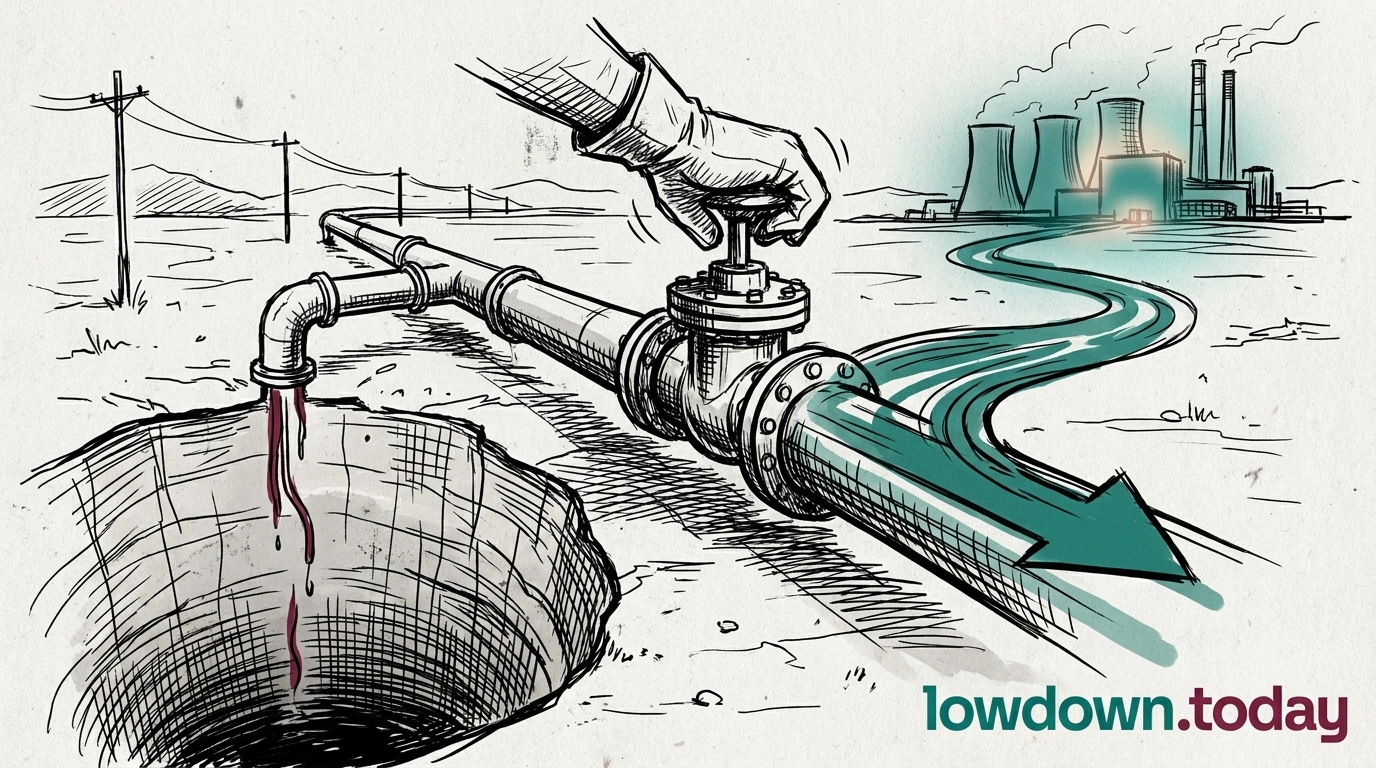
Saudi Aramco told every European term customer on Friday 18 September that they will receive no Saudi crude at all in October, and rerouted roughly 60 million barrels through its Gulf terminal at Ras Tanura and ship-to-ship transfers off Sohar, Oman, to buyers in China, South Korea, India and Japan 1. Those are the barrels European refiners had already planned their October runs around. The East-West pipeline, the Aramco line also known as Petroline, normally carries them to the Red Sea and is still down after the drone strike that shut it on 10 September . Europe's replacement cargoes must now clear Hormuz, clear the Red Sea, or sail five weeks around Africa.

The price of that reallocation shows up in one number that looks like a typing error until the mechanism is attached. Dated Brent, the benchmark for physical European cargoes, reached $130.80 on Tuesday 15 September 2, yet Brent futures on the Intercontinental Exchange (ICE) settled at $103.87 on Friday 18 September 3, a gap of roughly $26 per barrel. A Rotterdam refiner pays the first number and hedges against the second. Its hedge no longer covers its cost. Physical and paper normally trade within a couple of dollars of each other: the spread was minus $1.83 on 26 June, and the physical premium had already collapsed to near parity in May .

The gap widened inside this window; it did not open in it. It already stood at $13.45 on Wednesday 9 September. We reported a $14.20 physical premium on Thursday 19 March as the widest on record , yet the present gap is roughly double that mark. ORLEN is already buying North Sea, US and Kazakh crude in place of Saudi barrels 4. The cost does not stay in Rotterdam: that substitution tightens the North Sea and Kazakh pools in turn, and reaches every other Atlantic buyer bidding for the same cargoes.

US pump prices show the same market from the other side. Retail petrol averaged $4.455 per gallon in the week of 14 September on the Energy Information Administration's all-grades series 5, a third consecutive weekly rise that has added about 25 cents in a fortnight, or roughly $4 on a full tank. That series tracks West Texas Intermediate (WTI) and domestic refining margins rather than Dated Brent, and WTI futures moved only from $100.05 to $100.30 across the week 6. The extreme number belongs to Europe, not to the American motorist. US Energy Secretary Chris Wright said on Tuesday 15 September that the East-West line "should be flowing within days"; by Friday, people familiar with Aramco's plan put half capacity within days and full capacity six weeks out 7. Aramco's Yanbu loadings had already tilted 62% towards Asia in July .


Deep Analysis

In plain English

Saudi Arabia's state oil company, Aramco, normally sends a large share of its European-bound crude through the East-West Pipeline (also called Petroline), a pipe that crosses Saudi Arabia to loading points on the Red Sea. That pipeline is out of action. Instead of finding another way to reach Europe, Aramco has told its European customers they will get zero Saudi crude in October, and has sent about 60 million barrels that would normally go west out to buyers in China, South Korea, India and Japan instead. The reason is simple geography: reaching Asia doesn't require the broken pipeline or the dangerous Strait of Hormuz shipping lanes, so it was the easier oil to sell. European refiners now have to buy replacement crude from elsewhere, likely at a higher price.

Deep Analysis
Root Causes

Aramco's routing choice is constrained by geography, not preference: with the Petroline down, the only way to reach Europe is via the Strait of Hormuz and either the Red Sea, itself under attack, or the roughly five-week voyage around Africa. Gulf-loaded barrels bound for Asia require neither route, so rerouting Gulf-loaded crude to Asian buyers and leaving European term customers unserved is the shortest available path to market, not a deliberate reallocation of loyalty.

That asymmetry means the cost of the pipeline outage falls disproportionately on Europe even though the damage originated in a war Europe is not a direct party to, because Asia-bound cargoes never needed the pipeline or the contested strait in the first place.

What could happen next?
  • Consequence

    Orlen and other European term buyers must source replacement volumes from North Sea, US or Kazakh grades at spot-market pricing for at least the October loading cycle.

  • Risk

    If Asian buyers lock in the rerouted volumes under new term arrangements, European refiners may face a harder time regaining Saudi allocation even after the Petroline pipeline is repaired.

First Reported In

Update #179 · Russia and China kill Iran's UN monitor

OilPrice.com· 21 Sept 2026
Read original
Different Perspectives
Cross-border power traders
The France-Germany day-ahead spread flipped from a EUR 17.20 German premium on 1 August to a EUR 4.15 French premium on 3 August, the same day French curtailment peaked. They cannot yet attribute the flip to curtailment alone, since a like-for-like overnight comparison shows French nuclear output rising while wind fell and demand returned on the weekday step.
EDF
EDF
River-cooling limits took 7.6 GW, 12 per cent of its fleet, offline on 3 August, the highest curtailment since the heatwave began, with an easing forecast to 4.3 GW on 4 August and 3 GW after. It manages the cut as a recurring seasonal constraint, expecting it to lift with river temperature, not repair.
Gasunie
Gasunie
TTF, the Dutch hub it operates, drifted to roughly EUR 55 to 58 per MWh across the window, staying inside its recent range through both the German spark reversal and the French curtailment. It reads a flat hub price as evidence that neither event this window carried enough weight to move the fuel leg on its own.
German gas-fired generators
Record German solar of 18,761 MW on 2 August pushed the clean spark spread to minus 18.48 EUR/MWh, a loss-making day, before it returned to plus 16.20 on 3 August. They now price dispatch against post-solar residual load rather than wind alone, since the sign flipped inside 48 hours on unchanged fuel and carbon costs.
European Commission (DG Energy)
Its implementing-measures register logged transposition notices from only Portugal and Slovakia against Wednesday's Article 94 deadline for Directive (EU) 2024/1788, with 25 states silent. It expects the register to fill only gradually, since filing routinely lags legislating and any infringement track against non-notifying states runs on a slower clock than the deadline itself.
Spain's LNG terminal operators
Spain's 9,145 GWh terminal inventory is the largest single stock in the EU LNG network, an option value that can reroute cargoes wherever the winter strip pays best rather than a cavern gas obligation tied to a fixed date. That flexibility matters more as Germany's cavern shortfall pushes more of the winter security question onto import infrastructure.



