Skip to content
You can now search across every topic, entity and event.What's new
European Energy Markets
22JUN

Drones hit the pipeline built to dodge Hormuz

2 min read
13:56UTC

Drones struck Petroline on the morning of Thursday 10 September and the Saudi Ministry of Energy shut the line as a precaution. The ministry named no pumping station, no segment, no damage figure and nobody to blame.

EconomicDeveloping

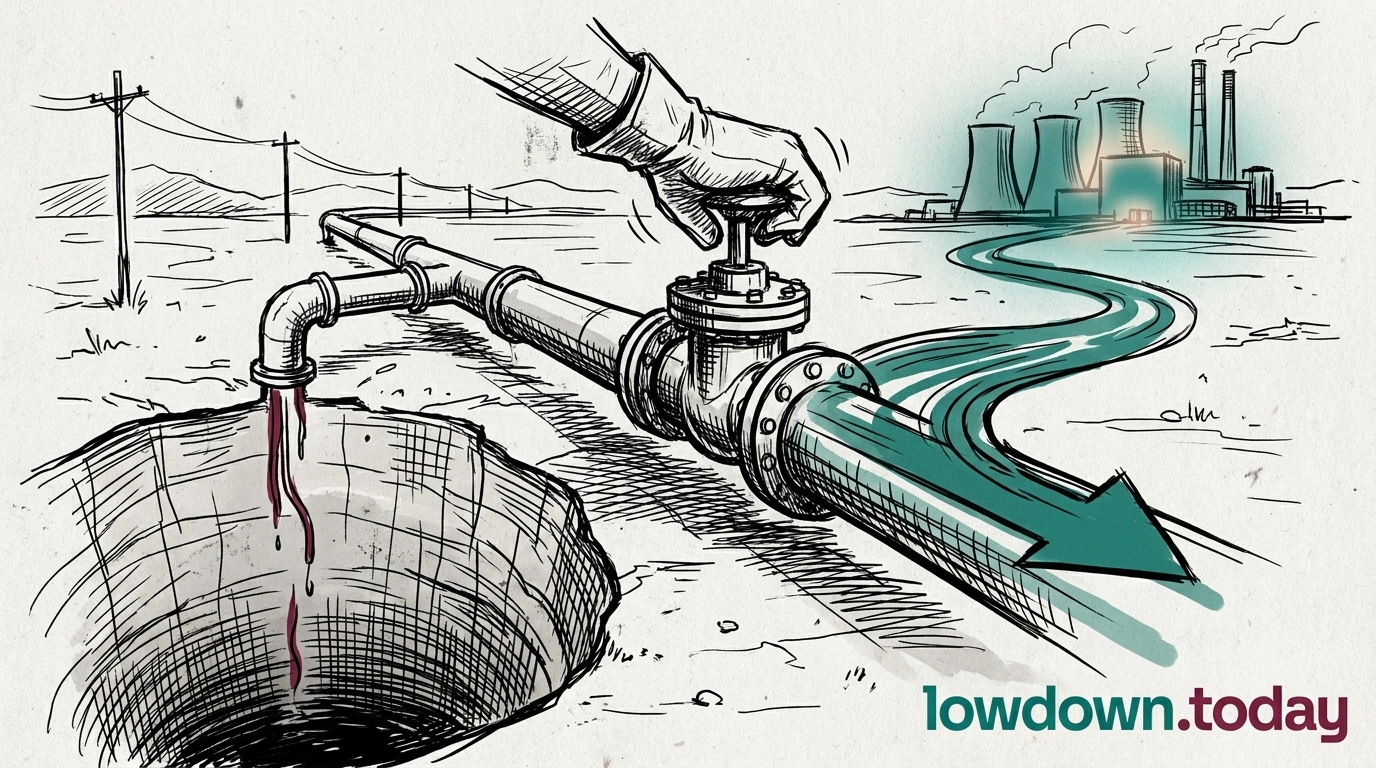
Drones struck Petroline, the east-west crude line Saudi Arabia built to reach the Red Sea without entering the Strait of Hormuz, on the morning of Thursday 10 September 2026. The Saudi Ministry of Energy said the line had been "subjected to multiple attacks on the morning of Thursday, September 10, 2026" and was shut as a precaution 1. The statement named no pumping station, no segment, no damage figure and no party responsible.

The line carries crude from The Kingdom's Eastern Province to Yanbu, the Red Sea export terminal that lets Saudi barrels reach the water without a Gulf transit. Nameplate capacity, the volume a line is built to carry, is 7 million barrels a day on the ministry's own April 2026 figure 2, the level Saudi Arabia restored the line to on 12 April . Early September loadings at Yanbu ran below that, and the two tanker trackers do not agree by how much: Vortexa reads 2.9 million barrels a day, Kpler 3.7 million 3.

Petroline had value precisely because nobody had hit it. Tanker operators had already shifted to a US-guided southern track around the strait on 3 September , which left the overland line as the one export path in the region nobody had attacked. A shut pipeline does not strand the crude; it pushes the same barrels back towards the water that the line was dug to avoid, and leaves The Kingdom without a fallback if the strait closes again.


Deep Analysis

In plain English

Saudi Arabia pumps most of its oil near the Gulf coast in the east. To sell it, tankers normally load there and sail out through the Strait of Hormuz, a narrow sea passage that Iran can threaten. Petroline, also called the East-West pipeline, avoids that. It carries crude across the country to Yanbu on the Red Sea, so some barrels can leave without going near Iran at all. On Thursday 10 September drones hit that pipeline and Saudi Arabia switched it off while it checks the damage. The country has not said which part was hit, how bad it is, or when the oil starts moving again.

Deep Analysis
Root Causes

Saudi Arabia's producing fields sit on the Gulf coast, so every barrel loaded there has to pass the Strait of Hormuz. Petroline carries crude west to Yanbu so that some of it does not have to, and that is the whole of the line's strategic value.

The design assumes the Red Sea end still works. Riyadh has loaded no crude for export through Bab al-Mandeb since the Houthi embargo of 23 July , and Yanbu barrels have gone north into the Suez Canal instead . The line was already feeding a longer and more expensive exit before the drones arrived.

The drones launched from Iraqi soil, in Maysan province. An attack mounted from a third country's soil turns retaliation into a question about Baghdad rather than a question about Tehran, and Riyadh answered it as one.

Escalation

Sideways, and the next move belongs to Baghdad rather than to Riyadh. The Saudi Ministry of Energy has set no restart date, and the Iraqi investigative council appointed on 12 September is the body whose findings would decide whether the kingdom treats this as an Iraqi failure or an Iranian act.

What could happen next?
  • Consequence

    Saudi barrels that would have left through Yanbu have to compete for tanker space at Gulf loading terminals, which puts them back into the water Petroline was dug to avoid.

    Immediate · Assessed
  • Risk

    With no published restart date, a buyer pricing Saudi supply for October has to guess at the outage length rather than plan around it.

    Short term · Assessed
  • Precedent

    An inland pipeline well away from the Gulf coast has now been hit from Iraqi territory, which extends the campaign's reach past the coasts and the strait.

    Medium term · Suggested
First Reported In

Update #178 · Saudi bypass hit, and Riyadh holds fire

Middle East Eye· 13 Sept 2026
Read original
Different Perspectives
Cross-border power traders
The France-Germany day-ahead spread flipped from a EUR 17.20 German premium on 1 August to a EUR 4.15 French premium on 3 August, the same day French curtailment peaked. They cannot yet attribute the flip to curtailment alone, since a like-for-like overnight comparison shows French nuclear output rising while wind fell and demand returned on the weekday step.
EDF
EDF
River-cooling limits took 7.6 GW, 12 per cent of its fleet, offline on 3 August, the highest curtailment since the heatwave began, with an easing forecast to 4.3 GW on 4 August and 3 GW after. It manages the cut as a recurring seasonal constraint, expecting it to lift with river temperature, not repair.
Gasunie
Gasunie
TTF, the Dutch hub it operates, drifted to roughly EUR 55 to 58 per MWh across the window, staying inside its recent range through both the German spark reversal and the French curtailment. It reads a flat hub price as evidence that neither event this window carried enough weight to move the fuel leg on its own.
German gas-fired generators
Record German solar of 18,761 MW on 2 August pushed the clean spark spread to minus 18.48 EUR/MWh, a loss-making day, before it returned to plus 16.20 on 3 August. They now price dispatch against post-solar residual load rather than wind alone, since the sign flipped inside 48 hours on unchanged fuel and carbon costs.
European Commission (DG Energy)
Its implementing-measures register logged transposition notices from only Portugal and Slovakia against Wednesday's Article 94 deadline for Directive (EU) 2024/1788, with 25 states silent. It expects the register to fill only gradually, since filing routinely lags legislating and any infringement track against non-notifying states runs on a slower clock than the deadline itself.
Spain's LNG terminal operators
Spain's 9,145 GWh terminal inventory is the largest single stock in the EU LNG network, an option value that can reroute cargoes wherever the winter strip pays best rather than a cavern gas obligation tied to a fixed date. That flexibility matters more as Germany's cavern shortfall pushes more of the winter security question onto import infrastructure.



