Skip to content
European Energy Markets
15APR

EU gas storage at 29.55% on 13 April

2 min read
13:33UTC

Aggregate fill moved 0.63 percentage points in four days on AGSI+, on the pace the Commission's reduced November target requires.

PoliticsDeveloping
Key takeaway

The EU aggregate is on pace; Germany is the variable that decides whether it holds.

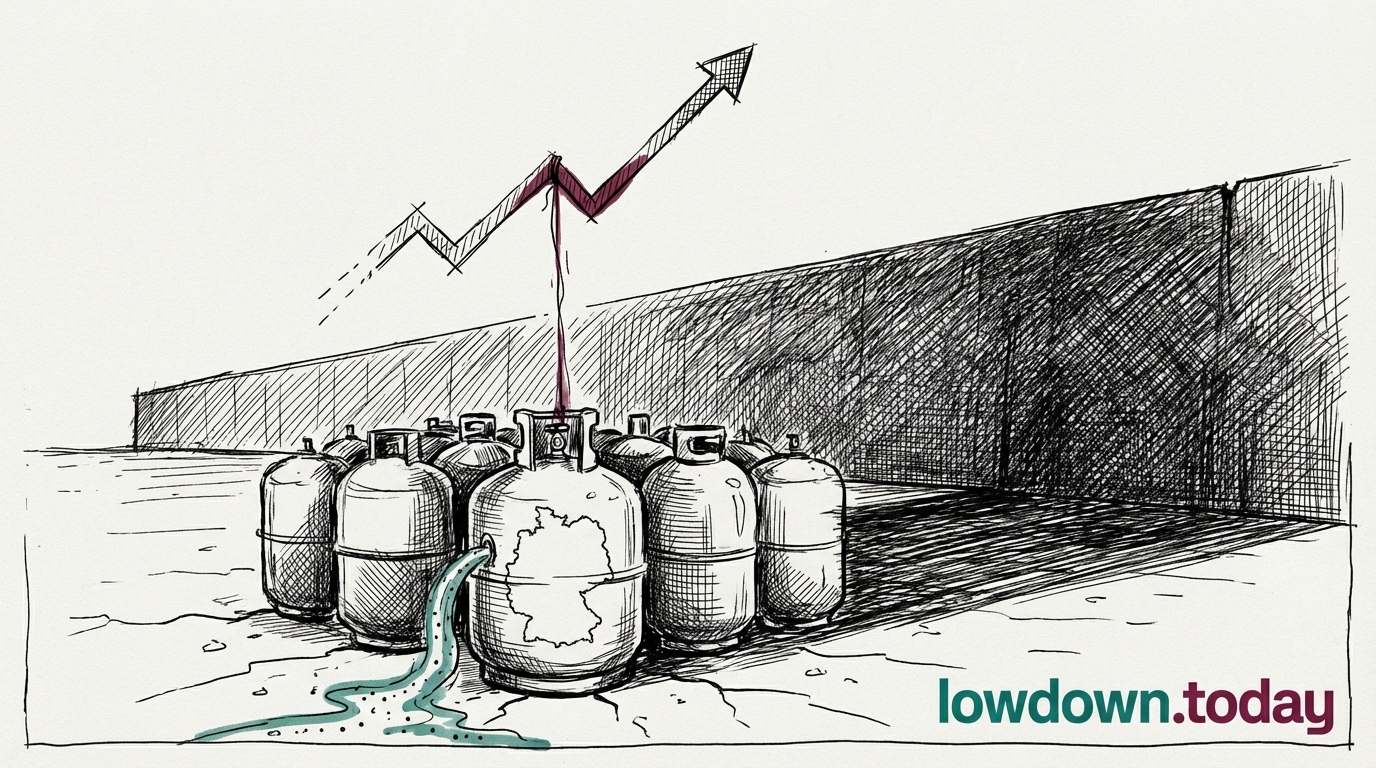
GIE AGSI+ recorded EU aggregate gas storage at 29.55% (334.35 TWh) on 13 April 2026, up from 28.92% on 9 April , a gain of 0.63 percentage points over four days 1. The European Commission has cut the November 2026 mandatory target from the standing 90% to 80% , which still requires roughly 0.67 TWh of net injection per day sustained through to November.

The four-day window ran at approximately 1.8 TWh per day on aggregate, comfortably above the target pace. That headline hides the distribution. Germany was net-withdrawing on 13 April , dragging on the aggregate; the 1.8 TWh/day pace depends on faster injection across peripheral storage estates.

The operational consequence is that the 80% target holds only if Germany flips to sustained net injection inside the next five to seven gas days. Each day the anchor keeps drawing is a day the periphery must inject faster to cover, and the capacity asymmetries on the periphery mirror Germany's at smaller scale: pipelines fill only as fast as they fill. A continued draw late into April is the structural signal that the aggregate number cannot maintain the pace.

Bruegel's refill estimate sits on top of an assumption that all member states flip to net injection on similar calendars. That assumption is under test. The EU Council's cutoff on the 25th then removes around 1.5 bcm per month of potential Russian supply into the same refill window, which makes the aggregate line on AGSI+ the single clearest public indicator of whether the November target is still in reach.


Deep Analysis

In plain English

EU gas storage across all 27 member states combined stood at 29.55% on 13 April, slightly up from 28.92% four days earlier. The target the EU has set for 1 November 2026 is 80%, which was reduced from 90% because the original target looked unachievable given current supply conditions. Getting from 29.55% to 80% requires sustained injections of gas into underground storage throughout summer and autumn. The pace required is tighter than in most previous years because storage started the season at a much lower level. The headline EU number looks slightly better than Germany's national number (23.27%), because other countries like France and Spain are currently injecting faster. But if those countries slow down or Germany takes longer to flip from withdrawal to injection, the EU aggregate will miss target.

What could happen next?
  • Risk

    If Germany remains in net withdrawal until late April, it will fall materially below its national injection trajectory required to contribute proportionally to the EU 80% target, leaving the EU aggregate dependent on southern European injection above their own seasonal norms.

First Reported In

Update #2 · TTF EUR 42 as Russian LNG ban enters range

Gas Infrastructure Europe· 15 Apr 2026
Read original
Causes and effects
This Event
EU gas storage at 29.55% on 13 April
The headline number is on track, but it is being carried by the periphery while Germany draws.
Different Perspectives
European Commission
European Commission
Commissioner Jorgensen formally acknowledged the post-Russia energy security framework cannot absorb the LNG shock, cutting the mandatory storage target from 90% to 80% and explicitly warning that normalisation is not foreseeable even with immediate peace. The Commission is now dependent on coordinated member state LNG purchasing and demand flexibility to bridge the remaining gap.
Germany
Germany
Germany holds the EU's largest storage estate but entered injection season at 23.32% fill with a 4.3 TWh/day injection ceiling that physically prevents any sprint recovery; the Bundeswirtschaftsministerium has maintained its early warning stage since July 2025. An escalation to Alarmstufe, which would trigger compulsory injection obligations, remains live if storage fails to rise through April.
QatarEnergy
QatarEnergy
QatarEnergy declared force majeure on European LNG contracts citing Ras Laffan strike damage, while the Gulf Research Centre assessed the declaration may also reflect a commercial decision to reallocate volumes toward higher-priced Asian spot markets without triggering breach penalties. Independent engineering confirmation of damage extent has not been published, leaving legal and commercial uncertainty unresolved.
Equinor / Norway
Equinor / Norway
Norway remains the EU's largest pipeline gas supplier and benefits from sustained elevated TTF; Norwegian pipeline capacity has partially offset the Russian supply loss but cannot close the structural gap. Norway Zone 4 power prices at EUR 2/MWh on 13 April illustrate how hydro-dominated systems are structurally decoupled from the gas price shock affecting continental Europe.
Italy
Italy
Italy cleared day-ahead power at EUR 133/MWh on 13 April, four to five times the Iberian equivalent, because gas-fired plants set the marginal price for approximately 90% of generation hours. Italy's circa 40 GW of gas-fired CCGT capacity, built when gas was cheap and nuclear was politically blocked, is now a structural liability at EUR 47/MWh TTF.
Spain
Spain
Spain cleared at EUR 29/MWh on the same day Italy paid EUR 133/MWh, the starkest single-day demonstration that its renewable energy investment is translating directly into price shock insulation for industry. Iberian interconnector constraints at the Pyrenees mean Spain cannot export this advantage to northern European markets at scale.
