Skip to content
You can now search across every topic, entity and event.What's new
European Energy Markets
4JUN

OIES frames Iran shock as multi-year

3 min read
10:45UTC

Bill Farren-Price ranks the Iran shock alongside the early 1970s in OIES Issue 148. Five contributing analysts converge on multi-year tightness, not a transitional pass-through.

EconomicDeveloping
Key takeaway

OIES Issue 148 puts the Iran shock alongside the early 1970s; the institutional consensus is now multi-year tightness.

The Oxford Institute for Energy Studies published Oxford Energy Forum Issue 148, "Global Gas: Battling the Next Crisis", in late April 2026. The introduction by Bill Farren-Price ranks the Iran shock as the largest episode of energy market disruption since the early 1970s 1. Across multiple papers in the issue, the institutional view converges on a multi-year tightness rather than a transitional one.

Vitaly Yermakov's paper on Russia-to-China LNG diversion intersects directly with the 25 April short-term Russian LNG ban : with Europe choking off the spot route, Russian volumes redirect south, and China is named explicitly as the global "balancing market". If Beijing moderates imports, European supply tightens further. Anouk Honoré finds prospects for European industrial gas demand recovery "very limited" after the 2022 shock, an outlook now compounded by Iran. Samia Adel and Carole Le Henaff treat storage resilience as the security baseline. Klaus-Dieter Borchardt argues the coming LNG wave and lower gas prices could undermine EU energy transition commitments over the longer term.

The practical effect of the Issue 148 frame: the IEA Q2 GMR (Gas Market Report) shift to a multi-year LNG capacity delay sits inside the institutional consensus rather than ahead of it. OIES Issue 32's own Q1 finding of a 20% global LNG supply fall provides the baseline from which Issue 148 now projects forward. Both reads make the storage-pace floor more binding, not less, and they raise the cost of any unplanned outage between now and mid-November.


Deep Analysis

In plain English

The Oxford Institute for Energy Studies, one of the world's leading energy research bodies, published a collection of expert papers in late April concluding that the current gas supply crisis is not a short-term problem. The lead researcher compared it to the oil shocks of the 1970s, which restructured global energy systems for a decade. Other researchers in the same publication found that European factories have already cut their gas use as much as they practically can, that Russia is simply diverting its gas toward China instead, and that cheaper gas prices from a future wave of new facilities could actually slow down Europe's shift to green energy. All of those findings together suggest the crisis will last years, not months.

Deep Analysis
Root Causes

The OIES institutional consensus on multi-year tightness rests on two structural conditions, not political judgements.

First, LNG capacity is not fungible on a two-year horizon. Projects sanctioned in 2022-2024 will not deliver meaningful volumes until 2028-2029 at the earliest, given 48-60 month construction cycles. The IEA Q2 GMR delay to multi-year reflects this pipeline, not a policy choice.

Second, European industrial demand is structurally lower after 2022 but cannot fall further without plant closures rather than efficiency gains. Honoré's finding in Issue 148 that recovery prospects are 'very limited' means the demand-side buffer has already been used. Any future disruption, including the Hormuz shock, transmits directly to storage and TTF rather than being absorbed by demand reduction.

What could happen next?
  • Meaning

    The OIES institutional consensus placing the IEA Q2 GMR delay inside a multi-year framing (rather than ahead of it) removes the 'lone outlier' defence that energy traders use to discount bearish long-dated reads; multiple major institutions now align on at least two more years of tightness.

  • Risk

    Klaus-Dieter Borchardt's finding that the coming LNG wave at lower prices could undermine EU energy transition investment creates a policy trap: cheap post-conflict LNG may reduce the commercial urgency for renewables buildout precisely when the transition needs to accelerate.

First Reported In

Update #7 · Storage pace 0.21 vs 0.257; floor not yet met

Oxford Institute for Energy Studies· 4 May 2026
Read original
Different Perspectives
Marine insurers and AIS trackers covering Hormuz
AIS data shows severe curtailment on 20 July, 479 vessels anchored, 36 dark, 123 still broadcasting inside the strait, not the closure the IRGC claims. War-risk premiums move on the unresolved CENTCOM-IRGC contest itself, since underwriters price the dispute as much as the count.
QatarEnergy
QatarEnergy
Ras Laffan has run at minimum output under force majeure into August since 9 July, a constraint already priced before this week's claim. The 17-20 July move is risk premium stacked on that standing loss, not a new physical loss at the plant.
ACER and the European Commission
ACER opened the REMIT reporting consultation on schedule on 16 July, giving firms to 11 September before a quarter to build systems against Regulation 648/2012. Brussels' separate silence on StromVKG state-aid clearance leaves Berlin's own capacity mechanism without legal authorisation.
EDF and French grid operator RTE
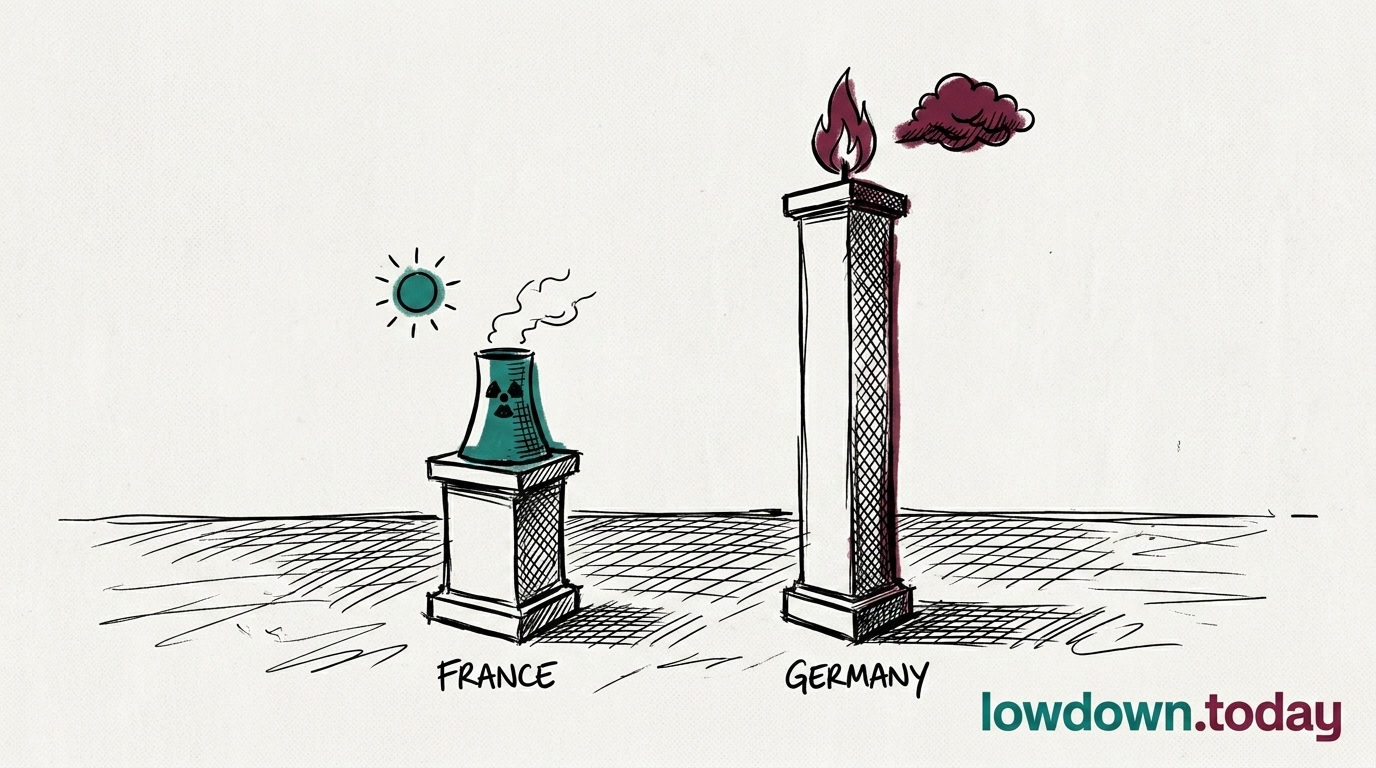
France's discount to Germany rests on an ASNR derogation from the 28C river-cooling limit at Bugey that expires today, not on a nuclear recovery; Chooz, Golfech and Bugey restarts run to 25 July. The cheap leg holds only as long as regulators keep waiving the limit each heatwave.
German CCGT operators and grid balancers
German gas plants went off-merit on 20 July as the clean spark spread inverted to minus EUR 15 to minus EUR 21/MWh, sidelining the flexible capacity storage injection needs. Operators are pricing 2027-28 capacity revenue against Bundesnetzagentur's own admission that Brussels has not cleared the 9 GW StromVKG auctions.
LNG spreads desk
LNG spreads desk
The JKM-TTF arb flipped to a TTF premium of roughly USD 0.6/MMBtu on 15 July, the first time this cycle Europe has outbid Asia, yet no Atlantic cargo has rerouted west. Until a cargo actually moves, the desk reads the Hormuz premium as unconfirmed and the EUR 55 print as vulnerable to a fast reversal.
