Skip to content
Briefings are running a touch slower this week while we rebuild the foundations.See roadmap
European Energy Markets
4JUN

IEA pivots: Hormuz delay now multi-year, not mid-year

4 min read
10:45UTC

The IEA's Q2-2026 Gas Market Report states the Middle East conflict is "expected to delay a significant amount of new LNG capacity" by at least two years, abandoning the mid-year resumption that anchored its April Oil Market Report.

EconomicDeveloping
Key takeaway

IEA shifted LNG baseline from mid-year resumption to multi-year delay between two consecutive reports.

The IEA (International Energy Agency)'s Q2-2026 Gas Market Report, published in Paris this week, states that the Middle East conflict is "expected to delay a significant amount of new LNG capacity that had been on track to come online in the second half of this decade" by at least two years 1. Two weeks earlier, the same agency's April OMR (Oil Market Report) had run a mid-year resumption of Middle East deliveries as the base case . The Q2 report names demand-side balancing, particularly Asian fuel switching, as the primary market mechanism rather than supply restoration.

The IEA is the OECD's energy intelligence arm; its base case anchors most utility-side and trading-floor supply models in Europe. Reframing Hormuz damage from a maintenance window into a medium-term structural change is a material revision between consecutive publications, and it has not yet propagated. ENTSOG (European Network of Transmission System Operators for Gas)'s Summer Supply Outlook 2026 and ACER's 23 April monitoring report were both built on the OMR mid-year assumption and have not recalibrated.

The transmission channel for European hedge programmes runs through Cal 27 and Cal 28: a multi-year capacity delay at the Qatari liquefaction layer means the Atlantic basin absorbs the gap for longer than 2026 alone. That puts the forward TTF curve through next winter and the one after at risk of being under-priced if the Q2 framing holds. The IEA's two consecutive publications running different base cases inside two weeks suggests the agency's supply-side modelling team has moved faster than its market-balance team, and Asian buyer behaviour now becomes the swing variable on European pricing rather than the reopening date for the strait. Iranian tanker seizures and the absence of LNG transits through Hormuz this week sit behind the agency's revision.


Deep Analysis

In plain English

The IEA (International Energy Agency) is the world's leading energy data and forecasting body, based in Paris. Every few months it publishes reports that governments and energy companies rely on to make supply and investment decisions. In April 2026 the IEA updated its gas forecast and concluded that the disruption around the Strait of Hormuz, a key shipping route between the Persian Gulf and the Indian Ocean, would delay new LNG supply projects by at least two years. This was a significant change from its previous forecast, which had assumed the disruption would resolve by mid-2026. Other EU bodies, including ENTSOG (the EU gas network operator group) and ACER (the EU energy regulator), had based their own forecasts on the older, more optimistic assumption and have not yet updated.

Deep Analysis
Root Causes

The IEA's Q2 base-case shift reflects a structural lag in its modelling framework: the Oil Market Report is a 12-month horizon tool calibrated to geopolitical base cases, while the Gas Market Report operates on a 2-5 year capacity horizon. When a Hormuz closure reshapes the LNG capacity installation calendar (delays to Qatari North Field expansion, rescheduling of liquefaction projects dependent on Gulf feedstock), the two reports diverge until the OMR explicitly updates its horizon.

The ENTSOG and ACER models that used the OMR mid-year resumption frame inherited this lag. Those organisations cite IEA OMR as an external baseline rather than running independent long-run capacity models, which is why their public documents have not yet recalibrated.

What could happen next?
  • Risk

    ENTSOG's Summer Supply Outlook 2026 and ACER's April monitoring report both embed the now-superseded OMR mid-year resumption base case; procurement teams relying on those models are underestimating 2027-28 refill costs by EUR 9-18bn.

  • Consequence

    LNG project financing banks will reassess discount rates on post-2028 capacity agreements, raising the cost of capital for Atlantic LNG expansions that underpin Europe's long-term supply diversification.

First Reported In

Update #5 · Ban day muted; Germany doubles injection rate

International Energy Agency· 26 Apr 2026
Read original
Causes and effects
Different Perspectives
TTF traders / Amsterdam hub desks
TTF broke its 38-session EUR 46-47 band on 2 June to EUR 48.9 on stalled Iran diplomacy and an unconfirmed Troll A restart; Dutch EBN mandates carry storage trajectory while commercial injection books nothing. The 17 June pipeline expiry is the next binary level: Central European hub premium above EUR 2/MWh widens sharply on any physical step-down.
Red Electrica / Spanish grid operators
Spain logged 397 negative-price hours in Q1 2026, eight times the 48 hours of Q1 2025, documenting midday solar surplus now embedding structurally into Continental pricing. Spain is four to six quarters ahead of France and Germany on the solar-penetration curve, making it the clearest forward indicator of where Continental midday clearing is heading.
Equinor
Equinor
Equinor issued no Troll A restart notice through 4 June despite extending the combined outage to 31 May, keeping up to 51 mcm/day of Norwegian supply offline alongside Hammerfest LNG dark since 22 April. The company's silence follows its 2025 Hammerfest pattern, which ran 24 days past target, and each day without a notice sustains the TTF supply premium.
European Commission / GMTF
SWD(2026)147 found EU gas spot and derivatives markets functioning well on 2 June, recommending MiFID-REMIT legislative alignment rather than emergency intervention. The GMTF verdict addressed derivatives-market integrity, not the physical injection mechanism FNB Gas declared broken five days earlier: the Commission's immediate next step is a legislative proposal, not an emergency storage order.
FNB Gas / Bundesnetzagentur
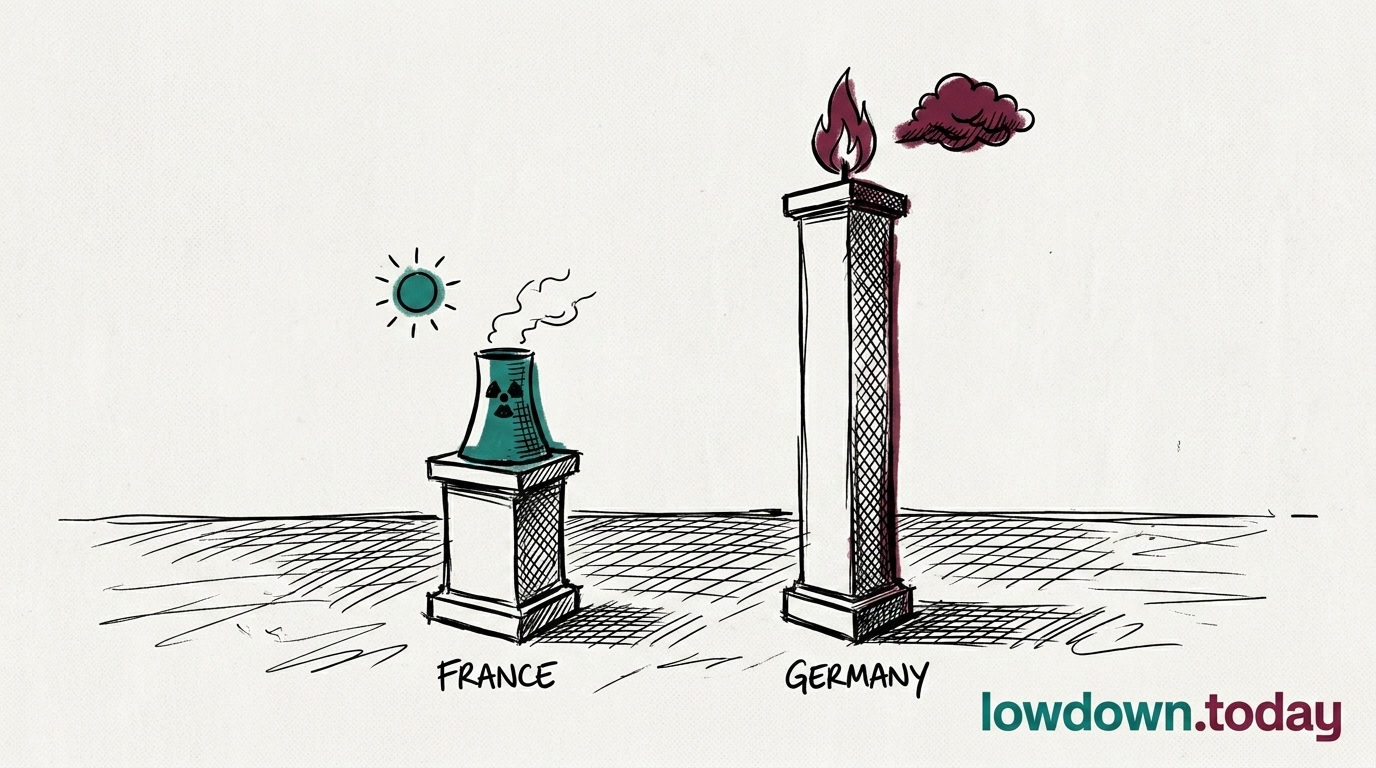
FNB Gas declared the storage-refill mechanism broken on 27 May after zero bookings in January 2026 auctions, and German day-ahead cleared EUR 102.64 on 3 June on a CCGT stack set by TTF near EUR 49 plus EUA near EUR 78. Winter storage fill now depends on state mandates with no commercial self-correction.
EDF / French government
EDF held full-year nuclear guidance at 350-370 TWh after April output of 29.3 TWh, anchoring the surplus that collapsed French day-ahead to EUR 8.96 on 3 June and passed that price to VNU industrials. Flamanville-3's September overhaul removes 1.6 GW at heating-season onset, reversing the nuclear surplus that made VNU pricing competitive.
