Skip to content
You can now search across every topic, entity and event.What's new
European Energy Markets
4JUN

Escort capacity caps Hormuz LNG throughput

2 min read
10:45UTC

Lloyd's List reports naval escorts can clear only three to four tankers a day through Hormuz on seven to eight warships, a ceiling that caps the restart regardless of diplomacy.

EconomicDeveloping
Key takeaway

Escorts clear only three to four ships a day, so throughput scales with warships, not diplomacy.

Naval escorts can currently move only three to four commercial ships a day through the Strait of Hormuz, using seven to eight escort warships for air cover against the residual mine and midget-submarine threat, Lloyd's List reports. The maritime publication frames the ratio as a fixed logistics ceiling, not a temporary bottleneck.

The corridor reopened for commercial traffic only when the first Hormuz carrier cleared to India in mid-June , and it has stayed thin since. TTF swung on each Hormuz headline over the following fortnight without settling , because the escort ratio cannot scale to normal volumes without a step-change in warships committed to the corridor. This extends the same capacity story, rather than opening a new one.

For QatarEnergy the implication is that its restart curve tracks the convoy schedule, not the communiques. Cargoes clear at the speed escorts allow, so a de-escalation headline shifts sentiment faster than it shifts throughput. A spreads desk watches the escort count as the real throttle on Qatari send-out, and treats any TTF relief on talk of normalisation as a fade candidate until the warship commitment actually rises.


Deep Analysis

In plain English

Even though Iran backed off its threats, only a handful of gas tankers can get through the Strait of Hormuz each day. That's not because of politics, it's because only seven or eight warships are escorting them, and each convoy trip takes time. Think of it like a single-lane bridge with a police escort: however many cars want to cross, only as many as the escort can handle get through. Until more warships join, three or four tankers a day is the limit, no matter how calm the diplomatic picture looks.

Deep Analysis
Root Causes

Sustaining a single escorted convoy on station requires roughly three committed warships for every one actually escorting at any given moment, the rest cycling through transit, refuelling and maintenance. Seven to eight warships is therefore close to the maximum convoy cadence a single coalition can sustain without redeploying vessels from other commitments.

Raising the ceiling means adding hulls, not paperwork, which is why Lloyd's List frames the bottleneck as logistical rather than diplomatic.

What could happen next?
  • Meaning

    QatarEnergy's restart pace is bound by convoy escort capacity rather than by diplomacy or terminal readiness, and will not lift until more warships join the corridor.

First Reported In

Update #23 · The EU's own regulator says the ban isn't biting

Lloyd's List· 3 Jul 2026
Read original
Different Perspectives
Marine insurers and AIS trackers covering Hormuz
AIS data shows severe curtailment on 20 July, 479 vessels anchored, 36 dark, 123 still broadcasting inside the strait, not the closure the IRGC claims. War-risk premiums move on the unresolved CENTCOM-IRGC contest itself, since underwriters price the dispute as much as the count.
QatarEnergy
QatarEnergy
Ras Laffan has run at minimum output under force majeure into August since 9 July, a constraint already priced before this week's claim. The 17-20 July move is risk premium stacked on that standing loss, not a new physical loss at the plant.
ACER and the European Commission
ACER opened the REMIT reporting consultation on schedule on 16 July, giving firms to 11 September before a quarter to build systems against Regulation 648/2012. Brussels' separate silence on StromVKG state-aid clearance leaves Berlin's own capacity mechanism without legal authorisation.
EDF and French grid operator RTE
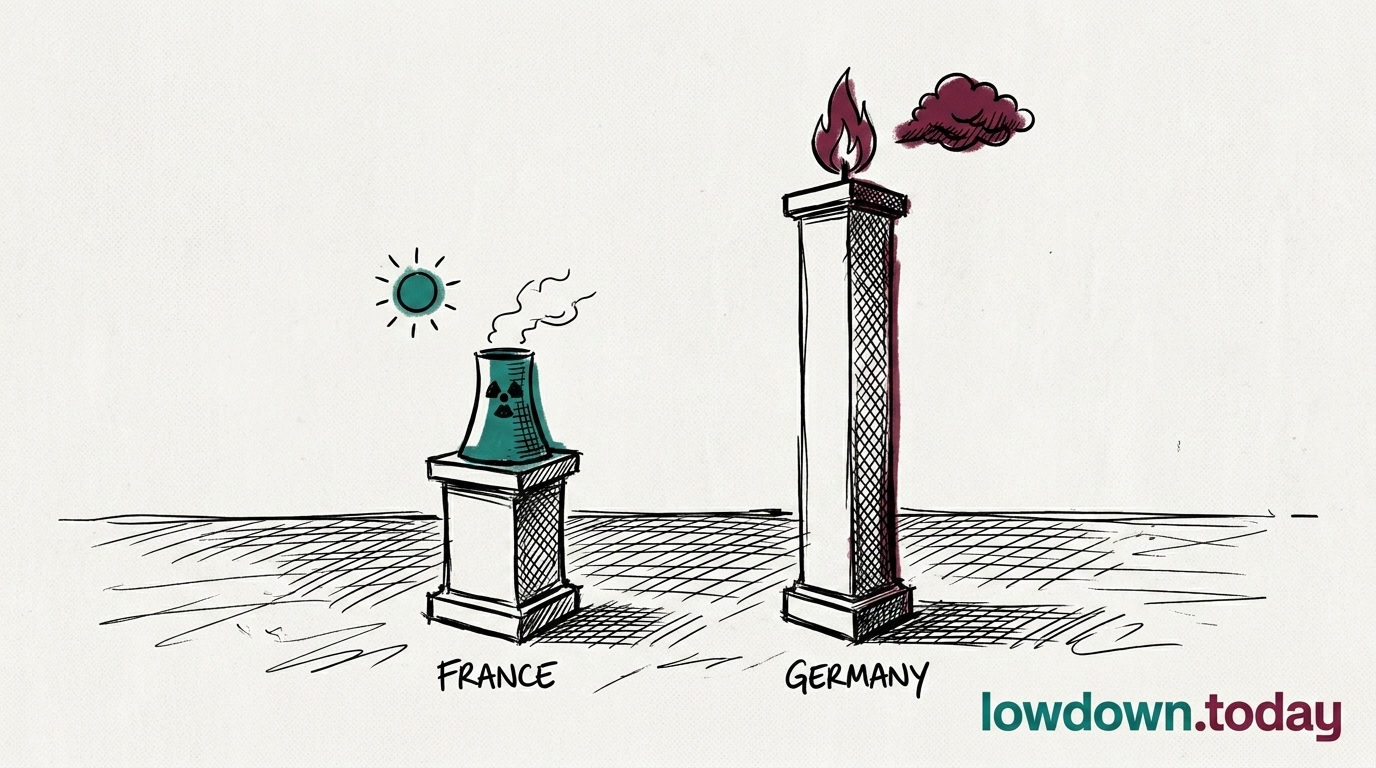
France's discount to Germany rests on an ASNR derogation from the 28C river-cooling limit at Bugey that expires today, not on a nuclear recovery; Chooz, Golfech and Bugey restarts run to 25 July. The cheap leg holds only as long as regulators keep waiving the limit each heatwave.
German CCGT operators and grid balancers
German gas plants went off-merit on 20 July as the clean spark spread inverted to minus EUR 15 to minus EUR 21/MWh, sidelining the flexible capacity storage injection needs. Operators are pricing 2027-28 capacity revenue against Bundesnetzagentur's own admission that Brussels has not cleared the 9 GW StromVKG auctions.
LNG spreads desk
LNG spreads desk
The JKM-TTF arb flipped to a TTF premium of roughly USD 0.6/MMBtu on 15 July, the first time this cycle Europe has outbid Asia, yet no Atlantic cargo has rerouted west. Until a cargo actually moves, the desk reads the Hormuz premium as unconfirmed and the EUR 55 print as vulnerable to a fast reversal.
