Skip to content
You can now search across every topic, entity and event.What's new
European Energy Markets
4JUN

TTF round-trips on Hormuz, ends Q2 down

3 min read
10:45UTC

TTF round-tripped from a EUR 43.6 two-week high to a EUR 40.6 two-month low and back to EUR 43.62 over 27-30 June, yet still closed the quarter down more than 14%.

EconomicDeveloping
Key takeaway

TTF round-tripped on Hormuz headlines over four sessions but still closed the quarter down more than 14%.

TTF ran a full round-trip in four sessions. The European benchmark gas price touched roughly EUR 43.6/MWh on 27 June, a two-week high on fears a Gulf strike would choke tanker traffic, then fell to EUR 40.6 on 29 June, a two-month low, once the verbal US-Iran stand-down pulled the risk premium back out 1. By 30 June it had snapped back to EUR 43.62, up 7.6% intraday, as heat returned and Gulf risk re-bid.

TTF, the Title Transfer Facility, is the Dutch hub price every European gas contract references, and it has spent the season taking its cue from Hormuz headlines rather than from any shift in the physical balance. Across 27 to 30 June, tanker-traffic fear, the stand-down, then a fresh re-escalation moved the front month nearly EUR 3 in either direction while storage filled steadily underneath 2.

For all that motion, the quarter closed lower. TTF fell more than 5% across June and more than 14% over the quarter 3. The same stand-down lifted Brent only 1.3%, to $72.91 , the oil benchmark reading the Gulf far more calmly than the gas one. Crude barely moved while European gas ran from its two-month low back to its prior level inside a week, and that gap puts Hormuz risk into gas before it touches oil in the current supply environment.


Deep Analysis

In plain English

TTF is the Dutch Title Transfer Facility, the main pricing point for wholesale gas in Europe. When you buy gas in Europe, the price is usually set by reference to TTF. Between 27 and 30 June, TTF swung from EUR 43.6 to EUR 40.6 and back to EUR 43.62, a round-trip caused by news reports from the Strait of Hormuz, the narrow sea channel through which most Middle Eastern gas tankers must pass. Oil prices barely moved on the same news, rising just 1.3% on the stand-down announcement. European gas moved more than seven times as much. That gap exists because Saudi Arabia can send its oil through an overland pipeline to bypass Hormuz, but there is no equivalent pipeline bypass for Qatar's gas. If Hormuz closes, European gas has no alternative supply route; oil has at least a partial one. The quarter closed with European gas down more than 14% overall, because the same Hormuz-de-escalation trade that lifted prices briefly in April reversed more permanently through June.

Deep Analysis
Root Causes

European gas has no strategic reserves equivalent to the IEA's 90-day oil stock mechanism, which allows oil markets to absorb a physical supply interruption without an immediate spot price response. European gas storage carries a structural buffer, but at 48.62% fill on 28 June it stood 31 points below the statutory 80% floor target, meaning the entire physical buffer was at risk under a closed-corridor scenario with no draw capacity to suppress price signals.

The JKM-TTF arb had already compressed to near-parity by 29-30 June, removing the Atlantic cargo routing flexibility that in a wider-arb environment would have dampened European price spikes: flexible US LNG cargoes could not divert to Europe without accepting parity-or-worse netback economics. Every Hormuz headline therefore hit a market with thin inventory, no strategic reserve backstop, and no Atlantic cargo pipeline to provide counter-cyclical supply.

Brent's relative insensitivity to the same news reflects Saudi Arabia's East-West crude pipeline, which can bypass Hormuz for roughly 5 million barrels per day of Saudi export capacity. No equivalent gas bypass exists for Qatari LNG.

What could happen next?
  • Risk

    A single Gulf re-escalation headline can move TTF front-month EUR 2-3/MWh within hours at current inventory levels, giving gas market participants limited ability to hedge headline risk through physical buffers alone.

  • Consequence

    The Q2 TTF decline above 14% reduces the embedded cost in next-winter forward contracts and may lower projected household energy bills relative to Q1 forecasts, provided Hormuz remains open through the autumn injection season.

First Reported In

Update #22 · Germany refills as the autumn cliff nears

Trading Economics· 30 Jun 2026
Read original
Different Perspectives
Marine insurers and AIS trackers covering Hormuz
AIS data shows severe curtailment on 20 July, 479 vessels anchored, 36 dark, 123 still broadcasting inside the strait, not the closure the IRGC claims. War-risk premiums move on the unresolved CENTCOM-IRGC contest itself, since underwriters price the dispute as much as the count.
QatarEnergy
QatarEnergy
Ras Laffan has run at minimum output under force majeure into August since 9 July, a constraint already priced before this week's claim. The 17-20 July move is risk premium stacked on that standing loss, not a new physical loss at the plant.
ACER and the European Commission
ACER opened the REMIT reporting consultation on schedule on 16 July, giving firms to 11 September before a quarter to build systems against Regulation 648/2012. Brussels' separate silence on StromVKG state-aid clearance leaves Berlin's own capacity mechanism without legal authorisation.
EDF and French grid operator RTE
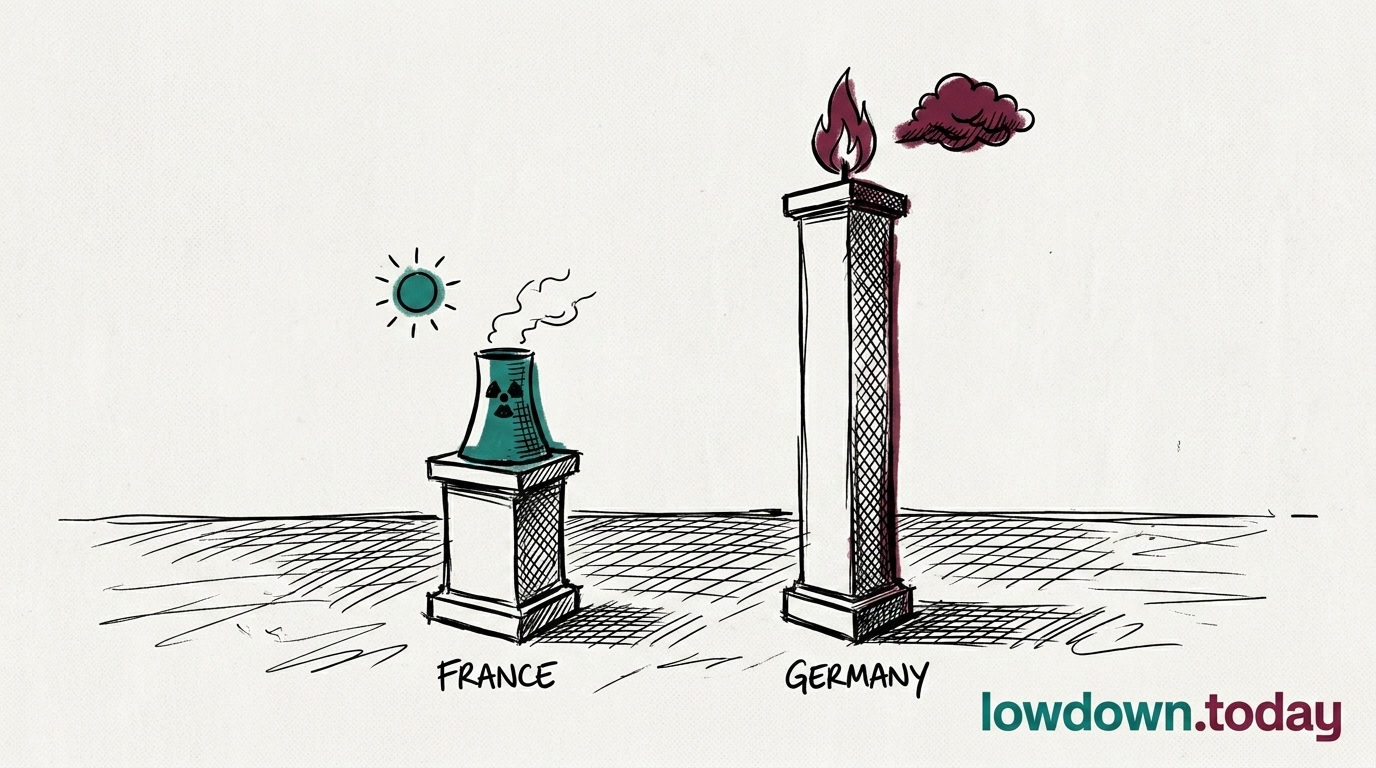
France's discount to Germany rests on an ASNR derogation from the 28C river-cooling limit at Bugey that expires today, not on a nuclear recovery; Chooz, Golfech and Bugey restarts run to 25 July. The cheap leg holds only as long as regulators keep waiving the limit each heatwave.
German CCGT operators and grid balancers
German gas plants went off-merit on 20 July as the clean spark spread inverted to minus EUR 15 to minus EUR 21/MWh, sidelining the flexible capacity storage injection needs. Operators are pricing 2027-28 capacity revenue against Bundesnetzagentur's own admission that Brussels has not cleared the 9 GW StromVKG auctions.
LNG spreads desk
LNG spreads desk
The JKM-TTF arb flipped to a TTF premium of roughly USD 0.6/MMBtu on 15 July, the first time this cycle Europe has outbid Asia, yet no Atlantic cargo has rerouted west. Until a cargo actually moves, the desk reads the Hormuz premium as unconfirmed and the EUR 55 print as vulnerable to a fast reversal.
