Skip to content
Briefings are running a touch slower this week while we rebuild the foundations.See roadmap
European Energy Markets
18MAY

EU LNG terminals drew 163kt in three days

2 min read
11:11UTC

Terminal stocks funded the marginal molecule into pipeline storage as Atlantic cargoes kept missing the basin.

EconomicDeveloping
Key takeaway

Terminal stocks are now the marginal supplier; the buffer is finite and shrinking.

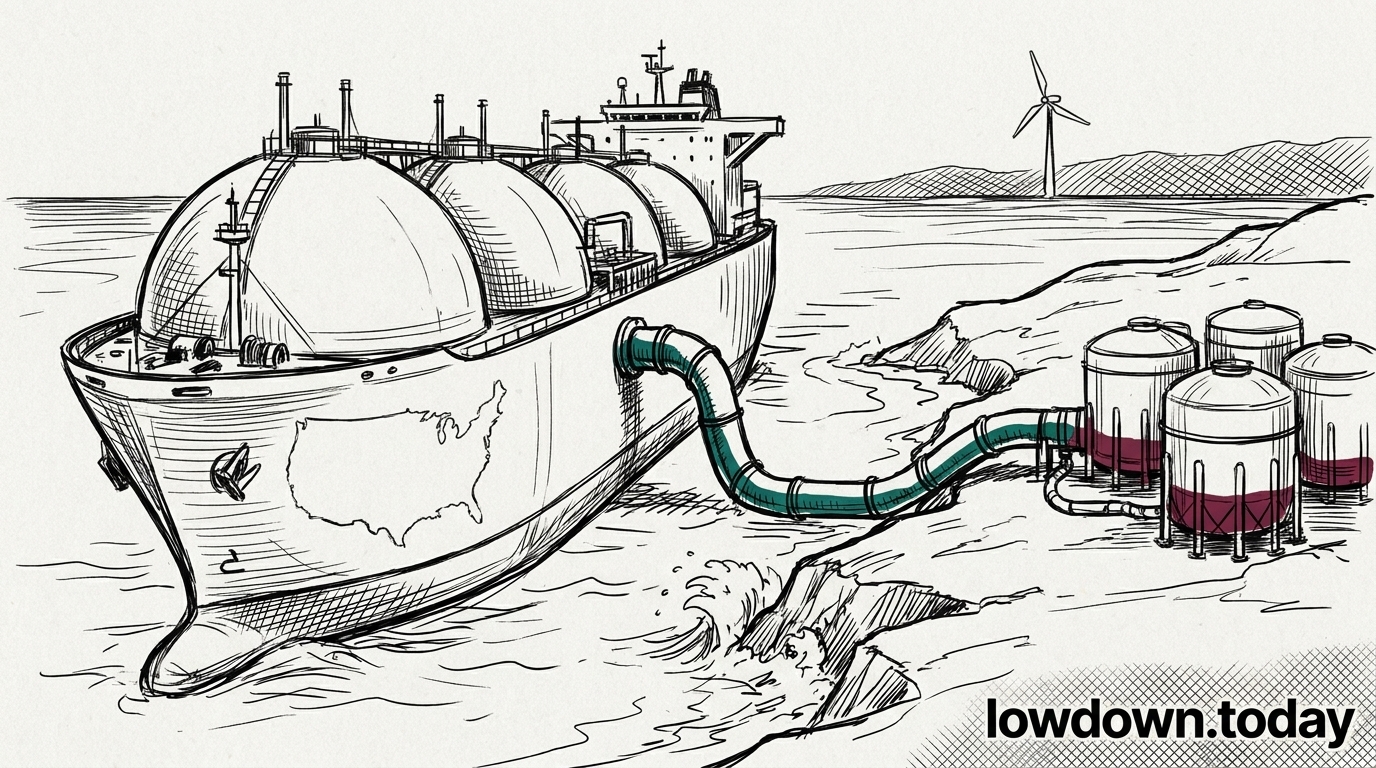
Gas Infrastructure Europe's ALSI (Aggregated LNG Storage Inventory, the terminal-stocks companion to AGSI+) showed aggregate EU terminal inventory falling from 5,929 thousand tonnes on 10 April to 5,766 thousand tonnes on 13 April, a draw of 163 kt over three days 1. Daily send-out averaged 4,348 GWh, with no evident new cargo arrivals landing in the window.

Around a dozen Atlantic LNG cargoes had already diverted to Asia since early March , compressing the JKM-TTF spread to near parity and removing the arbitrage that would ordinarily pull reload cargoes back into European terminals. QatarEnergy's Ras Laffan force majeure takes out the other direction of flexible supply. With Atlantic inflow thin and Qatari inflow blocked, terminal buffer is the only variable left, and it is being drawn at roughly 50 kt per day to keep pipeline send-out steady.

That dynamic has a short runway. ALSI carries finite stock, and drawing it during peak reload season means Europe enters May with a thinner LNG cushion against any late-April supply shock. With the Russian LNG cutoff arriving on 25 April and no replacement supply publicly named, the buffer question becomes a May question rather than a June one.


Deep Analysis

In plain English

LNG, liquefied natural gas, arrives at European ports as a super-cooled liquid in specialised tankers. It is stored at coastal terminals before being sent inland through pipelines as regular gas. Think of the terminals as the first link in the chain between ships arriving from Qatar, the US, or Nigeria, and the heating systems of European homes. Between 10 and 13 April, EU terminals collectively drew down their stocks by 163,000 tonnes in three days, and no new tankers appear to have docked to refill them. That is because LNG ships have been diverting from Europe to Asia, where buyers are paying slightly more. European terminals were funding their pipeline obligations by drawing on reserves, not new deliveries.

What could happen next?
  • Risk

    The Russian LNG ban on 25 April removes a portion of the terminal replenishment flow while injection season demand for send-out rises, accelerating the terminal drawdown rate beyond the current 54 kt/day.

First Reported In

Update #2 · TTF EUR 42 as Russian LNG ban enters range

Gas Infrastructure Europe· 15 Apr 2026
Read original
Causes and effects
Different Perspectives
US LNG exporter (Sabine Pass / Corpus Christi)
The 58% EU import share confirmed by ACER, heading toward 65% in 2026, represents a structural long-term offtake position that European terminal operators are now willing to underwrite against the German 2031 gas-demand floor. Ribera's warning lands inside a commercial relationship that is expanding, not contracting.
Teresa Ribera, European Commission EVP
Ribera warned Europe should 'avoid replacing one energy dependency with another', framing the ACER 58% US LNG figure as a supply-security risk in the same week TTF broke EUR 50. Her institution has spent EUR 117 billion on US LNG since 2022.
Yara International (ammonia producer)
Front-month TTF at EUR 50+ touches the demand-destruction threshold at which ammonia output curtailments have historically been triggered. Yara faces the same lock-or-ride binary as financial desks, but the downside is production loss rather than mark-to-market exposure.
Katherina Reiche, German Economy Minister
Reiche confirmed the 12 GW hydrogen-ready gas tender is formally agreed with the EU Commission, with first auctions in 2026 and all units operational by 2031. The confirmation closes three years of SPD environment-ministry obstruction and anchors German gas demand through the early 2030s.
European gas trader (Amsterdam desk)
The EUR 50 break is a watershed signal, not a squeeze: the forward curve at EUR 55.21 twelve months out implies the market has repriced structural winter risk, not a positioning overshoot. The lock-or-ride decision on winter hedges closes in June when injection-pace data for May lands.
Hungarian and Slovak gas buyers and regulators
Hungary cleared EUR 123.23/MWh on 12 May, EUR 54 above Spain's same-day clearing and the largest single-market premium of the briefing series, as ACER named it among seven NRAs in TurkStream derogation opinions with the 5 August EC ruling pending. A denial of derogation removes the only available pipeline substitute for Russian LNG banned since 25 April.
