Skip to content
You can now search across every topic, entity and event.What's new
Drones: Industry & Defence
20AUG

Drone Gauntlet now judges the parts

4 min read
16:38UTC

The Pentagon's Drone Dominance Gauntlet Stage 1 closed on 20 June after testing 49 companies and 79 drones; the next round bars Chinese, Russian, Iranian and North Korean motors and batteries, enforced by physical teardown.

TechnologyDeveloping
Key takeaway

Gauntlet II's component bar makes parts provenance, not flight performance, the decisive qualifier.

The Pentagon's Drone Dominance Gauntlet Stage 1 ran 8-20 June at Camp Grayling, Michigan, testing 49 companies and 79 drones before closing on 20 June 2026 1. The Gauntlet is a Pentagon procurement competition built to qualify drone manufacturers for large-volume attritable orders, the throwaway airframes meant to be fielded in bulk. About ten vendors per mission area are expected to advance to the second round, and Ukraine's Defense Drones Tech Corp competed as a returning Phase 1 winner. An initial batch of roughly 2,000 drones was accepted on the spot.

Advancing carries a heavy demand. Each Gauntlet II finalist must field 120 drones for orders of 4,000 to 9,500 units, under price ceilings of $5,500 for long-range and $4,500 for close-quarters airframes 2. A single winning lot is therefore worth more than $40 million, and qualifying turns a prototype shop into a volume manufacturer overnight. This beat advances the stage that opened on 8 June ; the new detail is the results and the component rule attached to the next round.

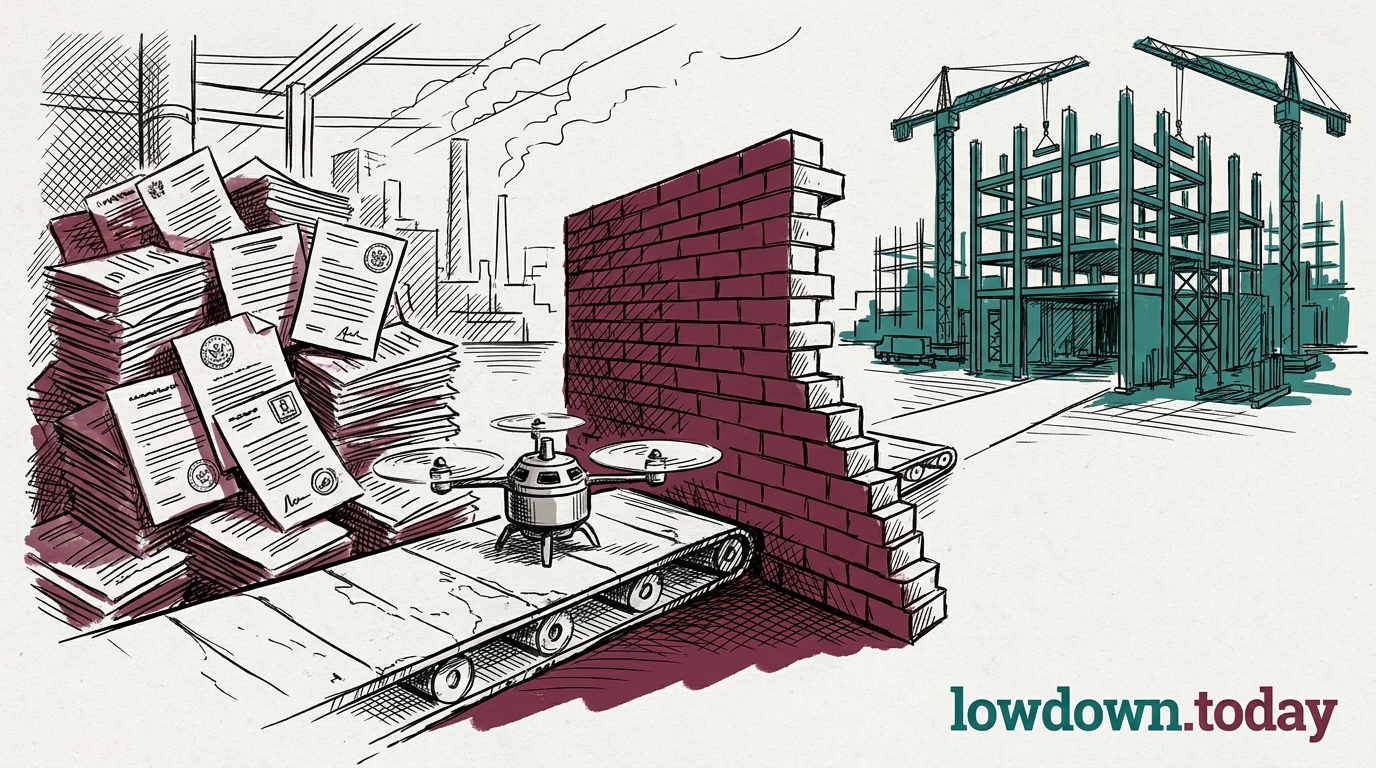
The component rule decides more than flight performance does. Motors and batteries from China, Russia, Iran or North Korea are barred, enforced through bill-of-materials review and physical inspection later this summer. Many FPV assemblers built their cost advantage on Chinese motors and cells, and a drone that flies well can still fail on a teardown. The contest is moving from who builds the best drone to who can prove where every part came from, a slower and more structural reordering of the supply base than any single award.

Deep Analysis

In plain English

The Pentagon held a two-week competition at a military training base in Michigan, testing drones from 49 different companies. This was Stage 1 of the 'Drone Dominance Gauntlet', the US military's programme to buy cheap attack drones in large numbers. For the next stage, there are new rules: any drone that uses motors or batteries made in China, Russia, Iran or North Korea is disqualified. Inspectors will physically check every drone's parts. This matters because cheap Chinese components are what made it possible to build drones at the target prices the Pentagon wants. Manufacturers now have to find alternatives , and those cost more.

Deep Analysis
Root Causes

The Gauntlet II component bar addresses a structural contradiction in the Pentagon's attritable drone programme: the $4,500-$5,500 unit price targets were set assuming Chinese-sourced motors and batteries, which cost approximately 40-60% less than equivalent Western components.

Phase 1's failure to achieve full acceptance (1,040 of 2,400 Archer drones cleared, per prior reporting) was partly attributable to quality variance in Chinese-sourced components under accelerated delivery schedules. The Gauntlet II bar is thus simultaneously a national security measure and a quality-control mechanism , Chinese components under production pressure exhibited failure rates that degraded acceptance testing pass rates.

The 49 companies and 79 drones in Stage 1 also reveal a structural asymmetry: roughly 1.6 drones per company, indicating that many entrants brought a single airframe design rather than a platform family. Gauntlet II's requirement for 120 drones per qualifying company will naturally select for manufacturers with either production volume or manufacturing scalability rather than design novelty.

What could happen next?
  • Consequence

    Drone manufacturers using Chinese components at Gauntlet II price ceilings face a structural margin squeeze; those without US-aligned battery and motor supply chains will either miss the price ceiling or exit the competition.

    Immediate · Assessed
  • Opportunity

    US and allied motor and battery manufacturers face a Pentagon-mandated demand signal at scale; companies like Molicel (Canadian) and Texas Instruments' motor controller division are positioned to capture supply chain substitution orders.

    Short term · Assessed
  • Risk

    Supply chain verification that stops at tier-one finished components rather than sub-component origins replicates the known failure mode of the Pentagon's prior counterfeit electronics programme, providing compliance theatre rather than genuine security.

    Medium term · Assessed
First Reported In

Update #13 · Air Force shuts primes out of drone wingman

Inside Unmanned Systems· 25 Jun 2026
Read original
Different Perspectives
South Korea's Defense Acquisition Program Administration
DAPA folded drone and roadside-bomb jammers into an 18-year, KRW 3.448 trillion K2 tank upgrade approved 11 August, rather than fund counter-drone kit as its own programme. Seoul is treating the threat as permanent enough to write into a platform's lifecycle, not urgent enough to buy ahead of it.
NATO Support and Procurement Agency
NSPA named five pre-qualified counter-drone suppliers under new framework contracts on 27 July, giving allies a purchasing route with no published budget attached. A framework without committed money is an instrument waiting for a spending decision, not a guarantee one is coming.
Ukraine's Ministry of Defence
Ukraine's forces strike with more than 70 AI and computer-vision systems drawn from over 200 domestic producers, the ministry said on 18 August, a supplier base neither Washington's tariff fight nor Beijing's export licence touches. Kyiv is scaling capability faster than either government is writing rules for it.
A European drone-component manufacturer
A European manufacturer selling components into the United States faces the same 100 per cent tariff and 3 September deadline as any other foreign supplier, with the duty-free onshoring carve-out available only to firms building on American soil. That leaves it to absorb the cost, relocate assembly, or cede the US market rather than shop around a rival supply chain.
Chinese drone component exporters
Exporters now need a case-by-case licence for each US-bound dual-use shipment after MOFCOM's 5 August order, with no published review clock. The same week Shenzhen logged nearly 200,000 domestic logistics-drone sorties and Hunan reported record spraying coverage, a home market large enough to absorb what the licence regime slows from leaving the country.
US drone manufacturers
The onshoring carve-out protects Performance Drone Works' $820 million War Department loan, but the same 3 September deadline hits Red Cat Holdings and Unusual Machines, both filing over 500 per cent revenue growth on 6 August, on Chinese-sourced components with no qualified domestic substitute yet.
