Skip to content
You can now search across every topic, entity and event.What's new
Drones: Industry & Defence
7JUN

Zelenskyy proposes EU drone deals at Bucharest summit

3 min read
11:27UTC

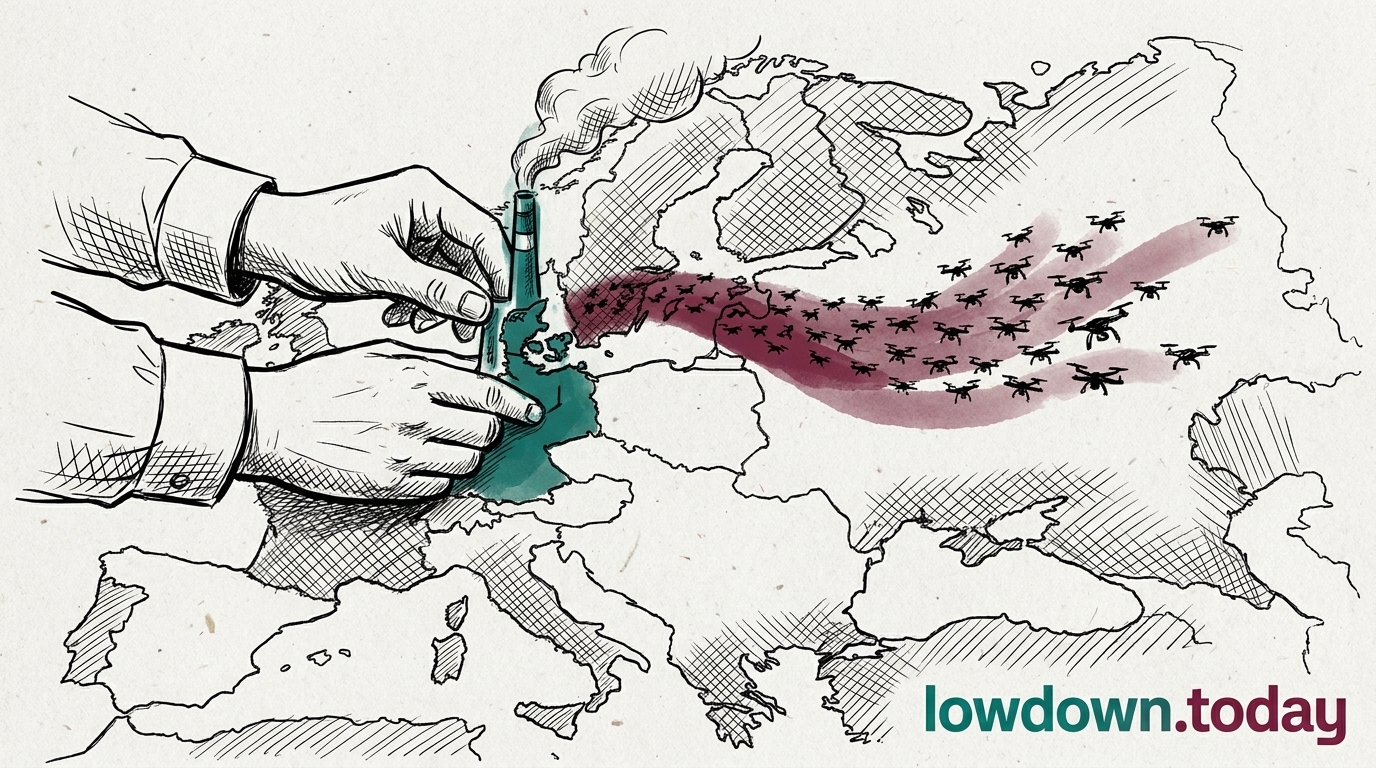
Zelenskyy addressed the Bucharest Nine plus Nordic allies at Cotroceni Palace on 13 May, proposing bilateral drone deals that pair European industrial capacity with Ukrainian battlefield experience, independent of US arms export approvals.

TechnologyDeveloping
Key takeaway

Zelenskyy's Bucharest drone deal proposal builds European security architecture outside the US export-approval layer.

Volodymyr Zelenskyy addressed the Bucharest Nine (B9), the nine NATO eastern-flank members (Bulgaria, Czech Republic, Estonia, Latvia, Lithuania, Poland, Romania, Slovakia, and Hungary) plus Nordic allies at Cotroceni Palace in Bucharest on 13 May 2026, as Russia's 800-drone barrage was tracked across 20 regions 1. The B9+Nordic joint statement reaffirmed Ukraine's sovereignty within internationally recognised borders, backed security guarantees, and called for NATO eastern flank reinforcement 2.

Zelenskyy's concrete deliverable was a proposal for bilateral drone deals: 'I believe we all need bilateral drone deals' 3. The architecture he described pairs European industrial capacity and financing depth with Ukrainian battlefield testing experience, and does not require US arms export approval for each transaction. That distinction is the structural innovation.

The Berlin EUR 4 billion defence package signed on 14 April is the template. Germany's route through Raytheon via direct commercial sale for GEM-T (Guidance Enhanced Missile-Tactical) interceptors, rather than a US Foreign Military Sale requiring State Department approval, demonstrated that a European state can transact US-manufactured systems commercially without engaging The White House licensing queue. Germany's Boris Pistorius published the first German military strategy naming Russia the biggest threat on 22 April , framing European rearmament as a decade-long structural project. The bilateral drone proposal extends that logic from air defence to a segment the US export freeze has left open.

Ukraine's drone industry produces strike systems European arms markets do not currently manufacture at battlefield-relevant scale. European capital and manufacturing depth can scale systems Ukrainian industry cannot produce in volume. Neither side is the sole donor in this arrangement. Zelenskyy proposed this at Bucharest on the same morning as Russia's largest diplomatic-season barrage, which the editorial brief describes as functioning less as irony and more as product demonstration.

Deep Analysis

In plain English

The Bucharest Nine are nine NATO countries on Europe's eastern border, including Poland, the Baltic states, and Romania, that are most directly exposed if Russia were to expand westward. They held a summit in Bucharest on 13 May with Zelenskyy present. Zelenskyy proposed a new type of arms deal: instead of waiting for the US to approve weapons exports, European countries would build drones themselves and supply Ukraine directly. Ukraine brings three years of battlefield knowledge about what works; European factories supply the manufacturing capacity. This matters because the US has frozen certain weapons exports to Ukraine, particularly advanced air-defence missiles. Europe cannot duplicate those, but it can produce attack drones and loitering munitions, and Zelenskyy wants to accelerate that path.

What could happen next?
  • Consequence

    A successful bilateral European drone framework would reduce Ukraine's dependence on US military aid decisions, giving European capitals more leverage over Ukraine's negotiating position and reducing Washington's ability to use aid conditionality as a ceasefire tool.

  • Opportunity

    European drone manufacturers, particularly German, Estonian, and Czech producers, gain a fast-track procurement pathway to scale production, accelerating capabilities that European NATO members also need for their own rearmament.

First Reported In

Update #16 · 800 drones, three ceasefires, one cliff

Romanian Presidency· 13 May 2026
Read original
Different Perspectives
Australian Department of Defence
The $6.9 million counter-drone award to DZYNE, part of Ondas's $70 million order book, is a funded delivery against a real budget line while most of Farnborough's reveals carry no disclosed contract value.
Baykar
Baykar
Astore Levante extends the Bayraktar TB3 into a European joint venture the same way the Kizilelma export deal opened Indonesian production, treating proven Turkish airframes as the basis for allied manufacturing rather than new design programmes.
Leonardo
Leonardo
Declaring LBA Systems fully operational converts a Turkish export relationship into Italian production lines for Astore Levante, giving Italy a domestic combat-drone manufacturing base without funding a new airframe from scratch.
Minneapolis City Council (Vice President Jamal Osman)
The council killed a free Skydio trial 6-6 over the company's Israeli and ICE sales, not its drone-as-first-responder technology. It sets a precedent that other councils evaluating DFR vendors will now have to weigh alongside cost and capability.
UK Ministry of Defence
BAE's Brontanax reveal at Farnborough runs alongside the MoD's own Project NYX and Project Corvus competitions, neither of which has named Brontanax a winner. A demonstrator and a £300 million programme name are not yet a production order.
Procurement sceptics
Two identically sized IDIQs to different primes within seven weeks, and a five-nation pact where one partner moves weeks ahead of the rest, could just as easily read as an industrial base still improvising vendor mix as a deliberate hedging doctrine. Neither ceiling appears sized against a validated requirement yet.
