Skip to content
You can now search across every topic, entity and event.What's new
Data Centres: Boom and Backlash
10JUN

Virginia floats a fee on backup gas

4 min read
10:06UTC

Senate Finance chair L. Louise Lucas proposed a $35-$45 per-kilowatt charge on data-centre diesel generators around 16 June, the first US levy aimed at installed fallback capacity rather than the power a campus draws.

IndustryDeveloping
Key takeaway

Virginia would tax the generators a campus installs, not the power it draws, reaching gas that grid billing misses.

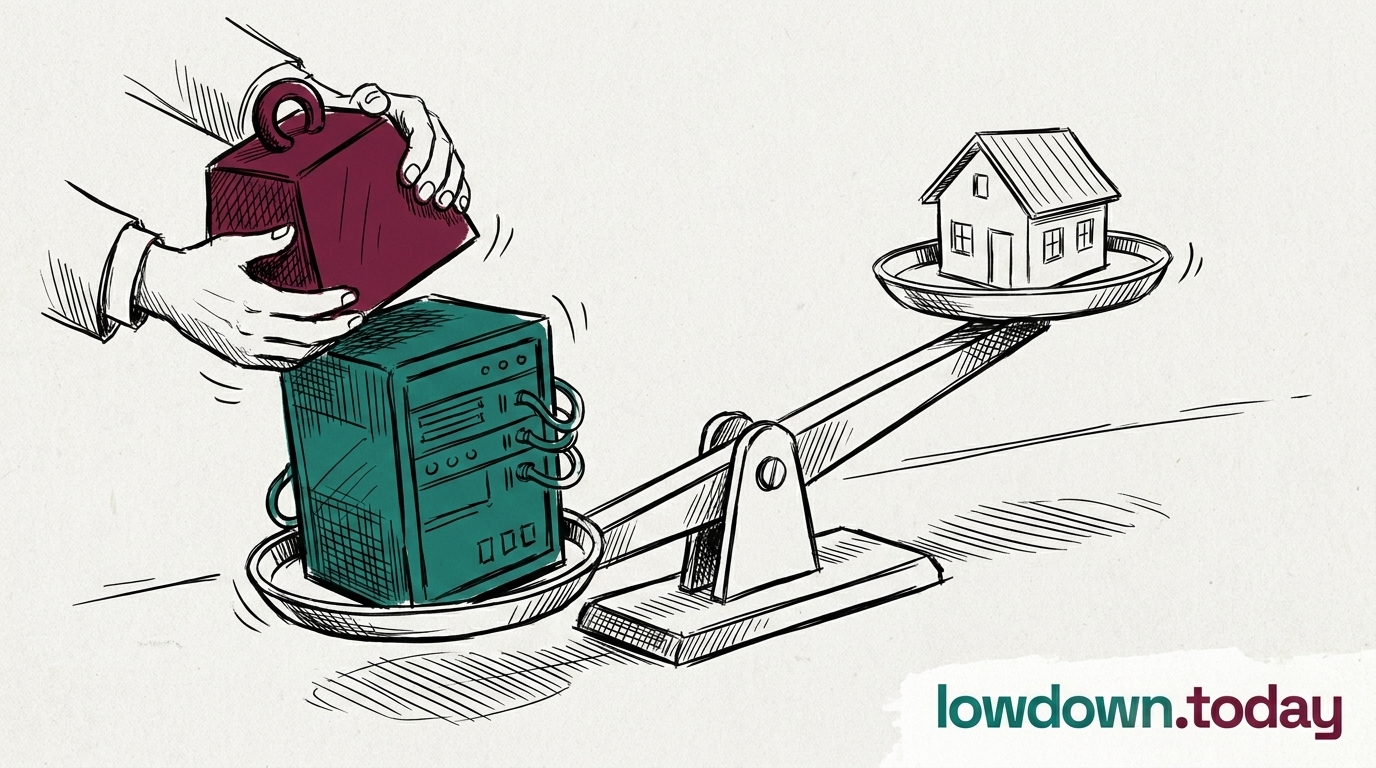
Virginia's Senate Finance Committee proposed a tiered fee of $35 to $45 per kilowatt on the diesel backup generators inside data centres around 16 June, the first US levy designed to tax installed fallback capacity rather than the electricity a campus draws 1. Finance chair L. Louise Lucas floated it as a compromise: operators keep the $1.9bn sales-tax exemption but pay a per-kilowatt charge on backup generation, projected to raise $582m in FY2027 and $1.2bn in FY2028. The committee has not voted the fee through, and the 22 June Senate session could let it lapse.

The charge falls on installed capacity a campus may never run. This is the behind-the-meter (BTM, on-site generation sited next to the load rather than drawn through the public grid) gas fleet the Department of Energy has switched off twice in 2026 under Section 202(c), the Federal Power Act's emergency-curtailment authority . Federal power can cut that gas off in a heat event; it cannot price it. A per-kilowatt fee reaches the part of the build that consumption billing never sees, because a generator sitting idle draws nothing to meter.

The 30 June fiscal deadline is forcing the pace. The House of Delegates cancelled its 18 June budget session, with Speaker Don Scott saying no agreement had been reached, and Governor Abigail Spanberger sided with the House the same day against any early end to the exemption. Virginia has already lost projects to this fight before any fee existed: Compass Datacenters abandoned two site searches over tax uncertainty , and Danville approved the Berry Hill campus only on condition that the exemption survives . The fee is a wager that a new revenue line can hold the budget together where ending the exemption outright cannot.

Deep Analysis

In plain English

Virginia gives data centres a big tax break; they pay no sales tax on equipment worth about $1.9 billion a year to the industry. The state legislature has been arguing about whether to cancel that break since early 2026, and the argument has blocked the whole state budget. The Senate's new idea is a middle path: keep the tax break, but charge data centres a fee on the diesel backup generators they use when the electricity grid fails. The fee would be $35 to $45 for every kilowatt of backup capacity installed. A large data centre might have hundreds of megawatts of backup power, so the annual bill could run into the tens of millions of dollars. The House of Representatives side of the legislature cancelled its budget meeting the same day, and the governor said she is against the idea. If no deal is reached by 30 June, some Virginia government services could be temporarily shut down: a rare event called a partial government shutdown.

Deep Analysis
Root Causes

Virginia's fiscal impasse rests on three structural conditions. First, the original 2000-era tax exemption was written with no sunset clause and no per-site revenue or employment threshold, meaning the state has never had a legal mechanism to recover costs as data-centre power density increased beyond the assumptions of the original legislation.

Second, the separation of powers between the Senate and House is unusually evenly balanced on this issue: the Senate Finance Committee controls revenue instruments while the House of Delegates controls budget appropriations, and neither chamber can move the budget without the other.

The Berry Hill conditional approval and Compass site abandonment show that the external industry response is already embedded in the political calculus, with operators treating the state-level standoff as a site-selection risk.

Third, the DOE's Section 202(c) curtailment orders targeting behind-the-meter backup gas make the generator fleet simultaneously a federal regulatory target and the chosen base for Virginia's new fiscal instrument, creating a structural tension between what the state wants to tax and what the federal government wants to switch off.

What could happen next?
  • Risk

    If enacted, the $35-$45/kW fee creates a template other states can adopt without touching the headline exemption, spreading capacity-fee instruments beyond Virginia.

    Short term · Suggested
  • Risk

    The 30 June budget deadline raises the prospect of Virginia's first partial government shutdown, which could accelerate or collapse the generator-fee proposal unpredictably.

    Immediate · Assessed
  • Consequence

    Operators sizing new Virginia campuses will need to model the generator-fee liability as a fixed annual cost, shifting break-even assumptions on large campuses by up to $20 million per year per 500 MW of backup capacity.

    Short term · Suggested
First Reported In

Update #7 · Virginia taxes the backup, not the draw

Bloomberg Tax· 17 Jun 2026
Read original
Different Perspectives
Indian data-centre investors
Amazon, CPPIB and Google committed billions to Indian data-centre capacity within a single week in June, a market absorbing hyperscale investment while New Mexico and Maryland tighten permitting this fortnight. Every US moratorium makes that alternative more attractive, not less.
Gulf sovereign capital and hyperscale infrastructure investors
GE Vernova's turbine backlog grew to 116 GW and Synergy counted a 45 GW US pipeline the same week New Mexico killed a pipeline outright. Capital keeps moving toward campuses that can secure power fastest, in the Gulf as much as Texas or Virginia.
New Mexico and Virginia regulators, and the counties opposing the build-out
Garcia Richard killed Energy Transfer's Green Chili lateral for a second time on 15 July, and Sierra, Santa Fe and Socorro counties layered moratoria on top; Virginia's DEQ, lacking a PFAS rule, issued Amazon's Lake Anna permit regardless. Consent belongs in statute, and New Mexico's 2027 bill is the next test of whether that principle spreads.
Global hyperscale operators
Operators are still filing gigawatt-scale campuses and Meta is proceeding with its $10bn Lebanon, Indiana site despite the county-level bans nearby, betting Q2 capex outruns the patchwork of restrictions. Industry framing casts New York's freeze, Oregon's surcharge and Indiana's bans as taxes and levies that push build-out toward faster-permitting jurisdictions such as India and the Gulf.
EirGrid
EirGrid
EirGrid set a 900 MW instantaneous demand-loss ceiling because a single voltage dip can trip many data centres onto backup power at once, risking imbalance above 1,150 MW. It wrote the limit into a standing procedure rather than waiting for an emergency to force one.
US host communities and ratepayers
Prince William residents backed the 8-0 denial of Dulles South over the Occoquan watershed, drinking water for eight million people, while Oregon's approved tariff cuts residential bills 1.3% by charging large loads 29% more. Their position: consent and cost-attribution belong in law, not left to a developer's or a utility's discretion.

