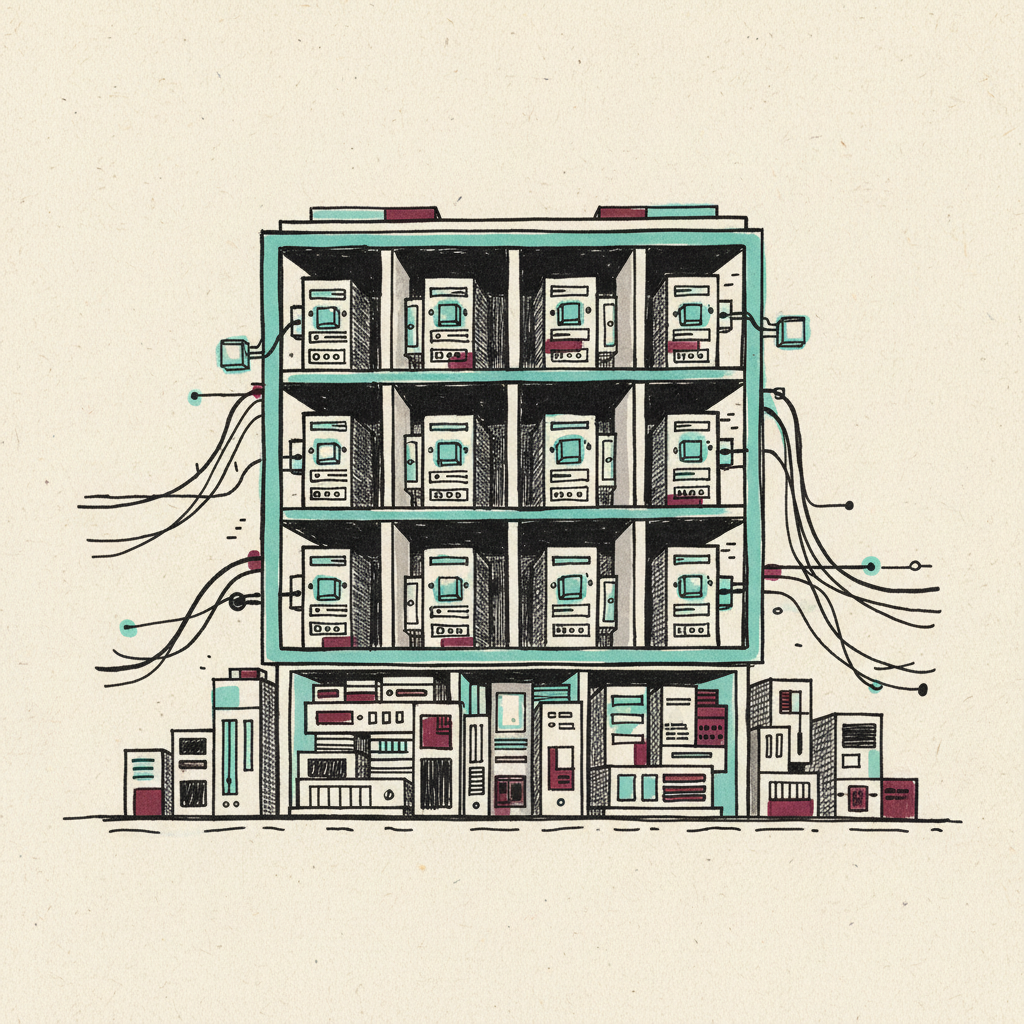
Colocation
colocation: a data centre model where the facility owner provides space, power, and cooling to multiple customers WHO own their own servers.
Last refreshed: 28 June 2026 · Appears in 1 active topic
Can colocation providers keep pace with hyperscalers as AI demand strains both grid access and capital?
Timeline for colocation
Mentioned in: OpenAI pauses Cobalt Park Stargate site
Data Centres: Boom and BacklashMentioned in: Pure DC's 110 MW Dublin microgrid skips queue
Data Centres: Boom and BacklashBackground
colocation (colo) is the data centre operating model in which a facility owner leases physical space, power, and network connectivity to multiple tenant customers WHO install their own servers and networking equipment. The largest colocation operators, including Equinix, Digital Realty, and NTT, collectively operate hundreds of facilities globally, providing shared physical infrastructure to thousands of enterprise, cloud, and carrier customers.
colocation sits alongside hyperscale as a distinct segment in the data centre market. While hyperscalers build purpose-built owner-operated campuses, colocation serves smaller enterprises and cloud providers that cannot justify owning a facility. The AI infrastructure boom is reaching colocation through GPU-as-a-service demand: operators including CoreWeave and Lambda Labs lease colocation capacity to run GPU clusters for AI training customers.
Grid-connection constraints affect colocation operators differently from hyperscalers. A colo provider cannot easily shift to behind-the-meter gas generation because it must serve multiple tenants with potentially different power requirements and sustainability commitments. This makes the grid queue problem particularly acute for colocation expansion in constrained markets such as Dublin, London, and Northern Virginia.