Skip to content
Briefings are running a touch slower this week while we rebuild the foundations.See roadmap
Data Centres: Boom and Backlash
10JUN

Oregon bills data centres, not homes

3 min read
10:06UTC

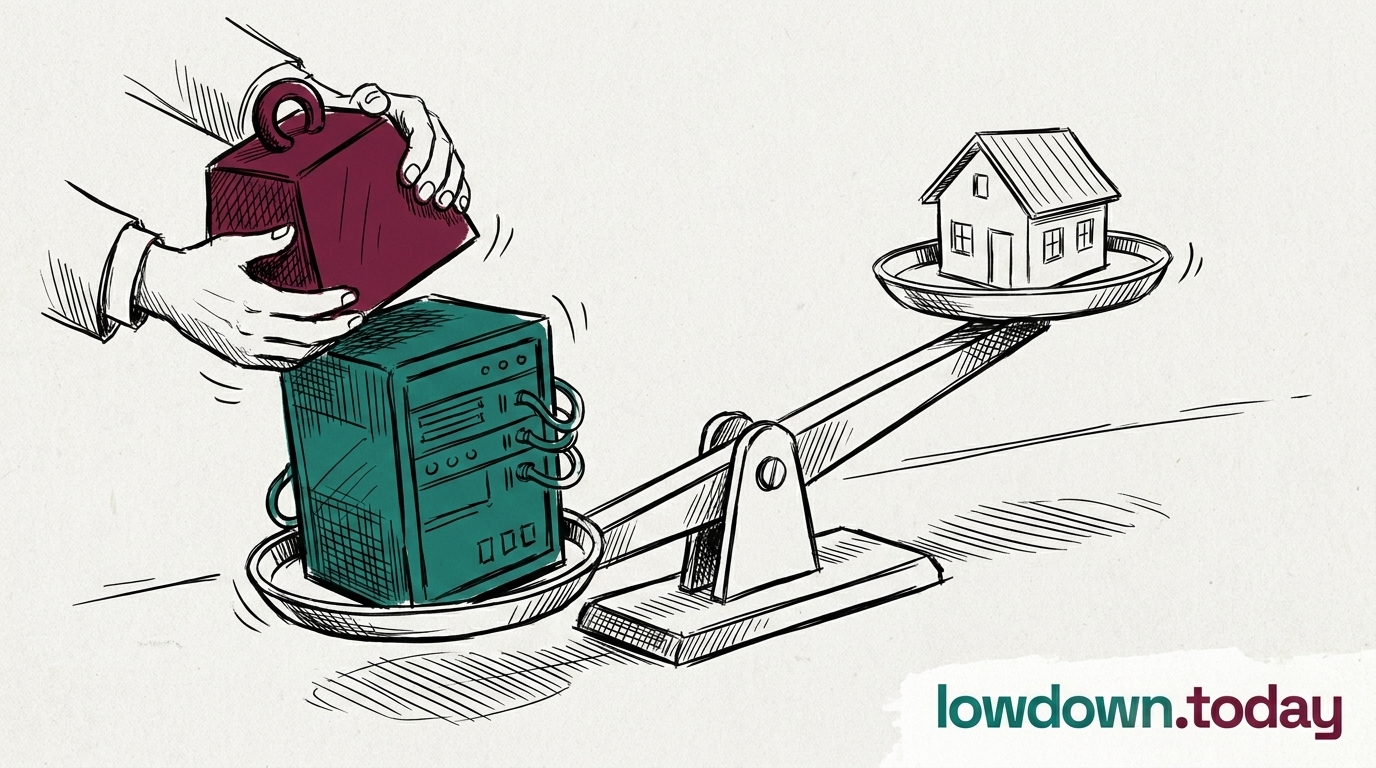
Portland General Electric filed a 29% rate rise for data centres on 4 June and cut household bills 1.3%, the first US regulator to move grid costs onto operators. Hill County dropped its Texas moratorium under a $100m lawsuit the same week. And SoftBank chose France, not Britain, for the boom's largest European bet.

Key takeaway

For the first time, the cost of hosting compute is landing on operators, not households or courts.

This briefing mapped
Loading map…
Regulatory
Legal
Economic

Portland General Electric filed a 29% data-centre rate rise on Thursday 4 June and cut household bills 1.3%, the first US utility to make campuses absorb the grid costs they impose.

Sources profile:This story draws on neutral-leaning sources

Portland General Electric filed a 29% electricity rate rise for large data-centre sites in Oregon on 4 June 2026, under a new state law called the POWER Act. Homes and small businesses will see bills fall by 1.3% as a result.

Oregon is the first US state to turn cost-attribution law into an actual utility tariff, directly answering the question PJM board chair Paula Conboy put to 13 governors : who pays when the grid bends for AI. 

Sources:OPB
1 OPB

Hill County, Texas rescinded its data-centre moratorium on Thursday 4 June, seven days after developer RCM Hill sued it for $100 million. The suit is still live.

Sources profile:This story draws on neutral-leaning sources

Hill County, Texas rescinded its data-centre moratorium on 4 June 2026, exactly seven days after developer RCM Hill filed a $100 million federal lawsuit claiming the freeze on its 1,235 MW Project Aquila campus was an unconstitutional taking of its property rights .

The county folded before any court hearing. RCM Hill's damages claim for the freeze period is still active, making this the first case in the current US moratorium wave where a developer has used the Fifth Amendment to reverse a local ban pre-adjudication. 

SoftBank committed up to EUR 75 billion to build 5 GW of data centres in France on Saturday 30 May, routing the boom's largest European bet at EDF nuclear baseload to skip the grid queue.

Sources profile:This story draws on neutral-leaning sources

SoftBank committed up to EUR 75 billion to build 5 gigawatts of data-centre capacity across three sites in northern France, announced at the Choose France summit on 30 May 2026. Phase 1 targets 3.1 GW by 2031, with EDF providing nuclear power directly at Bouchain via a repurposed old power station.

The investment went to France rather than Britain because UK electricity is more than four times US rates and the Cobalt Park pause showed UK grid conditions can stop a project mid-build . France's nuclear baseload bypasses the connection queue entirely. 

Virginia regulators heard objections on Tuesday 9 June to Amazon discharging 280,000 gallons a day of cooling water into a Lake Anna tributary, with no PFAS testing in the draft permit.

Sources profile:This story draws on neutral-leaning sources

Virginia's environmental agency held a public hearing on 9 June 2026 on Amazon's application to discharge 280,000 gallons of cooling water per day into Sedges Creek, which feeds Lake Anna . The hearing drew objections but produced no permit decision.

The draft permit contains no PFAS testing requirement. The absence reflects a federal regulatory gap: EPA's 2024 PFAS drinking-water rules do not extend to industrial discharge permits, leaving Virginia unable to impose PFAS conditions without a federal hook. 

Sources:WWBT NBC12

Energinet extended its pause on new large-load grid connections on Wednesday 27 May, showing that even one of Europe's cleanest, wind-rich grids cannot wire data centres fast enough.

Sources profile:This story draws on neutral-leaning sources

Energinet, Denmark's national grid operator, extended its freeze on new large-load data-centre connections on 27 May 2026. Its connection queue stands at 60 gigawatts against a national peak demand of 7 gigawatts, an 8.6 to 1 ratio.

The freeze shows that even the cleanest grid in Europe offers no relief when the physical transmission network cannot absorb the load, the same constraint that halted approvals in Johor despite available generation capacity

Sources:Energinet

Kenya suspended the $1bn Microsoft-G42 geothermal data centre at Olkaria, after President Ruto warned the full build would mean switching off half the country.

Sources profile:This story draws on neutral-leaning sources

Kenya's government suspended the $1 billion Microsoft-G42 geothermal data-centre project at Olkaria in May 2026 because its full 1 GW target would draw a third of the country's total installed power capacity of around 3 GW. President Ruto said building it would mean switching off half the country.

Africa's national grid sizes mean a single hyperscale campus can equal a meaningful fraction of the whole country's electricity supply, a constraint with no equivalent in Europe or North America and no straightforward engineering fix. 

PJM restructured its September reliability backstop to a bilateral-first model targeting roughly 9 GW, down from 14.9 GW, per a Jefferies estimate published around 19 May.

Sources profile:This story draws on neutral-leaning sources

PJM Interconnection revised its September backup power purchase from a 14.9 gigawatt competitive auction to a bilateral-first structure targeting roughly 9 gigawatts, according to a Jefferies estimate published around 19 May 2026.

The change is a direct downstream consequence of PJM's warning to 13 state governors that residential ratepayers could absorb grid costs if states do not create data-centre cost frameworks before September. Switching to bilateral deals reduces the cleared cost, but at the price of price transparency. 

Sources:Utility Dive

A formal objection was lodged against two Equinix data centres under construction in Cape Town over undisclosed water, power and environmental impact, extending the backlash to sub-Saharan Africa.

Sources profile:This story draws on neutral-leaning sources

A formal objection was filed against two Equinix data centres under development in Cape Town in early June 2026, citing undisclosed water consumption, power draw, and environmental impact.

Cape Town's 2018 Day Zero drought made water-use transparency a politically charged local issue, giving the objection more traction than comparable filings in European markets. Sub-Saharan Africa now joins the global grid-wall map alongside Johor and Denmark

Closing comments

Sideways with structural irreversibility. PGE's tariff and PJM's bilateral backstop are durable instruments that will either be copied by other states or challenged by developers in court; the Hill County precedent means blanket rural moratoriums are now economically rational to rescind before any hearing. The live decision point is FERC's RM26-4-000 co-location ruling, due by end of June 2026: FERC Commissioner Mark Christie (Republican appointee) dissented in May that bilateral-first procurement removes the price-discovery mechanism in competitive auctions; if FERC accepts Christie's position and rejects PJM's bilateral structure as non-discriminatory, PJM's September procurement collapses to the full 14.9 GW competitive auction and Paula Conboy's cost-transfer warning to 13 governors on 19 May becomes operative again.

Different Perspectives
US residential ratepayers and state regulators
Portland General Electric's 4 June tariff is the first evidence that PJM's cost-transfer warning to governors on 19 May can run in reverse: Oregon households get a 1.3% bill reduction as data centres absorb their grid costs. The 12 other states carrying active cost-attribution bills now have a filed tariff with actual numbers to cite.
SoftBank Group
SoftBank Group
SoftBank's EUR 75 billion France commitment on 30 May anchors at EDF's Bouchain nuclear baseload, bypassing the UK's four-times-US electricity cost premium (cited by OpenAI as reason to pause Cobalt Park) and Germany's grid-queue delays. EDF's supply relationship is bilateral; SoftBank never enters the French connection queue.
France and EDF
France and EDF
EDF's repurposing of the Bouchain former power-station site for SoftBank's Phase 1 campus gives France a replicable siting instrument, a brownfield nuclear connection bypass, that no other G7 grid operator can match. France's Choose France summit on 30 May secured the boom's largest European bet without a connection-queue fight or community moratorium.
Denmark and Energinet
Energinet's 27 May extension of its large-load connection pause, with a 60 GW queue against 7 GW peak demand, demolishes the assumption that surplus renewable generation is a relief valve for compute demand. Denmark has more wind than it can use and still cannot connect data centres, because transmission pace is the binding constraint.
Kenya and President Ruto
Kenya's suspension of the $1 billion Microsoft-G42 Olkaria project in early May applies raw-capacity logic at national scale: President Ruto stated the full 1 GW build would mean switching off half the country against a 3 GW installed base. A single hyperscale campus can consume a third of a Sub-Saharan grid with no equivalent constraint in Europe.
Data-centre developers and hyperscale operators
Hill County's rescission on 4 June, seven days after RCM Hill filed a $100 million taking suit, shows the Fifth Amendment threat is faster than any appellate route: the damages clock runs from the day the moratorium passed. Rural counties with no large-load permitting framework face a litigation bill that can exceed their entire annual budget.


