Skip to content
You can now search across every topic, entity and event.What's new
Autonomous Systems: Land & Sea
12AUG

Ukraine robot maker doubles its output

2 min read
14:17UTC

Trinity Robotics doubled its 2026 plan for the Konyk One supply-and-casevac ground robot to about 2,200 units and opened joint-venture talks with a French manufacturer, co-founder Oleksii Konik said.

TechnologyDeveloping
Key takeaway

Ukrainian UGV capacity is starting to relocate into the European Union, competitor and supplier at once.

Trinity Robotics doubled its 2026 production plan for the Konyk One logistics and casualty-evacuation UGV (uncrewed ground vehicle) from about 1,100 to about 2,200 units, co-founder Oleksii Konik said on 9 July 1. The Konyk One weighs 460kg and carries a 300kg payload.

Trinity Robotics is a Ukrainian maker of uncrewed ground vehicles, robots that haul supplies to the front and carry wounded soldiers back. A single firm doubling its own target is a harder datapoint than the top-line Ukrainian figure of 50,000 robots for 2026 already on the record : committed tooling and workforce sit behind the firm's number, where the national 50,000 reflects ambition.

Trinity is in talks with an unnamed French producer for a joint venture to build abroad under the Build with Ukraine programme, the first concrete sign of Ukrainian UGV manufacturing migrating to a NATO-Europe production node 2. Recent backers include Sweden's Front Ventures and Hede Capital Partners. European primes selling logistics UGVs into Ukraine must now price in a home-grown competitor that has fought its product to maturity and wants to build inside the European Union.

Deep Analysis

In plain English

Trinity Robotics is a Ukrainian company that makes the Konyk One, a 460kg uncrewed ground vehicle (UGV), a robot on tracks or wheels used to carry supplies to the front line or evacuate wounded soldiers without risking a driver. The company said it is doubling how many it plans to build in 2026, from about 1,100 to 2,200. Trinity is also talking to a French company about building the Konyk One together outside Ukraine. This matters because it is one of the clearest signs yet of Ukrainian battlefield-tested robot designs moving their factories into the European Union, rather than staying only inside Ukraine's war zone.

Deep Analysis
Root Causes

Ukrainian UGV factories sit inside a live-fire war zone, which caps how much production capacity can safely concentrate in-country regardless of demand.

Cross-border joint ventures under Build with Ukraine let a firm like Trinity access EU manufacturing capacity and, eventually, EU defence-industrial funding routes a purely domestic Ukrainian producer cannot reach, which is the structural reason 'doubling production' increasingly means opening a second country's factory rather than a second Ukrainian one.

What could happen next?
  • Precedent

    The first concrete sign of a Ukrainian UGV manufacturer moving production into an EU country rather than staying domestic, via a French joint venture under Build with Ukraine.

    Short term · Assessed
  • Risk

    Trinity's doubled output figure is self-reported and not yet checkable against delivered units or signed government contracts, unlike Ukraine's own DPA contract data.

    Immediate · Assessed
  • Opportunity

    Front Ventures' and Hede Capital Partners' recent backing gives Trinity capital to fund the French venture without waiting on a single government order.

    Medium term · Suggested
First Reported In

Update #6 · UK airdrops a robot boat; Gulf order stalls

The Telegraph· 11 Jul 2026
Read original
Different Perspectives
Conservative opposition
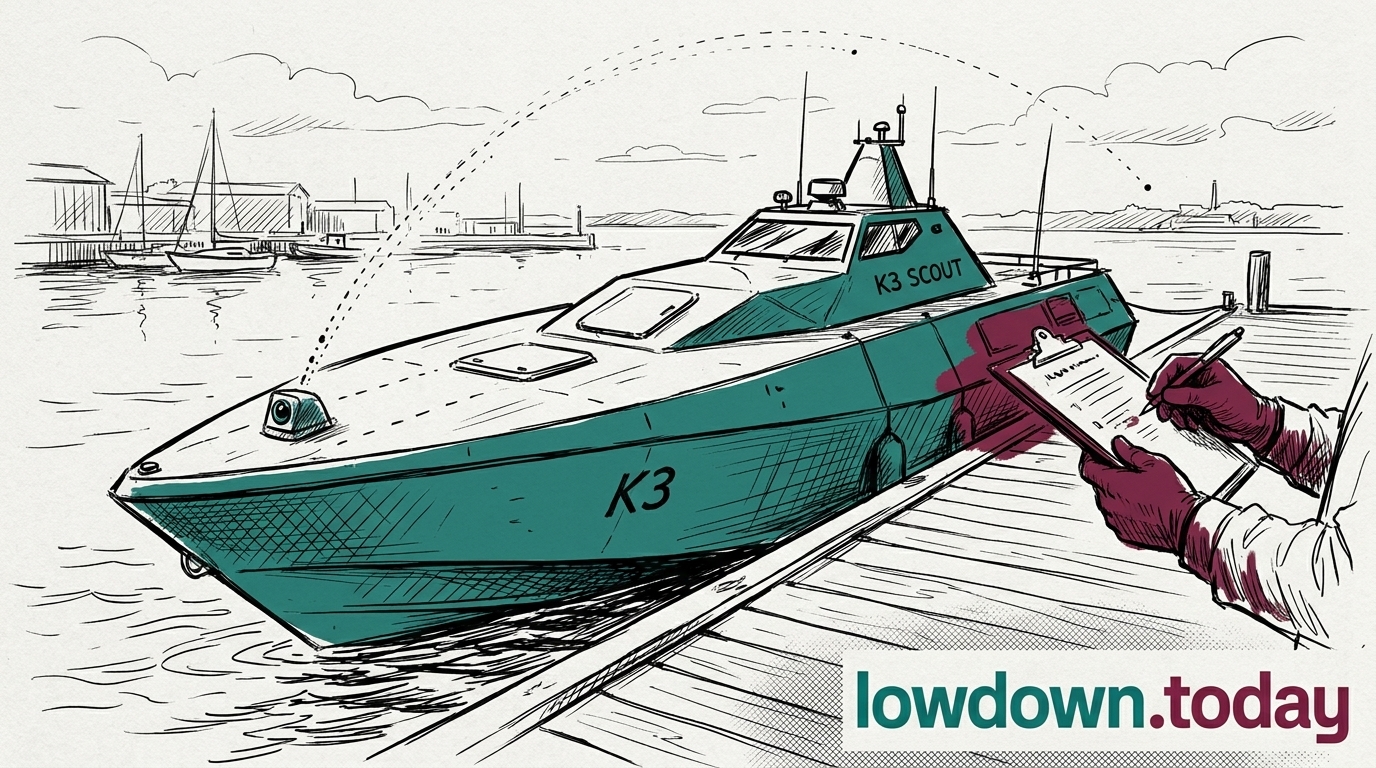
The Conservative opposition called on the Government on 9 August to 'urgently audit' equipment for hidden Chinese components, after the Telegraph's K3 SCOUT report. No named MP has been quoted on the record; the call came at party level, alongside the Ministry of Defence's own 10 August statement that no data had been compromised.
Netherlands Ministry of Defence
The Netherlands Ministry of Defence authorised Dutch Naval Design on 4 August to design 12-metre anti-submarine warfare uncrewed vessels for the Dutch-Belgian frigate programme, and to buy an adapted Compact FLASH dipping sonar from Thales Underwater Systems France. The order commits money and a named supplier while Britain's own certification body remains at the market-engagement stage.
Kraken Technology Group
Kraken Technology Group is a UK maritime-defence company based in Portsmouth that builds the K3 SCOUT, and crossed a $1bn valuation in July on a single-sourced $175m raise. The camera components reached the fleet under a third party's written security assurance, which the Platform Authority, which does not yet exist, was never positioned to check.
Navy Commercial
Navy Commercial
Navy Commercial at Whale Island published two notices on 5 August: 074032-2026, asking industry how to build a Platform Authority to certify uncrewed vessels, and 074351-2026, a GBP10m multi-role USV testbed for the Defence Chief Technology Officer. Responses on the Platform Authority close 19 August, ten days after the cameras were found transmitting to China.
Ministry of Defence
Ministry of Defence
The Ministry of Defence said on 10 August that a routine cyber vulnerability assessment found the camera fault, and a thorough investigation found no evidence that MoD data or systems had been accessed, compromised or transmitted externally. It stripped the cameras of internet connectivity but did not say whether it acted against the supplier.
Thales
Thales
Thales converted its 6 July engaging accord with Exail into a definitive combination agreement on 30-31 July, but the tender offer for Exail's remaining shares now closes by early 2028, later than July's timetable implied. Thales integrates its new undersea prime while still bidding against Kongsberg and DRASS's 2027 target for the AUKUS Pillar II contest.
