Skip to content
You can now search across every topic, entity and event.What's new
Autonomous Systems: Land & Sea
12AUG

Ukraine's order book sets the pace

3 min read
14:17UTC

Ukraine has set a target of 50,000 ground-robot contracts for 2026, with first-half procurement already near 25,000, roughly twice the whole of last year and the volume European armies are now building to match.

TechnologyDeveloping
Key takeaway

Ukraine is buying ground robots by the tens of thousands, and European industry is building the catalogue to match.

Ukraine has set a target of 50,000 uncrewed ground vehicle (UGV) contracts for 2026, with first-half procurement already near 25,000 1. That first-half figure alone is roughly twice Ukraine's entire 2025 volume, and it advances the 25,000 number tied to its accelerating buying earlier this year . The point here is the order book, not the front line: Ukraine has become the world's largest UGV buyer, and its purchasing sets the capability and volume benchmark European manufacturers calibrate to.

The robots themselves have moved well past resupply and demining. Ukrainian ground platforms now carry electronic-warfare suites, radar, mortars and missiles, and in the most contested sectors UGVs handle up to 90% of frontline logistics 2, a single-source figure worth treating as indicative rather than audited. The capabilities European armies inspected on the Eurosatory stands, mine-breaching, weaponised carriers, casualty retrieval, are the ones Ukraine is buying by the tens of thousands.

That sequence is the leading indicator. A buyer ordering at this cadence specifies a roadmap through volume rather than through doctrine, and the European primes are building to meet a demand curve that a procurement white paper would take years to describe. Where the battlefield buys in bulk, the catalogue follows.

Deep Analysis

In plain English

Ukraine has set a target of buying 50,000 unmanned ground vehicles in 2026 alone. By the middle of the year, it had already contracted around 25,000, roughly twice the total it bought in all of 2025. These ground robots do jobs that are too dangerous for soldiers: carrying ammunition and supplies to the front line under enemy fire, detecting enemy movements, and in some cases firing weapons. In the most heavily contested parts of the front, robots now handle up to 90% of all supply runs to forward positions. This matters for the rest of Europe because European defence companies are watching what Ukraine buys and adapting their products to match it. Ukraine is effectively running the world's largest live test of military ground robots, and the results are shaping what Britain, Germany, France, and other countries plan to procure.

Deep Analysis
Root Causes

Ukraine's procurement velocity has two structural underpinnings.

First, the wartime legal and operational framework suspends normal procurement qualification requirements: a UGV that demonstrates field utility in a combat sector can receive a production order without the 18-36 month qualification cycle a NATO peace-time procurement demands. Ukrainian operators iterate directly with manufacturers, generating product requirements in weeks rather than years.

Second, UGVs removing human operators from the most lethal logistics runs creates a direct force-preservation incentive that has no peacetime equivalent. In sectors where UGVs handle up to 90% of frontline logistics, the calculation is concrete: a destroyed UGV costs EUR20,000-200,000 and takes weeks to replace; a killed soldier cannot be replaced at all.

This asymmetry drives command-level prioritisation that European MoD procurement processes, which do not face the same immediate calculus, structurally cannot replicate.

What could happen next?
  • Consequence

    Ukraine's 25,000 first-half deliveries validate that European industry can produce at scale when a buyer commits; the question for European MoDs is whether national procurement offices can absorb lessons from battlefield iteration faster than their standard qualification cycles allow.

  • Risk

    If European armies build procurement plans to match Ukraine's 50,000-unit figure without distinguishing certified platforms from improvised adaptations, they risk locking capability requirements to a heterogeneous battlefield count rather than a coherent doctrine.

First Reported In

Update #4 · Allied robot minehunters reach the Gulf

United24 Media· 24 Jun 2026
Read original
Different Perspectives
Conservative opposition
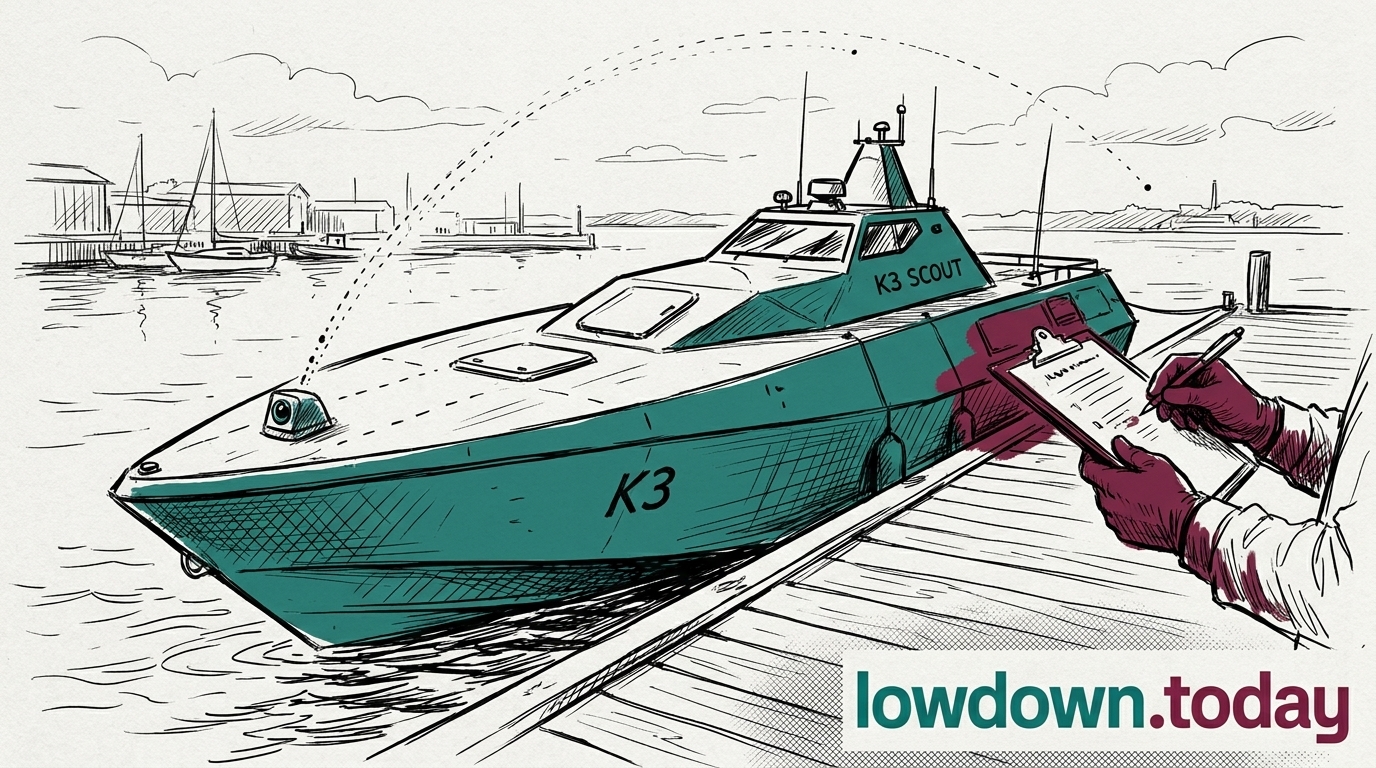
The Conservative opposition called on the Government on 9 August to 'urgently audit' equipment for hidden Chinese components, after the Telegraph's K3 SCOUT report. No named MP has been quoted on the record; the call came at party level, alongside the Ministry of Defence's own 10 August statement that no data had been compromised.
Netherlands Ministry of Defence
The Netherlands Ministry of Defence authorised Dutch Naval Design on 4 August to design 12-metre anti-submarine warfare uncrewed vessels for the Dutch-Belgian frigate programme, and to buy an adapted Compact FLASH dipping sonar from Thales Underwater Systems France. The order commits money and a named supplier while Britain's own certification body remains at the market-engagement stage.
Kraken Technology Group
Kraken Technology Group is a UK maritime-defence company based in Portsmouth that builds the K3 SCOUT, and crossed a $1bn valuation in July on a single-sourced $175m raise. The camera components reached the fleet under a third party's written security assurance, which the Platform Authority, which does not yet exist, was never positioned to check.
Navy Commercial
Navy Commercial
Navy Commercial at Whale Island published two notices on 5 August: 074032-2026, asking industry how to build a Platform Authority to certify uncrewed vessels, and 074351-2026, a GBP10m multi-role USV testbed for the Defence Chief Technology Officer. Responses on the Platform Authority close 19 August, ten days after the cameras were found transmitting to China.
Ministry of Defence
Ministry of Defence
The Ministry of Defence said on 10 August that a routine cyber vulnerability assessment found the camera fault, and a thorough investigation found no evidence that MoD data or systems had been accessed, compromised or transmitted externally. It stripped the cameras of internet connectivity but did not say whether it acted against the supplier.
Thales
Thales
Thales converted its 6 July engaging accord with Exail into a definitive combination agreement on 30-31 July, but the tender offer for Exail's remaining shares now closes by early 2028, later than July's timetable implied. Thales integrates its new undersea prime while still bidding against Kongsberg and DRASS's 2027 target for the AUKUS Pillar II contest.
