Skip to content
You can now search across every topic, entity and event.What's new
Autonomous Systems: Land & Sea
12AUG

Pentagon DAWG line jumps to $54.6bn

4 min read
14:17UTC

Pentagon Comptroller Jules Hurst III released the FY2027 request on 21 April, lifting the Defense Autonomous Warfare Group line from $225.9 million to $54.6 billion in a single cycle.

TechnologyDeveloping
Key takeaway

DAWG centralises $54.6 billion in autonomous-systems funding and reorders DoD's procurement hierarchy in a single budget cycle.

Pentagon Comptroller Jules Hurst III released the FY2027 Department of Defense budget request on Tuesday 21 April, lifting the Defense Autonomous Warfare Group (DAWG) line from $225.9 million in FY2026 to $54.6 billion in FY2027, a 24,100% single-cycle increase 1. The total drone and counter-drone request reaches $70 billion, against a combined FY2026 baseline of roughly $16.5 billion. DAWG is a new umbrella programme office created to centralise autonomous-systems procurement that has, until now, been distributed across Army PEO Aviation, Navy NAVAIR and Air Force programme executive offices. Two further umbrella programmes appear in the budget for the first time: Pegasus Charge and Ironhorse Rebirth, both unspecified at the line-item level.

The DAWG number sits in the same magnitude band as the major Navy shipbuilding and Air Force aircraft procurement lines, both of which historically run in the $30 to $35 billion range. The 24,100% jump dwarfs the $10 billion Golden Dome top-up Lowdown flagged in March and re-bases the funding pool from which the 50,000-drone Gauntlet II target will now be paid for. The closest historical parallel for a single-cycle increase of this magnitude is the FY1986 Strategic Defense Initiative line, which scaled from low millions to roughly $3.7 billion across three cycles, not one.

Congress has not appropriated the request. The House Armed Services Committee (HASC) and Senate Armed Services Committee (SASC) will mark up DAWG through May to July 2026, and the historical base rate for full presidential budget requests reaching enacted appropriations at the requested dollar level sits below 60%. A 50% haircut still leaves $27 billion, twelve thousand percent above the FY2026 line. Sub-base-rate cuts cannot return DAWG to the FY2026 baseline without a coordinated SASC-HASC override that has no precedent on autonomous-systems lines.

The pressure that produced this number sits in two places. Gulf attrition data since 28 February 2026, with the UAE absorbing 55% of strikes , broke the previous Pentagon production assumption that loitering-munition stocks measured in 'dozens' could meet near-term demand. CSIS's finding that Russia's drone industry runs on US chips added the second pressure: tightening exports without a domestic substitute would idle US production lines at the moment they need to scale. DAWG centralises the disbursement mechanism that previously sat across Army PEO Aviation, Navy NAVAIR, and Air Force programme offices, all of which underperformed against the 300,000-drone Phase II target through 2025.

Deep Analysis

In plain English

The US Pentagon asked Congress for $54.6 billion to build drones and drone-stopping systems in 2027. That is more than the UK spends on its entire military in a year. The previous year's equivalent request was $225.9 million, so this is a 241-times increase in a single go. Congress still has to agree the money, and it usually cuts presidential requests. But even if it cuts this one in half, the drone-spending account would still be 120 times bigger than last year. The Pentagon also created a new office called DAWG to manage all of this in one place, rather than spreading decisions across multiple competing departments.

Deep Analysis
Root Causes

Two structural pressures produced the DAWG number. First, Gulf attrition data since 28 February 2026 showed that loitering-munition stockpiles measured in dozens were inadequate against a threat that struck the UAE at scale over three weeks. The distributed programme-office structure had no mechanism to coordinate cross-service production scaling because each service's budget line was its own procurement island.

Second, CSIS's finding that Russian drone production runs on Western chips identified a supply-chain vulnerability that the fragmented programme-office architecture could not address collectively. Each service PEO had a different answer for chip dependency; none held authority over the others. DAWG provides a single disbursement authority with the mandate to coordinate supply-chain policy across all service lines simultaneously; the institutional structure the distributed model lacked.

What could happen next?
  • Consequence

    HASC and SASC markup in May to July 2026 will produce the first defensible DAWG ceiling. A 50% cut still leaves autonomous-systems the dominant DoD procurement category; a 75% cut would require coordinated SASC-HASC override with no modern precedent on autonomous-systems lines.

    Short term · 0.82
  • Risk

    Pegasus Charge and Ironhorse Rebirth, both appearing without technical specifications or named contractors, carry high execution risk. Programmes that reach Congress without named contractors typically attract appropriations scrutiny and multi-year delays.

    Medium term · 0.71
  • Opportunity

    If DAWG adopts OTA pools as its primary contract vehicle, software and autonomy vendors operating below FAR competition thresholds gain disproportionate access to an account previously gated by prime-contractor relationships.

    Medium term · 0.75
  • Precedent

    DAWG establishes centralised autonomous-systems procurement as the DoD default architecture. Allied procurement offices; UK DSTL, Australian ASCA, French DGA; will read the centralisation model as pressure to consolidate their own fragmented counter-UAS programme offices.

    Long term · 0.68
First Reported In

Update #7 · DAWG jumps 24,000% as Anduril sweeps board

DefenseScoop· 30 Apr 2026
Read original
Different Perspectives
Conservative opposition
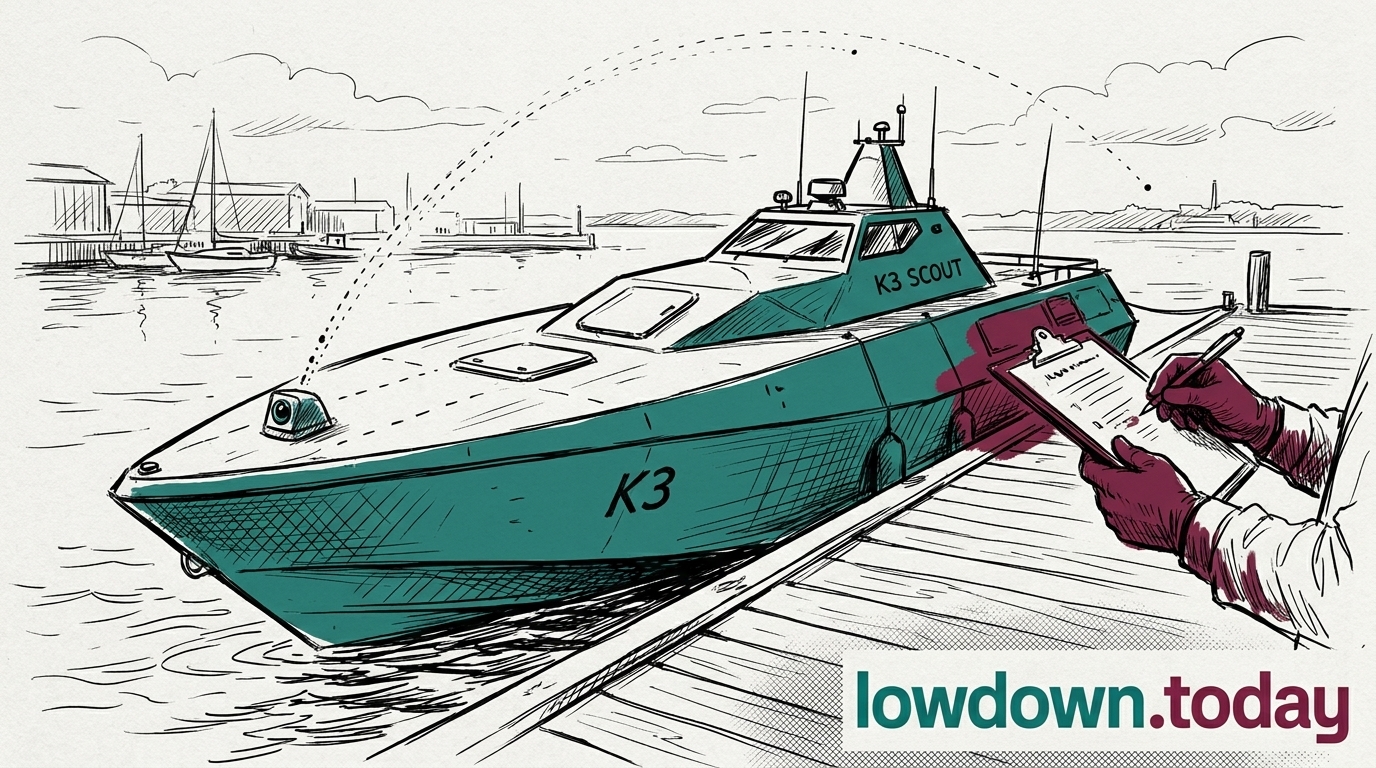
The Conservative opposition called on the Government on 9 August to 'urgently audit' equipment for hidden Chinese components, after the Telegraph's K3 SCOUT report. No named MP has been quoted on the record; the call came at party level, alongside the Ministry of Defence's own 10 August statement that no data had been compromised.
Netherlands Ministry of Defence
The Netherlands Ministry of Defence authorised Dutch Naval Design on 4 August to design 12-metre anti-submarine warfare uncrewed vessels for the Dutch-Belgian frigate programme, and to buy an adapted Compact FLASH dipping sonar from Thales Underwater Systems France. The order commits money and a named supplier while Britain's own certification body remains at the market-engagement stage.
Kraken Technology Group
Kraken Technology Group is a UK maritime-defence company based in Portsmouth that builds the K3 SCOUT, and crossed a $1bn valuation in July on a single-sourced $175m raise. The camera components reached the fleet under a third party's written security assurance, which the Platform Authority, which does not yet exist, was never positioned to check.
Navy Commercial
Navy Commercial
Navy Commercial at Whale Island published two notices on 5 August: 074032-2026, asking industry how to build a Platform Authority to certify uncrewed vessels, and 074351-2026, a GBP10m multi-role USV testbed for the Defence Chief Technology Officer. Responses on the Platform Authority close 19 August, ten days after the cameras were found transmitting to China.
Ministry of Defence
Ministry of Defence
The Ministry of Defence said on 10 August that a routine cyber vulnerability assessment found the camera fault, and a thorough investigation found no evidence that MoD data or systems had been accessed, compromised or transmitted externally. It stripped the cameras of internet connectivity but did not say whether it acted against the supplier.
Thales
Thales
Thales converted its 6 July engaging accord with Exail into a definitive combination agreement on 30-31 July, but the tender offer for Exail's remaining shares now closes by early 2028, later than July's timetable implied. Thales integrates its new undersea prime while still bidding against Kongsberg and DRASS's 2027 target for the AUKUS Pillar II contest.
