Skip to content
You can now search across every topic, entity and event.What's new
Autonomous Systems: Land & Sea
12AUG

Kratos beats Q1, raises guidance, stock falls 5.3%

3 min read
14:17UTC

Kratos Defense reported Q1 2026 revenue of $371 million on Wednesday 6 May, beating analyst estimates of $344.6 million, with EPS of $0.16 against $0.13 expected. Kratos Unmanned Systems revenue rose to $82.6 million, up 30.9% organically, on XQ-58 Valkyrie activity.

TechnologyDeveloping
Key takeaway

Kratos beat consensus but the Valkyrie cadence makes a CCA down-selection visible inside the production line.

Kratos Defense reported Q1 2026 revenue of $371 million on Wednesday 6 May, beating analyst estimates of $344.6 million, with earnings per share (EPS) of $0.16 against $0.13 expected 1. Kratos Unmanned Systems (KUS) revenue rose to $82.6 million, up 30.9% organically, driven by XQ-58 Valkyrie activity. Management raised FY2026 guidance to $1.7-1.76 billion, 15-19% organic growth. The stock fell 5.3% after the release. Q1 revenue beat consensus by $26 million; the year-on-year slope is the figure defence-tech analysts will price into FY2027 multiples.

Kratos opened production on a second lot of twelve XQ-58A Valkyrie aircraft in early 2026, according to the Q1 transcript. Kratos is targeting approximately 40 Valkyries per year by end-2027 2, a correction to earlier media shorthand suggesting early 2028. Anduril's Arsenal-1 line, which received Roadrunner production hiring on 22 April , is rated at 150 Fury aircraft per year already, a 3.75x cadence gap on competing Collaborative Combat Aircraft (CCA) platforms. Kratos backlog stands at $2.010 billion as of 29 March, with a Q1 Kratos Government Solutions (KGS) book-to-bill of 1.8 to 1 lifted by a $447 million Space Force prime contract.

Kratos is hedging through hypersonics ($400 million expected in 2026, $700 million in 2027) and a directed-energy weapon prime award expected to ramp from 2027. Anduril has shipped four platforms onto the Arsenal-1 line and signalled fundraising at $60 billion-plus, the inverse strategy of holding diversification hedges in reserve. The market sell-off on a Q1 beat suggests analysts are pricing a worry that Kratos's drone mix is growing slower than the autonomous-systems budget would imply, with Valkyrie revenue at roughly $20 million inside the $82.6 million KUS quarter.

The DAWG $54.6 billion request is large enough to fund both companies at present. FY2028 down-selection pressure is now visible inside the production cadence, not the income statement.

Deep Analysis

In plain English

Kratos builds military drones, including the XQ-58 Valkyrie: a jet-powered unmanned aircraft designed to fly alongside crewed fighters as an autonomous wingman. It reported solid financial results this week, but its stock fell because investors noticed a specific problem. Kratos plans to build 40 Valkyries per year by the end of 2027, while its main competitor Anduril already has a factory rated to build 150 of its competing aircraft per year. When the Pentagon eventually picks which company gets the large contract, production capacity is one of the key measures. A 3.75-to-one gap at the current stage is what the market priced into the sell-off.

First Reported In

Update #8 · The week defence-AI got priced

Kratos Defense· 10 May 2026
Read original
Causes and effects
This Event
Kratos beats Q1, raises guidance, stock falls 5.3%
The Valkyrie production cadence is the figure defence-tech analysts will price into FY2027 multiples: 40 aircraft per year by end-2027 against Anduril's Arsenal-1 line rated at 150 Fury aircraft per year. The 5.3% sell-off on a beat is a cleaner read on analyst sentiment than the headline numbers. Kratos's hypersonics ramp ($400 million in 2026, $700 million in 2027) is the explicit hedge if CCA narrows to a single prime.
Different Perspectives
Conservative opposition
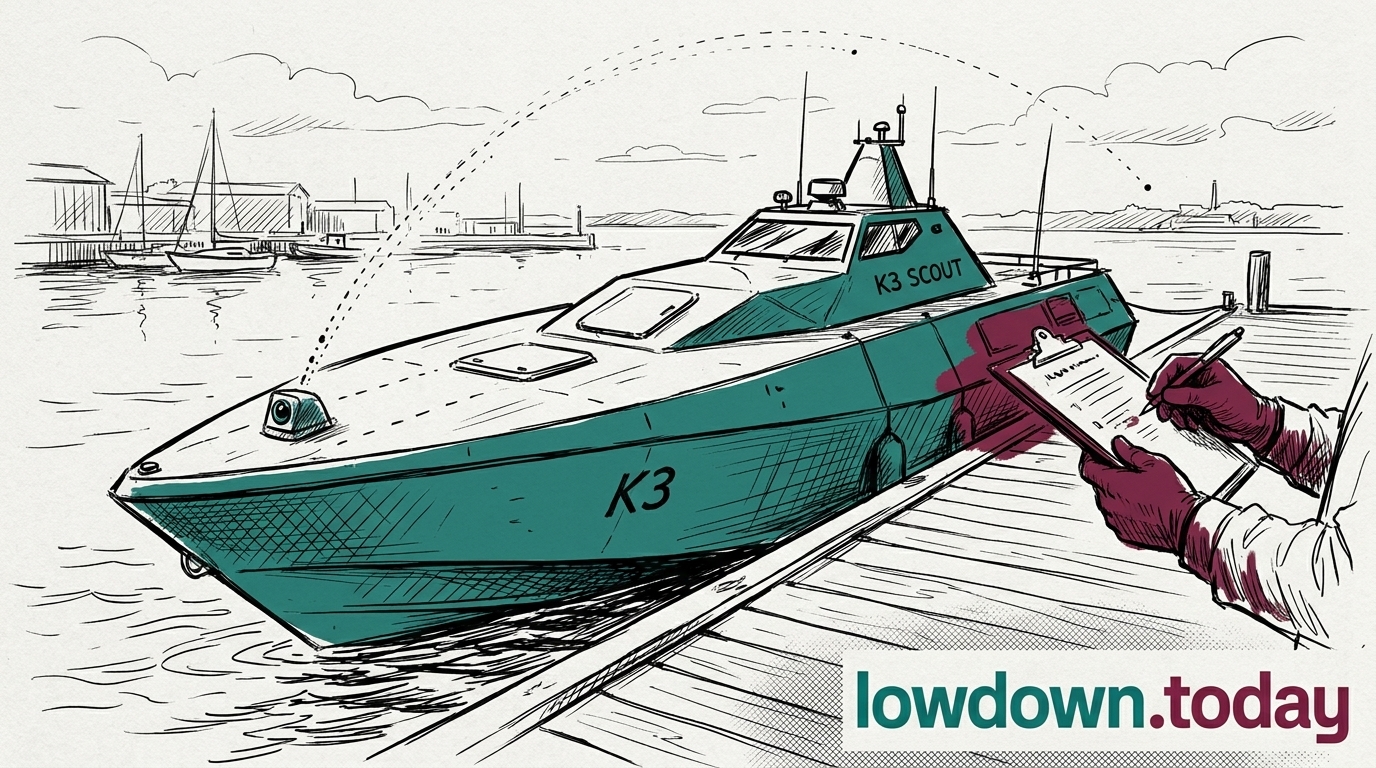
The Conservative opposition called on the Government on 9 August to 'urgently audit' equipment for hidden Chinese components, after the Telegraph's K3 SCOUT report. No named MP has been quoted on the record; the call came at party level, alongside the Ministry of Defence's own 10 August statement that no data had been compromised.
Netherlands Ministry of Defence
The Netherlands Ministry of Defence authorised Dutch Naval Design on 4 August to design 12-metre anti-submarine warfare uncrewed vessels for the Dutch-Belgian frigate programme, and to buy an adapted Compact FLASH dipping sonar from Thales Underwater Systems France. The order commits money and a named supplier while Britain's own certification body remains at the market-engagement stage.
Kraken Technology Group
Kraken Technology Group is a UK maritime-defence company based in Portsmouth that builds the K3 SCOUT, and crossed a $1bn valuation in July on a single-sourced $175m raise. The camera components reached the fleet under a third party's written security assurance, which the Platform Authority, which does not yet exist, was never positioned to check.
Navy Commercial
Navy Commercial
Navy Commercial at Whale Island published two notices on 5 August: 074032-2026, asking industry how to build a Platform Authority to certify uncrewed vessels, and 074351-2026, a GBP10m multi-role USV testbed for the Defence Chief Technology Officer. Responses on the Platform Authority close 19 August, ten days after the cameras were found transmitting to China.
Ministry of Defence
Ministry of Defence
The Ministry of Defence said on 10 August that a routine cyber vulnerability assessment found the camera fault, and a thorough investigation found no evidence that MoD data or systems had been accessed, compromised or transmitted externally. It stripped the cameras of internet connectivity but did not say whether it acted against the supplier.
Thales
Thales
Thales converted its 6 July engaging accord with Exail into a definitive combination agreement on 30-31 July, but the tender offer for Exail's remaining shares now closes by early 2028, later than July's timetable implied. Thales integrates its new undersea prime while still bidding against Kongsberg and DRASS's 2027 target for the AUKUS Pillar II contest.
