Skip to content
You can now search across every topic, entity and event.What's new
Drones: Industry & Defence
4APR

LUCAS Enters Combat With Dozens in Stock

2 min read
20:57UTC

The first US-made loitering munition flew its combat mission five weeks ago. The Pentagon still has enough to arm a single platoon.

TechnologyDeveloping
Key takeaway

LUCAS proved affordable mass works in combat but revealed a production shortfall of three orders of magnitude.

SpektreWorks' LUCAS (Low-cost Uncrewed Combat Attack System) became the first US-manufactured loitering munition to see combat on 28 February 2026, deployed during Operation Epic Fury. Pentagon chief technology officer Emil Michael confirmed the inventory stood at "dozens." 1

The drone carries an 18 kg payload over 500 miles with six hours of endurance, at a unit cost of $35,000 to $55,000. That is roughly one hundredth of a Patriot interceptor's price. 2 Built in Phoenix, Arizona, LUCAS was designed as a reverse-engineered answer to Iran's Shahed-136. Michael described the situation bluntly: "not in full-rate production; we shipped what we had." 3

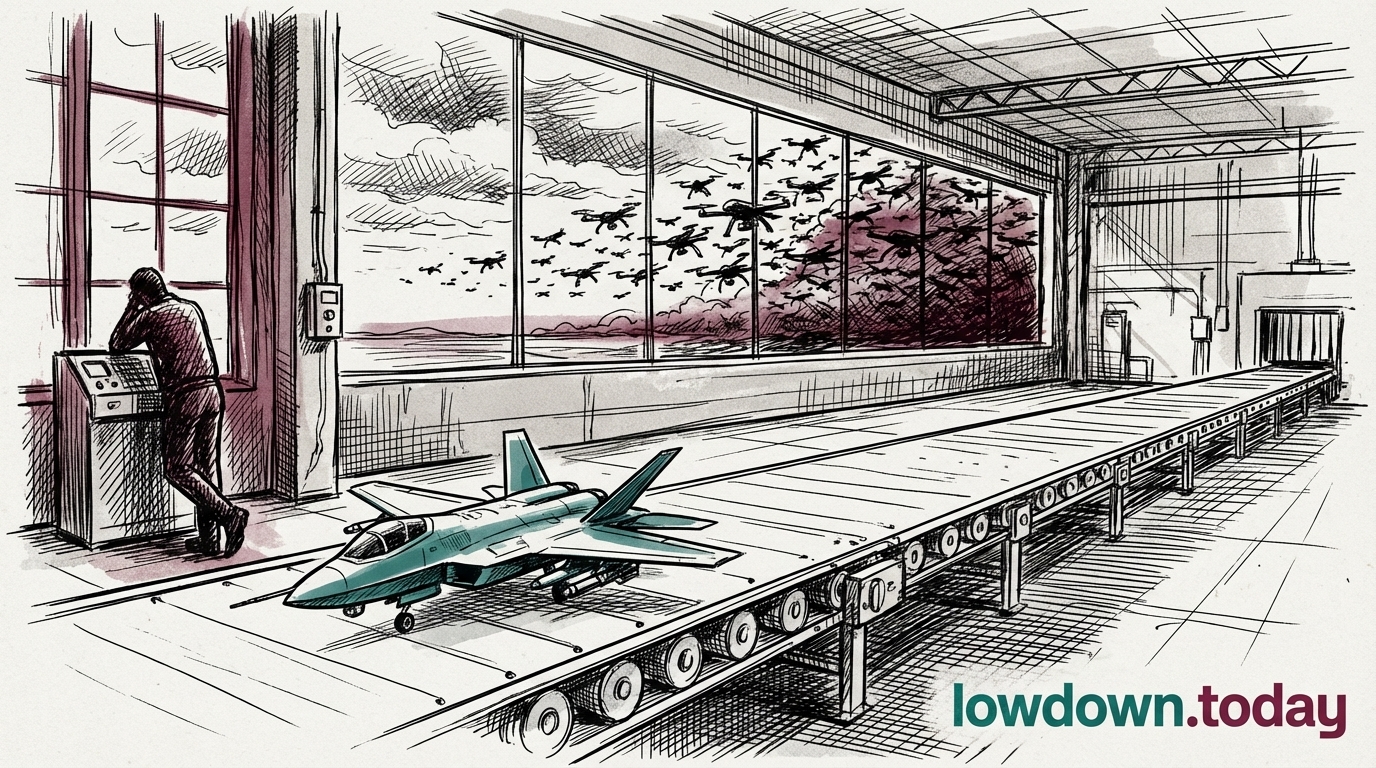
The $30 million initial contract under the Drone Dominance programme was intended to seed production of hundreds. The programme's stated goal remains 300,000 drones by 2027 under a $1.1 billion budget . Five weeks into a conflict that has consumed thousands of interceptors, the US has produced enough attack drones to equip a single squad. The gap between the Gauntlet's procurement ambition and the factory floor is not a future risk. It is an operational fact.

LUCAS validated the central thesis: cheap, expendable drones can substitute for million-dollar munitions. Production scarcity, not capability, is now the binding constraint on the entire programme.

Deep Analysis

In plain English

Imagine the US military revealed its most advanced new weapon, and it turned out there were only enough to fill a single soldier's kit bag. That is roughly the situation with LUCAS. The drone worked in combat for the first time in February 2026. But the Pentagon only has "dozens" of them, against a target of 300,000. Think of it like a car factory that built a prototype, sold it successfully, but never built the assembly line. The prototype proved the design works. Now someone needs to build the factory.

Deep Analysis
Root Causes

US defense procurement law mandates full competition, environmental review, and multi-year contracting cycles that are structurally incompatible with rapid scale-up. SpektreWorks received a $30 million seed contract, not a production order.

LUCAS was designed under an Other Transaction Authority (OTA) pathway intended to accelerate small-company innovation, but OTA does not include provisions for production surge financing or guaranteed offtake that would justify factory investment.

The affordable mass doctrine assumes high volume to achieve unit cost targets below $2,000. Without volume commitments, suppliers cannot invest in the tooling that enables volume, creating a bootstrapping problem.

What could happen next?
  • Pentagon will likely expand multi-year production commitments beyond OTA seed contracts to unlock factory investment.

    6-18 months · Medium
  • SpektreWorks faces a critical choice between raising private capital to build production capacity or seeking a strategic acquirer with existing facilities.

    12 months · Medium
  • The US military will remain dependent on expensive interceptor missiles for peer-adversary drone defence until domestic production reaches meaningful scale.

    2-3 years · High
First Reported In

Update #4 · Factories Under Fire: America's Drone Gap Meets Reality

AeroVironment / Army Recognition· 4 Apr 2026
Read original
Causes and effects
This Event
LUCAS Enters Combat With Dozens in Stock
LUCAS proved affordable mass doctrine works in combat but exposed a production gap between dozens of drones and a 300,000 target.
Different Perspectives
Procurement sceptics
Two identically sized IDIQs to different primes within seven weeks, and a five-nation pact where one partner moves weeks ahead of the rest, could just as easily read as an industrial base still improvising vendor mix as a deliberate hedging doctrine. Neither ceiling appears sized against a validated requirement yet.
Chinese component suppliers
FCC and Pentagon-level restrictions on Chinese-origin airframes and motors have progressively excluded DJI-linked suppliers from federal counter-drone catalogues, narrowing the field JIATF-401 and Gauntlet II can buy from to a short list of certified domestic bidders. Beijing reads the exclusions as protectionism dressed as security policy.
Quantum Systems
Quantum Systems
Blackstone, Airbus, Advent and Noteus reportedly priced the Munich drone maker at $8 billion, more than double its prior mark, on the strength of 19,000 Ukraine missions rather than confirmed revenue. It is betting production capacity, not current sales, is what buyout capital is now paying for.
United Kingdom
United Kingdom
Britain released the first LEAP effector money three weeks after its defence secretary quit over the size of the drone budget, splitting £3.16 million across three small firms rather than one contractor. It expects the other four LEAP partners to follow its pace, not set their own.
JIATF-401
JIATF-401
The task force handed AeroVironment a $500 million counter-drone ceiling identical to Perennial Autonomy's from seven weeks earlier, while its own Gauntlet II red team prepares to attack the drones the winners of that sprint will build. It expects to keep several qualified suppliers warm rather than certify one.
DroneShield
DroneShield
DroneShield appointed retired Rear Admiral Lee Goddard as an independent director from 1 July, its second board move since founder Oleg Vornik's April exit. The ASIC probe into November's disclosures and share sales stays open, so the admiral steadies the story without closing the file.
