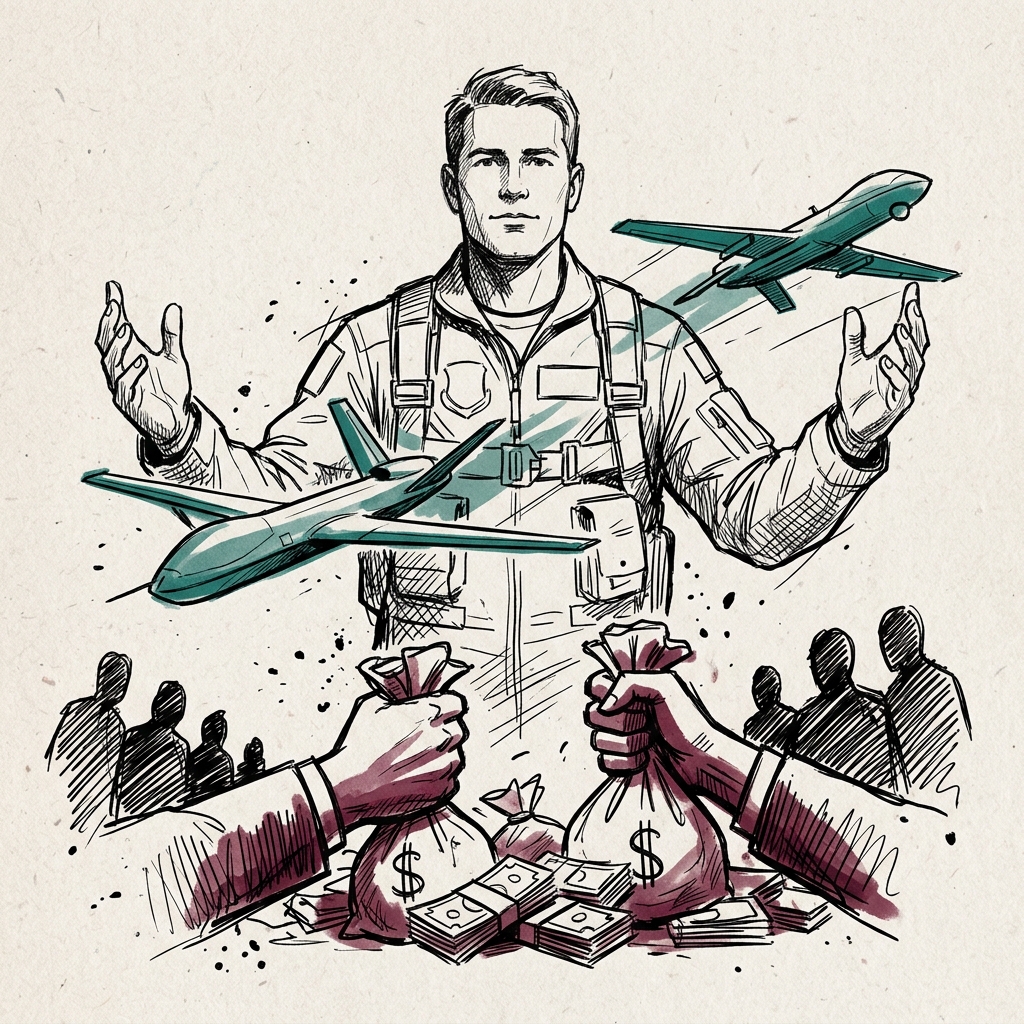
Collaborative Combat Aircraft
USAF programme awarding funded production to Anduril and General Atomics; target 150+ aircraft under $30 million each.
Last refreshed: 25 June 2026 · Appears in 1 active topic
Will the USAF mandate Hivemind portability across CCA platforms, creating a software standard?
Timeline for Collaborative Combat Aircraft
Mentioned in: Britain unveils its first sovereign combat drone
Drones: Industry & DefenceEntered funded production phase with first contracts awarded
Drones: Industry & Defence: Air Force hands robot fighter to upstartsMentioned in: UK launches Apache drone wingman trial
Drones: Industry & DefenceMentioned in: Kratos lifts guidance, opens Valkyrie talks
Drones: Industry & DefenceMentioned in: Kratos beats Q1, raises guidance, stock falls 5.3%
Drones: Industry & DefenceBackground
The Collaborative Combat Aircraft (CCA) programme is the US Air Force's initiative to develop autonomous drone wingmen that can fly alongside crewed fighters, extending their sensor range, drawing enemy fire, or delivering weapons without a pilot aboard. On 17 June 2026 the Air Force awarded the first funded production contracts to two non-traditional defence companies: Anduril (FQ-44A) and General Atomics (FQ-42A). The three largest US primes, Boeing, Lockheed Martin, and Northrop Grumman, all competed and were excluded from the franchise. The FY2027 budget request carries $1.4 billion for development and approximately $1 billion for procurement, with the programme targeting more than 150 aircraft at under $30 million each by end of decade.
The programme's background spans several years of competitive prototyping. Anduril began production of its YFQ-44A Fury at Arsenal-1 in Columbus, Ohio in early 2026, rated at 150 aircraft per year, which became its primary argument for readiness. Shield AI's Hivemind autonomy software was selected for the CCA prototype programme in February 2026 and confirmed a mid-air software switch on the Fury airframe, demonstrating cross-platform interoperability. The June 2026 production award did not name Shield AI, leaving the software architecture question open for the production phase.
The exclusion of the legacy primes is the programme's most significant industrial-policy signal: the Air Force is betting that a next-generation autonomous combat aircraft franchise does not require the same companies that built the F-35. CCA's outcome will shape DoD autonomous air combat doctrine and procurement patterns for a decade, with direct implications for China's parallel loyal wingman development and for Allied Nations building comparable programmes such as the UK's Project NYX.
What is the Collaborative Combat Aircraft?
Which companies are building CCA drones?
How does a drone wingman work?
How much does the CCA programme cost?
Can CCA drones fire missiles?
Who won the US Air Force Collaborative Combat Aircraft contract?
What is the Collaborative Combat Aircraft programme and what does it do?
Why did Boeing, Lockheed Martin, and Northrop Grumman lose the CCA contract?
How much will the US Air Force spend on autonomous combat drones?


