Skip to content
You can now search across every topic, entity and event.What's new
Autonomous Systems: Land & Sea
12AUG

Anduril hires for Roadrunner at Arsenal-1

4 min read
14:17UTC

Anduril posted manufacturing engineer, quality engineer and production technician roles for Roadrunner at the Arsenal-1 mega-factory in Pickaway County, Ohio on 22 April.

TechnologyDeveloping
Key takeaway

Roadrunner moves from announcement to production hiring, the second platform on Anduril's four-line Arsenal-1 schedule.

Anduril Industries on Wednesday 22 April posted manufacturing engineer, quality engineer and production technician roles for Roadrunner at the Arsenal-1 factory in Pickaway County, Ohio, telling local press: "When we said we'd begin Roadrunner production at Arsenal-1 by the end of the year, we meant it" 1. Roadrunner is a vertical-takeoff reusable counter-UAS interceptor, designed to launch from a ground container, intercept a hostile drone, and recover for relaunch. Arsenal-1 itself is the five-million-square-foot site Anduril is converting into a four-platform production hub.

Roadrunner is the second of the four platforms Anduril committed to running at Arsenal-1 by end-2026 , after the YFQ-44A Fury collaborative combat aircraft and ahead of Barracuda and one classified airframe. Fury's early delivery from Arsenal-1 is the milestone the hiring wave is sized against. Manufacturing-engineer postings are the leading indicator of a production line: they precede tooling installation by three to six months and first-article output by nine to twelve.

Anduril has now publicly committed to four simultaneous production lines on a single site, a footprint pattern more familiar from Lockheed's Marietta or Boeing's Renton than from a venture-backed defence firm. Whether the four lines all hit serial production by end-2026 will determine whether the Arsenal-1 model becomes the template for autonomous-systems manufacturing or remains a singular bet. The bottleneck is not capital, of which the $3.2 billion Golden Dome OTA pool and the $20 billion Lattice contract supply plenty; it is supervisor headcount, machine tools, and the certification cycle for new welders and machinists. Each Roadrunner posting is a marker on that constraint.

A more cautious view: announcement-to-production gaps in the defence sector routinely run two years longer than the press release suggests. Roadrunner has not yet been integrated into a programme of record; the postings confirm intent, not delivery. The August 2026 production target remains the testable hinge, and the missing fourth platform will tell the reader whether Arsenal-1 is a four-line factory or a three-line factory with marketing.

Deep Analysis

In plain English

Anduril, a defence technology company, opened job listings on 22 April to hire workers for a new production line at its large factory in Ohio. The product is Roadrunner, a drone that launches vertically, intercepts enemy drones, and lands back to fly again. This is the second production line to open at the factory, which Anduril calls Arsenal-1. The first, for a jet-powered combat aircraft called Fury, started ahead of schedule. The company aims to run four separate production lines at the same factory by the end of 2026.

Deep Analysis
Root Causes

Arsenal-1's four-line ambition responds to two Pentagon procurement pressures. First, the DAWG $54.6 billion request requires production at volumes no single-platform factory can supply alone; a multi-platform co-location reduces the DoD's dependence on multiple geographically dispersed suppliers who each face their own labour and tooling constraints.

Second, Anduril's contract portfolio now spans counter-UAS, collaborative combat aircraft and Golden Dome space-based defence simultaneously. Each contract stream creates demand for a different product line; co-locating all four at Arsenal-1 allows shared programme-management overhead and a single interface with the Defense Contract Management Agency inspection team, rather than four separate production audits at four separate sites.

What could happen next?
  • Consequence

    If all four Arsenal-1 lines hit serial production by end-2026, Anduril will have assembled the most diverse autonomous-systems production portfolio in any single facility in US defence history; a structural advantage that will take any competitor at least three years to replicate.

    Short term · 0.67
  • Risk

    Running two mechanically dissimilar production lines on shared floor space creates tooling-conflict risk. Boeing's Renton 737 experience shows that quality failures in this scenario can embed before they become visible in production statistics.

    Medium term · 0.7
  • Opportunity

    Pickaway County, Ohio benefits from an industrial employment base that scales with each new Arsenal-1 line. The county's labour market will become a leading indicator of Anduril's production health; local employment postings are publicly visible before Pentagon contract updates.

    Short term · 0.82
First Reported In

Update #7 · DAWG jumps 24,000% as Anduril sweeps board

Scioto Post· 30 Apr 2026
Read original
Different Perspectives
Conservative opposition
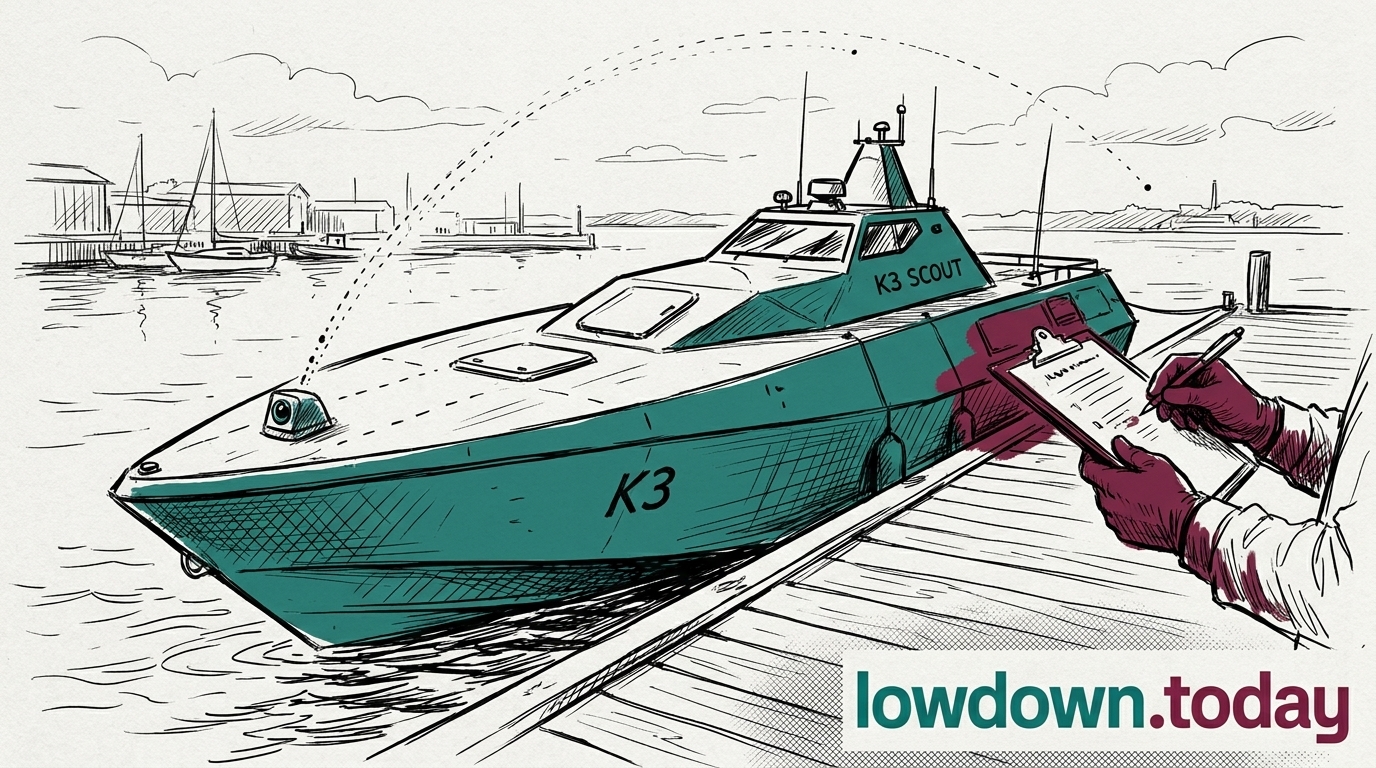
The Conservative opposition called on the Government on 9 August to 'urgently audit' equipment for hidden Chinese components, after the Telegraph's K3 SCOUT report. No named MP has been quoted on the record; the call came at party level, alongside the Ministry of Defence's own 10 August statement that no data had been compromised.
Netherlands Ministry of Defence
The Netherlands Ministry of Defence authorised Dutch Naval Design on 4 August to design 12-metre anti-submarine warfare uncrewed vessels for the Dutch-Belgian frigate programme, and to buy an adapted Compact FLASH dipping sonar from Thales Underwater Systems France. The order commits money and a named supplier while Britain's own certification body remains at the market-engagement stage.
Kraken Technology Group
Kraken Technology Group is a UK maritime-defence company based in Portsmouth that builds the K3 SCOUT, and crossed a $1bn valuation in July on a single-sourced $175m raise. The camera components reached the fleet under a third party's written security assurance, which the Platform Authority, which does not yet exist, was never positioned to check.
Navy Commercial
Navy Commercial
Navy Commercial at Whale Island published two notices on 5 August: 074032-2026, asking industry how to build a Platform Authority to certify uncrewed vessels, and 074351-2026, a GBP10m multi-role USV testbed for the Defence Chief Technology Officer. Responses on the Platform Authority close 19 August, ten days after the cameras were found transmitting to China.
Ministry of Defence
Ministry of Defence
The Ministry of Defence said on 10 August that a routine cyber vulnerability assessment found the camera fault, and a thorough investigation found no evidence that MoD data or systems had been accessed, compromised or transmitted externally. It stripped the cameras of internet connectivity but did not say whether it acted against the supplier.
Thales
Thales
Thales converted its 6 July engaging accord with Exail into a definitive combination agreement on 30-31 July, but the tender offer for Exail's remaining shares now closes by early 2028, later than July's timetable implied. Thales integrates its new undersea prime while still bidding against Kongsberg and DRASS's 2027 target for the AUKUS Pillar II contest.
