Skip to content
You can now search across every topic, entity and event.What's new
Autonomous Systems: Land & Sea
12AUG

Mach hits $1.8B in fintech-backed round

3 min read
14:17UTC

Mach Industries closed a $300M Series C at a $1.8B valuation, quadrupling its value in a year, with a fintech fund and mainstream tech investors crossing into attack-drone equity.

TechnologyDeveloping

Mach Industries closed a $300M Series C at a $1.8B valuation on Monday 1 June, four times its level twelve months earlier 1. The round was co-led by Infinite Capital and Ribbit Capital, with Sequoia Capital, Khosla Ventures and Bedrock participating. Mach, a US defence-tech startup building low-cost strike drones and interceptors, simultaneously bought solid-rocket-motor firm Exquadrum for $50M.

The specialist rounds are already logged, including Anduril's $5bn and Helsing's $1.2bn , so the round's size is not the signal. Ribbit is a fintech fund; Sequoia and Khosla are mainstream technology investors. Generalist money crossing into attack-drone equity prices the category as ordinary venture tech rather than a government niche.

That repricing compresses the cost of capital across the cohort, but it carries a risk the specialist rounds did not. Mach's 4x step-up decouples valuation from revenue. If Pentagon order flow slows, valuations set on a mainstream-tech thesis correct faster than ones underwritten by defence specialists who price the procurement cycle into their models.

Deep Analysis

In plain English

Mach Industries is a young American company building low-cost attack drones and missiles. On 1 June 2026, it raised $300 million from investors, including Sequoia Capital, which also backed Apple and Google early on, valuing the company at $1.8 billion. That is four times more than it was worth just a year ago. At the same time, it bought a company called Exquadrum for $50 million. Exquadrum makes the solid rocket motors that power the kinds of missiles Mach builds. Buying the supplier means Mach controls more of its own production chain and does not depend on outside companies for a critical component.

Deep Analysis
Root Causes

Mach's valuation acceleration from ~$450M (twelve months prior, implied by the 4x step-up from the $1.8B post-money) reflects two concurrent forces: the Pentagon's FY2027 defence budget request lifting drone and counter-drone allocation to $70B gave investors a visible government demand signal, and Anduril's Arsenal-1 factory announcement created competitive urgency for a production-scale rival.

Exquadrum's $50M acquisition solves a specific bottleneck: Mach's five-vehicle programme requires solid-rocket-motor supply that it previously sourced externally. Bringing propulsion in-house reduces single-source supply risk and makes the company's cost structure more predictable for the LRIP contract negotiations it will need to enter.

What could happen next?
  • Consequence

    Ribbit Capital and Sequoia's participation in an attack-drone round will draw scrutiny from Congressional committees on investment in autonomous lethal systems, potentially triggering disclosure requirements for non-specialist VC firms in future defence rounds.

  • Opportunity

    Exquadrum integration gives Mach a credible proposition for Pentagon LRIP competitions where supply-chain independence is a scoring criterion, directly competitive with Kratos's Valkyrie LRIP negotiations.

First Reported In

Update #11 · Ukraine starts exporting the factory

Unmanned Airspace· 7 Jun 2026
Read original
Different Perspectives
Conservative opposition
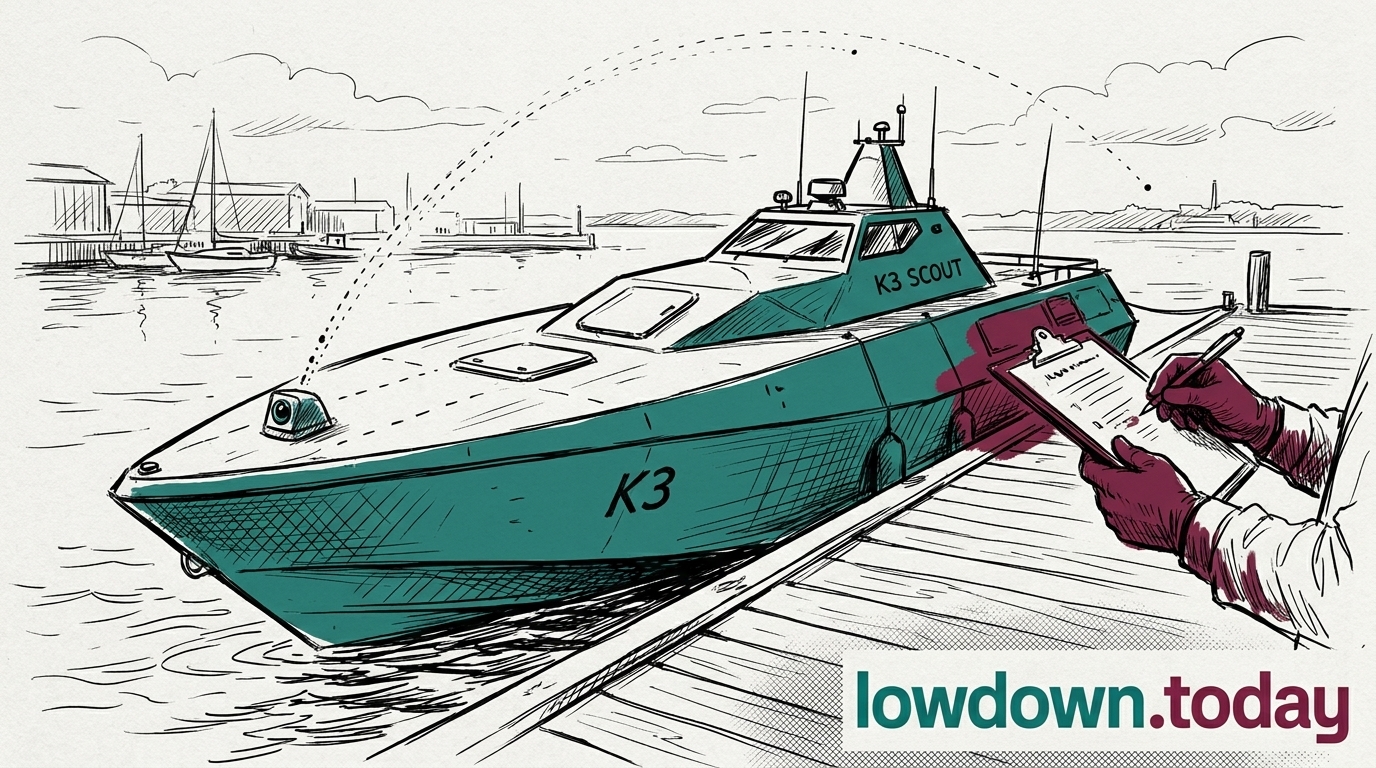
The Conservative opposition called on the Government on 9 August to 'urgently audit' equipment for hidden Chinese components, after the Telegraph's K3 SCOUT report. No named MP has been quoted on the record; the call came at party level, alongside the Ministry of Defence's own 10 August statement that no data had been compromised.
Netherlands Ministry of Defence
The Netherlands Ministry of Defence authorised Dutch Naval Design on 4 August to design 12-metre anti-submarine warfare uncrewed vessels for the Dutch-Belgian frigate programme, and to buy an adapted Compact FLASH dipping sonar from Thales Underwater Systems France. The order commits money and a named supplier while Britain's own certification body remains at the market-engagement stage.
Kraken Technology Group
Kraken Technology Group is a UK maritime-defence company based in Portsmouth that builds the K3 SCOUT, and crossed a $1bn valuation in July on a single-sourced $175m raise. The camera components reached the fleet under a third party's written security assurance, which the Platform Authority, which does not yet exist, was never positioned to check.
Navy Commercial
Navy Commercial
Navy Commercial at Whale Island published two notices on 5 August: 074032-2026, asking industry how to build a Platform Authority to certify uncrewed vessels, and 074351-2026, a GBP10m multi-role USV testbed for the Defence Chief Technology Officer. Responses on the Platform Authority close 19 August, ten days after the cameras were found transmitting to China.
Ministry of Defence
Ministry of Defence
The Ministry of Defence said on 10 August that a routine cyber vulnerability assessment found the camera fault, and a thorough investigation found no evidence that MoD data or systems had been accessed, compromised or transmitted externally. It stripped the cameras of internet connectivity but did not say whether it acted against the supplier.
Thales
Thales
Thales converted its 6 July engaging accord with Exail into a definitive combination agreement on 30-31 July, but the tender offer for Exail's remaining shares now closes by early 2028, later than July's timetable implied. Thales integrates its new undersea prime while still bidding against Kongsberg and DRASS's 2027 target for the AUKUS Pillar II contest.
