Skip to content
You can now search across every topic, entity and event.What's new
Autonomous Systems: Land & Sea
12AUG

France sends eight SAMP/T air defences

4 min read
14:17UTC

Paris is transferring anti-missile systems its own air force received weeks ago, betting Ukraine's front line will prove what no test range can: whether Europe has a viable alternative to America's Patriot.

TechnologyDeveloping
Key takeaway

France's battlefield test creates a procurement decision point reshaping European air defence independence from US systems.

France will transfer eight SAMP/T NG anti-aircraft systems to Ukraine for battlefield testing against Russian ballistic missiles. The French Air and Space Force accepted its first operational unit in late February — Paris is sending equipment its own military has fielded for weeks, not months. The system, produced by Eurosam — a joint venture of MBDA and Thales — carries the Ground Fire GaN radar with 360-degree coverage and a 400 km detection range, a generation beyond the Arabel radar on the SAMP/T variant Italy transferred to Ukraine in 2024.

The transfer responds to a measurable shortage. More Patriot interceptors were consumed in three days of the Iran war than Ukraine received in three years of fighting . An estimated 100–150 THAAD interceptors — roughly a quarter of global inventory — were expended in the opening week . Lockheed Martin has agreed to quadruple THAAD production from 96 to 400 interceptors per year, but delivery at scale remains years away. European air forces have relied on American-manufactured interceptors for Ballistic missile defence since the Cold War's end; the Iran conflict has exposed that supply cannot meet simultaneous demand across two theatres.

Ukraine negotiated priority access to the SAMP/T NG if tests confirm Ballistic missile interception capability. The arrangement makes Ukraine's front line a live-fire proving ground for what European defence firms intend as a Patriot alternative. If the system performs against Russian Iskander ballistic missiles — which strike at speeds exceeding Mach 6 and have hit Ukrainian cities on a near-daily basis — MBDA and Thales will hold a combat-validated product no peacetime test range can replicate.

France accepts a short-term gap in its own air defence posture by transferring newly fielded equipment. European governments are using the war to rebuild defence-industrial capacity, with EU arms exports outpacing the United States over the most recent five-year period . The SAMP/T NG's battlefield performance will determine whether that rebuilding extends to the most consequential category: Ballistic missile defence.

Deep Analysis

In plain English

Europe currently relies heavily on American-made Patriot missiles to shoot down ballistic missiles — weapons that arc through the upper atmosphere at very high speed. France has developed its own next-generation system, SAMP/T NG, claiming comparable performance. Rather than simply selling it, France is sending eight units to Ukraine to test them in actual combat against real Russian missiles. If it works, European governments may choose to buy European instead of American — reducing strategic dependence on US defence exports. The condition attached to Ukraine's priority access — that tests must first confirm ballistic missile interception — is itself telling: it signals that this specific capability remains unproven in combat, which is precisely why Ukraine becomes the testing ground.

Deep Analysis
Synthesis

The Ukraine conflict is functioning as a live procurement laboratory at industrial scale. France receives battlefield validation data that would cost billions to replicate in exercises; Ukraine receives capability at accelerated delivery. This model — where the test beneficiary and the combat user are the same actor — is novel in post-Cold War arms transfers and may become a template for future European defence cooperation that bypasses traditional certification timelines entirely.

Root Causes

Europe's structural dependence on Patriot traces to Cold War burden-sharing arrangements in which the US underwrote NATO air defence to keep European defence budgets politically sustainable. MBDA — the Franco-Italian-British joint venture manufacturing SAMP/T NG — has sought for two decades to recapture market share eroded by Patriot's dominance but lacked the combat record needed to compete on equal terms. Ukraine provides that record at no acquisition cost to MBDA and at a fraction of the timeline required through exercise-based certification.

Escalation

Russia has previously targeted Ukrainian Patriot batteries specifically — both to degrade air defence coverage and to destroy high-profile assets that generate negative headlines for Western suppliers. SAMP/T NG units are likely to face analogous targeting pressure, particularly if early deployments coincide with major Russian missile salvoes. A race between battlefield validation and system attrition is a plausible near-term dynamic not addressed in the body.

What could happen next?
  • Risk

    Russia may prioritise destroying SAMP/T NG units to prevent performance data accumulation, increasing targeting pressure on Ukraine's already-scarce air defence assets.

    Short term · Assessed
  • Opportunity

    Validated European ballistic missile defence could reduce NATO dependence on US extended deterrence architecture, reshaping burden-sharing negotiations at a structural level.

    Medium term · Suggested
  • Precedent

    Battlefield testing as a condition of priority procurement access establishes a new template for European defence cooperation that circumvents traditional multi-year certification timelines.

    Long term · Suggested
  • Consequence

    Successful SAMP/T NG performance would fracture Raytheon's near-monopoly on NATO-compatible ballistic missile defence procurement, with significant industrial consequences for the US defence sector.

    Long term · Suggested
First Reported In

Update #5 · Trump frees 124m barrels; Russia earns €6bn

Defense News· 18 Mar 2026
Read original
Causes and effects
This Event
France sends eight SAMP/T air defences
Europe's first combat test of an indigenous ballistic missile defence system could reduce dependence on American Patriot interceptors, which the Iran war has revealed are consumed faster than they can be manufactured.
Different Perspectives
Conservative opposition
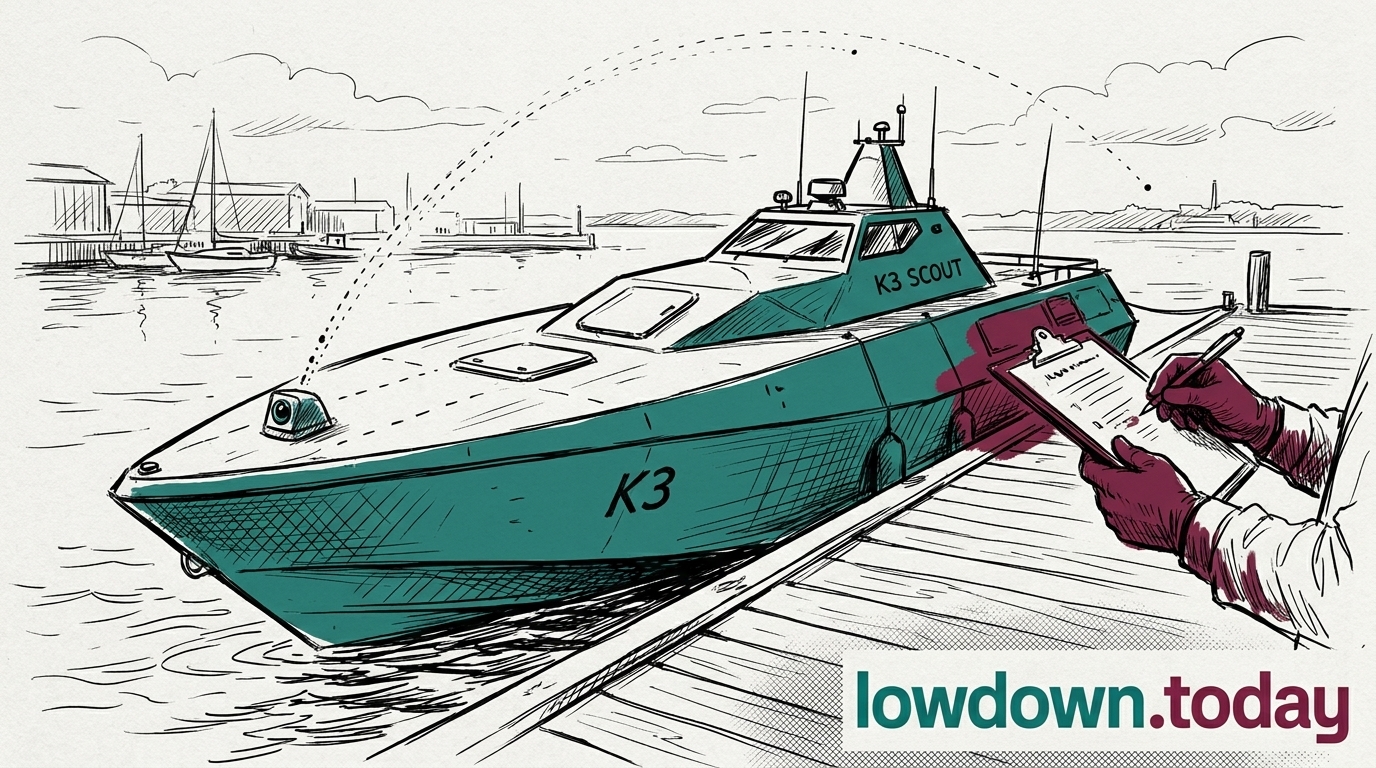
The Conservative opposition called on the Government on 9 August to 'urgently audit' equipment for hidden Chinese components, after the Telegraph's K3 SCOUT report. No named MP has been quoted on the record; the call came at party level, alongside the Ministry of Defence's own 10 August statement that no data had been compromised.
Netherlands Ministry of Defence
The Netherlands Ministry of Defence authorised Dutch Naval Design on 4 August to design 12-metre anti-submarine warfare uncrewed vessels for the Dutch-Belgian frigate programme, and to buy an adapted Compact FLASH dipping sonar from Thales Underwater Systems France. The order commits money and a named supplier while Britain's own certification body remains at the market-engagement stage.
Kraken Technology Group
Kraken Technology Group is a UK maritime-defence company based in Portsmouth that builds the K3 SCOUT, and crossed a $1bn valuation in July on a single-sourced $175m raise. The camera components reached the fleet under a third party's written security assurance, which the Platform Authority, which does not yet exist, was never positioned to check.
Navy Commercial
Navy Commercial
Navy Commercial at Whale Island published two notices on 5 August: 074032-2026, asking industry how to build a Platform Authority to certify uncrewed vessels, and 074351-2026, a GBP10m multi-role USV testbed for the Defence Chief Technology Officer. Responses on the Platform Authority close 19 August, ten days after the cameras were found transmitting to China.
Ministry of Defence
Ministry of Defence
The Ministry of Defence said on 10 August that a routine cyber vulnerability assessment found the camera fault, and a thorough investigation found no evidence that MoD data or systems had been accessed, compromised or transmitted externally. It stripped the cameras of internet connectivity but did not say whether it acted against the supplier.
Thales
Thales
Thales converted its 6 July engaging accord with Exail into a definitive combination agreement on 30-31 July, but the tender offer for Exail's remaining shares now closes by early 2028, later than July's timetable implied. Thales integrates its new undersea prime while still bidding against Kongsberg and DRASS's 2027 target for the AUKUS Pillar II contest.
