Skip to content
You can now search across every topic, entity and event.What's new
Autonomous Systems: Land & Sea
12AUG

Britain awards first LEAP effector money

2 min read
14:17UTC

Britain became the first of five nations to award under the LEAP interceptor pact on 13 July, splitting £3.16m across three small firms including Cambridge Aerospace, winning its second Ministry of Defence line in three months.

TechnologyAssessed
Key takeaway

Britain awarded the first LEAP interceptor money to three small firms, setting a template for four more nations.

Britain became the first of five partner nations to award money under the Low-Cost Effectors and Autonomous Platforms (LEAP) framework on Monday 13 July, releasing its Low-Cost Air Defence Effectors (LCADE) slice as £3.16 million split across three small and medium-sized enterprises: Frankenberg Technologies, Greenjets and Cambridge Aerospace. Effectors are the interceptor drones and munitions that physically engage an incoming target, the cheap end of air defence that the war in Ukraine has made a procurement priority.

LEAP binds the UK, Poland, France, Italy and Germany on joint interceptor buying, and Britain reaching the cheque stage first gives the other four a working template. The award advances the £5 billion Defence Investment Plan Britain banked in June , turning a headline figure into contracts on three companies' books. It also adds a third parallel European procurement structure to the EU's AGILE programme and NATO's own marketplace, each competing to organise the same fragmented supplier base.

Cambridge Aerospace built the Skyhammer interceptor Britain rushed into procurement in April, and now, with no long production record behind it, it has won Ministry of Defence trust for a second counter-drone line in three months. Splitting the first money three ways rather than backing a single interceptor mirrors the distributed instinct on show in Washington the same week, though LEAP leaves interoperability between five national effector sets unsolved.

Deep Analysis

In plain English

LEAP is an agreement between five countries, including Britain, France, Germany, Italy and Poland, to jointly develop cheap drone-defence weapons instead of each country building its own separately. LCADE is Britain's own slice of that money, worth £3.16 million so far. Britain has now become the first of the five countries to actually hand that money to companies, splitting it between three small British firms making anti-drone equipment. For readers, the headline is less the money, which is small relative to defence budgets, and more the fact that Britain moved first while its four partner countries have not yet released a penny, which says something about how joint international defence programmes often move at the speed of their slowest member, not their fastest.

Deep Analysis
Root Causes

Britain's ability to be first is a fiscal authorisation timing story, not a technical one: its Defence Investment Plan folded LCADE funding into an already-approved four-year budget line on 29 June, while France, Germany, Italy and Poland's LEAP contributions still route through their own national appropriations processes, each running on a different fiscal calendar.

LCADE's three SME awardees were consequently competing only against Britain's own domestic shortlist, not a pan-European one, because no shared LEAP-wide tender mechanism yet exists to synchronise supplier selection across the five partner nations.

What could happen next?
  • Precedent

    Britain's early LCADE release sets a funding pace the other four LEAP partners have not yet matched.

  • Risk

    A widening gap between Britain's spending and its partners' still-unreleased budgets could push LEAP toward parallel national programmes rather than one joint capability.

First Reported In

Update #15 · Two $500m drone deals, still no winner

GOV.UK· 14 Jul 2026
Read original
Different Perspectives
Conservative opposition
The Conservative opposition called on the Government on 9 August to 'urgently audit' equipment for hidden Chinese components, after the Telegraph's K3 SCOUT report. No named MP has been quoted on the record; the call came at party level, alongside the Ministry of Defence's own 10 August statement that no data had been compromised.
Netherlands Ministry of Defence
The Netherlands Ministry of Defence authorised Dutch Naval Design on 4 August to design 12-metre anti-submarine warfare uncrewed vessels for the Dutch-Belgian frigate programme, and to buy an adapted Compact FLASH dipping sonar from Thales Underwater Systems France. The order commits money and a named supplier while Britain's own certification body remains at the market-engagement stage.
Kraken Technology Group
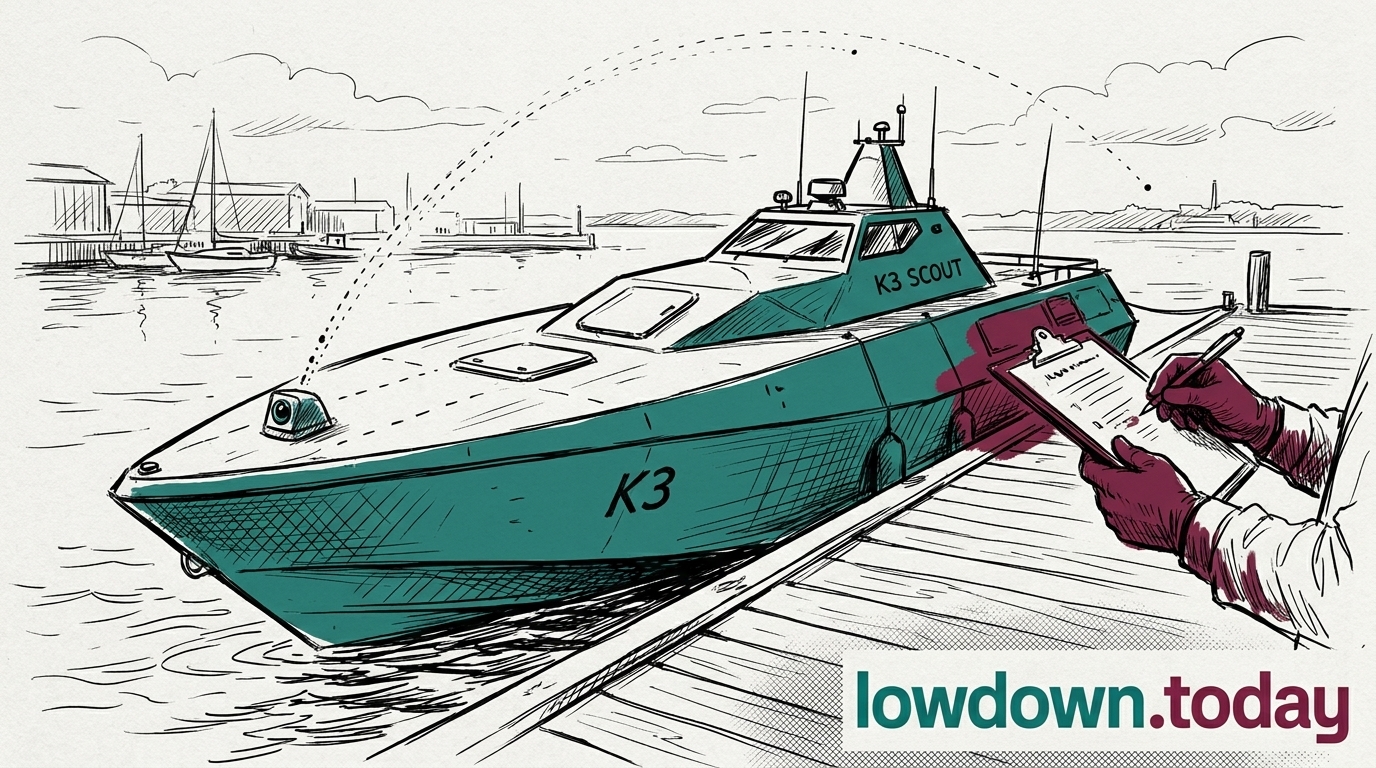
Kraken Technology Group is a UK maritime-defence company based in Portsmouth that builds the K3 SCOUT, and crossed a $1bn valuation in July on a single-sourced $175m raise. The camera components reached the fleet under a third party's written security assurance, which the Platform Authority, which does not yet exist, was never positioned to check.
Navy Commercial
Navy Commercial
Navy Commercial at Whale Island published two notices on 5 August: 074032-2026, asking industry how to build a Platform Authority to certify uncrewed vessels, and 074351-2026, a GBP10m multi-role USV testbed for the Defence Chief Technology Officer. Responses on the Platform Authority close 19 August, ten days after the cameras were found transmitting to China.
Ministry of Defence
Ministry of Defence
The Ministry of Defence said on 10 August that a routine cyber vulnerability assessment found the camera fault, and a thorough investigation found no evidence that MoD data or systems had been accessed, compromised or transmitted externally. It stripped the cameras of internet connectivity but did not say whether it acted against the supplier.
Thales
Thales
Thales converted its 6 July engaging accord with Exail into a definitive combination agreement on 30-31 July, but the tender offer for Exail's remaining shares now closes by early 2028, later than July's timetable implied. Thales integrates its new undersea prime while still bidding against Kongsberg and DRASS's 2027 target for the AUKUS Pillar II contest.
