Skip to content
You can now search across every topic, entity and event.What's new
Autonomous Systems: Land & Sea
3AUG

Ukraine robot maker doubles its output

2 min read
10:02UTC

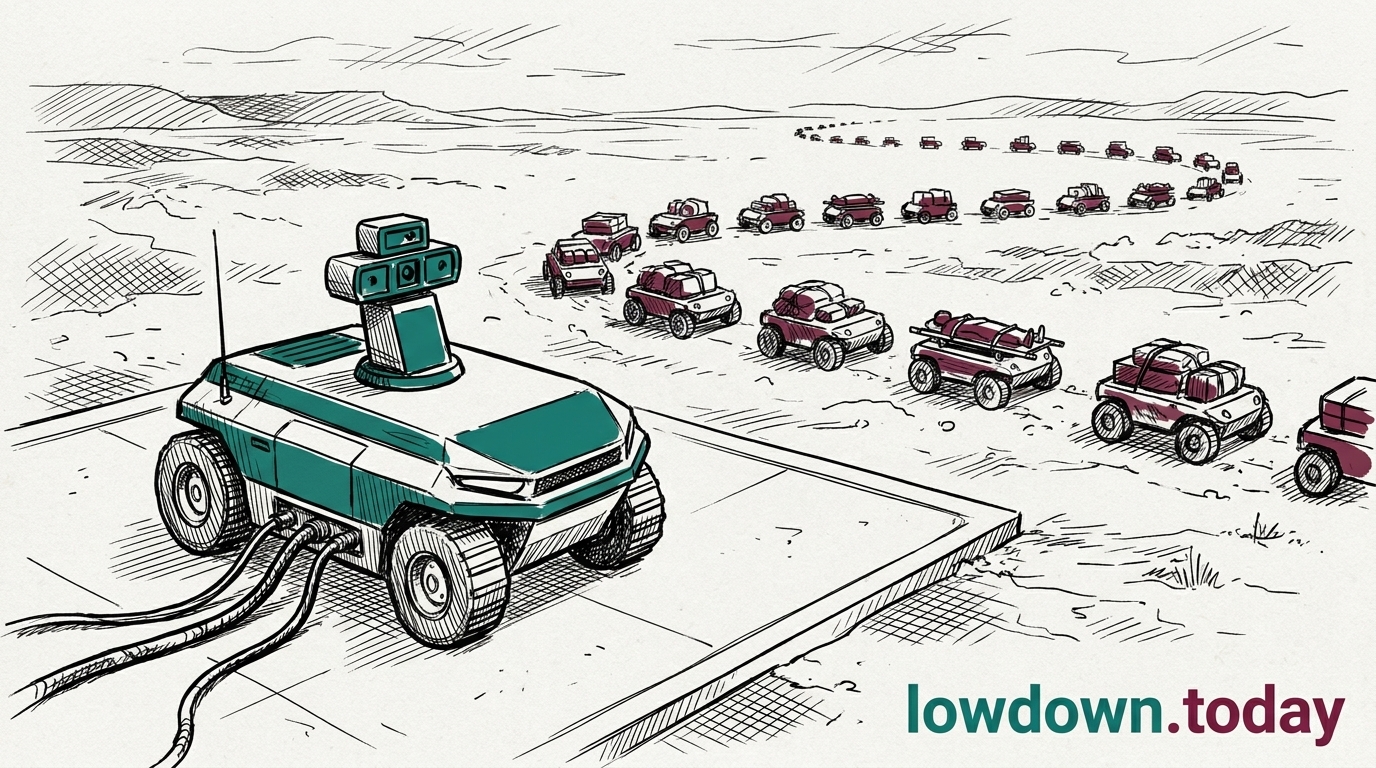
Trinity Robotics doubled its 2026 plan for the Konyk One supply-and-casevac ground robot to about 2,200 units and opened joint-venture talks with a French manufacturer, co-founder Oleksii Konik said.

TechnologyDeveloping
Key takeaway

Ukrainian UGV capacity is starting to relocate into the European Union, competitor and supplier at once.

Trinity Robotics doubled its 2026 production plan for the Konyk One logistics and casualty-evacuation UGV (uncrewed ground vehicle) from about 1,100 to about 2,200 units, co-founder Oleksii Konik said on 9 July 1. The Konyk One weighs 460kg and carries a 300kg payload.

Trinity Robotics is a Ukrainian maker of uncrewed ground vehicles, robots that haul supplies to the front and carry wounded soldiers back. A single firm doubling its own target is a harder datapoint than the top-line Ukrainian figure of 50,000 robots for 2026 already on the record : committed tooling and workforce sit behind the firm's number, where the national 50,000 reflects ambition.

Trinity is in talks with an unnamed French producer for a joint venture to build abroad under the Build with Ukraine programme, the first concrete sign of Ukrainian UGV manufacturing migrating to a NATO-Europe production node 2. Recent backers include Sweden's Front Ventures and Hede Capital Partners. European primes selling logistics UGVs into Ukraine must now price in a home-grown competitor that has fought its product to maturity and wants to build inside the European Union.


Deep Analysis

In plain English

Trinity Robotics is a Ukrainian company that makes the Konyk One, a 460kg uncrewed ground vehicle (UGV), a robot on tracks or wheels used to carry supplies to the front line or evacuate wounded soldiers without risking a driver. The company said it is doubling how many it plans to build in 2026, from about 1,100 to 2,200. Trinity is also talking to a French company about building the Konyk One together outside Ukraine. This matters because it is one of the clearest signs yet of Ukrainian battlefield-tested robot designs moving their factories into the European Union, rather than staying only inside Ukraine's war zone.

Deep Analysis
Root Causes

Ukrainian UGV factories sit inside a live-fire war zone, which caps how much production capacity can safely concentrate in-country regardless of demand.

Cross-border joint ventures under Build with Ukraine let a firm like Trinity access EU manufacturing capacity and, eventually, EU defence-industrial funding routes a purely domestic Ukrainian producer cannot reach, which is the structural reason 'doubling production' increasingly means opening a second country's factory rather than a second Ukrainian one.

What could happen next?
  • Precedent

    The first concrete sign of a Ukrainian UGV manufacturer moving production into an EU country rather than staying domestic, via a French joint venture under Build with Ukraine.

    Short term · Assessed
  • Risk

    Trinity's doubled output figure is self-reported and not yet checkable against delivered units or signed government contracts, unlike Ukraine's own DPA contract data.

    Immediate · Assessed
  • Opportunity

    Front Ventures' and Hede Capital Partners' recent backing gives Trinity capital to fund the French venture without waiting on a single government order.

    Medium term · Suggested
First Reported In

Update #6 · UK airdrops a robot boat; Gulf order stalls

Rheinmetall· 11 Jul 2026
Read original
Different Perspectives
Thales
Thales
Thales converted its 6 July engaging accord with Exail into a definitive combination agreement on 30-31 July, but the tender offer for Exail's remaining shares now closes by early 2028, later than July's timetable implied. Thales integrates its new undersea prime while still bidding against Kongsberg and DRASS's 2027 target for the AUKUS Pillar II contest.
University of Limerick
The University of Limerick tendered on 3 August, the morning this briefing published, for a single coastal and offshore autonomous surface vehicle to survey rather than fight. Where Belgium bought certainty on a cable, a research fleet buys endurance and area coverage, because a lost survey mission costs a re-run, not a casualty.
Ukraine's UGV manufacturers
Ukraine's UGV manufacturers, Trinity Robotics among them, have already run resupply and casualty-evacuation robots at a scale the US Army's new 18-month Project Sustainment award is only now attempting to match. Every month the American programme spends prototyping is a month a wartime supply base keeps compounding its lead in fielded units.
Ocean Infinity
Ocean Infinity
Ocean Infinity's President of Solutions, Joe Robinson, said on 30 July that vessel Needlefish has logged more than 13,000 hours of continuous coastal security work in Kuwait since August 2025, an unaudited company claim. It is commercial security, not mine clearance, and not Omani waters, but the hours logged are real regardless.
Belgian Ministry of Defence
Belgium's Ministry of Defence published a tender for twelve tethered Underwater Remotely Operated Vehicles on 29 July, for its engineer divers, EOD service, Naval Mine Warfare Group and Special Forces Group. A human on the boat, not an algorithm underwater, decides what the manipulator touches near live ordnance.
American Rheinmetall
American Rheinmetall took the 18-month Project Sustainment prime slot on 31 July, fielding hybrid-powered autonomous resupply vehicles for company-sized element sustainment missions with Harbinger, Forterra and Primordial Labs, without disclosing a contract value. The award tests whether an Army acquisition office can match the production tempo Ukrainian UGV makers already run at industrial scale.