Skip to content
You can now search across every topic, entity and event.What's new
Autonomous Systems: Land & Sea
3AUG

Ukraine pulls in Europe's robot supply

4 min read
10:02UTC

Germany's ARX Robotics won an order on 6 May to quintuple its GEREON ground-robot fleet for Ukraine, which has said it wants 25,000 ground robots in the first half of 2026.

TechnologyDeveloping
Key takeaway

Ukraine's appetite for cheap ground robots is forcing European firms to build far more of them, closer to home.

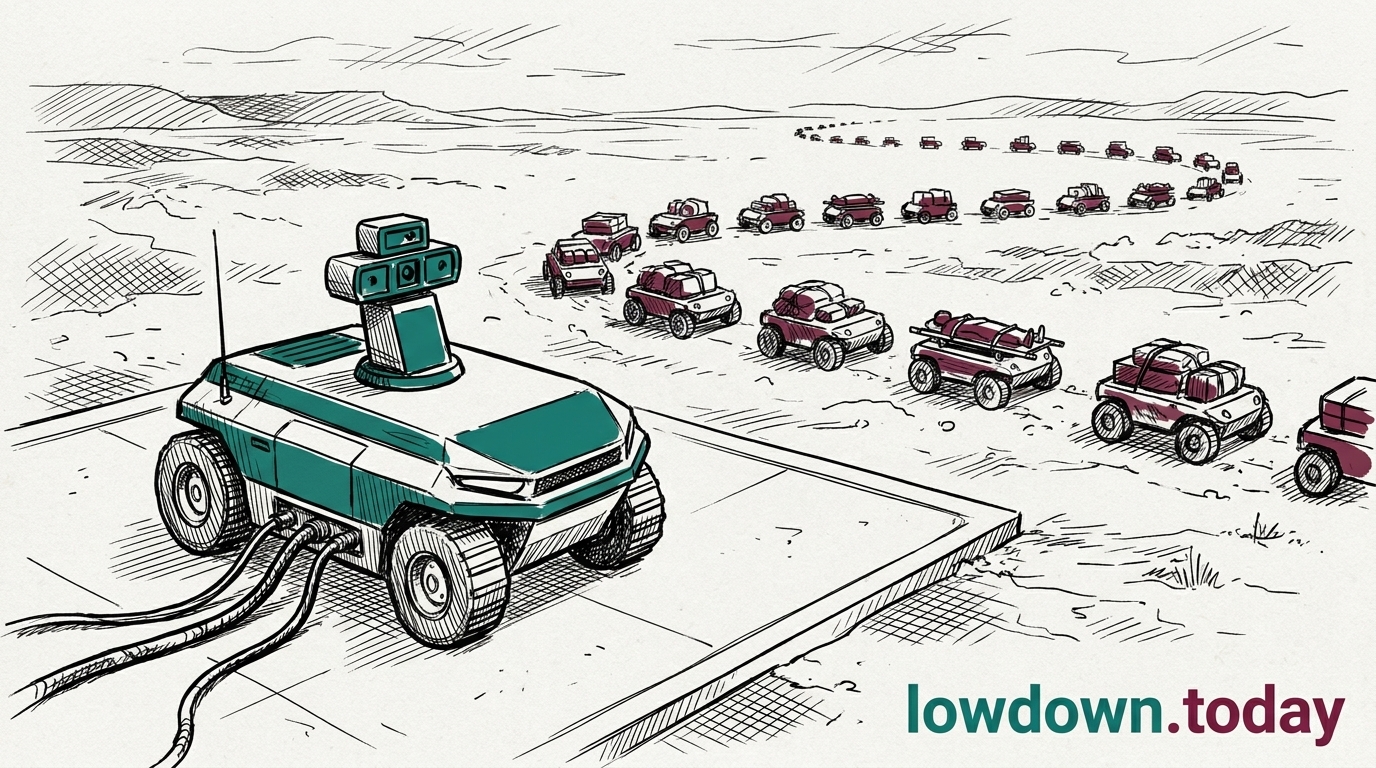
Germany's ARX Robotics said on 6 May it had won an order to expand its GEREON unmanned ground vehicle (UGV) fleet for Ukraine to roughly five times its previous size. 1 A UGV is a robot that drives on land; the GEREON fleet runs logistics, resupply, casualty evacuation (CASEVAC) and intelligence, surveillance and reconnaissance (ISR). Ukraine has said it wants to buy 25,000 ground robots in the first half of 2026. Read that as an industry indicator, not a war report. A buyer consuming robots at that rate sets the production tempo for the whole European sector, ARX included.

The demand signal is for cheap, repairable robots delivered at scale, not a handful of exquisite ones. That favours integrators who can manufacture fast inside the customer's region, and it is reshaping where the robots get built. ARX signed a teaming agreement with Britain's Supacat on 28 April to turn the Jackal patrol vehicle, a high-mobility platform used by the British Army, into an optionally crewed version, putting UGV manufacturing on UK soil. 2 For a UK reader the significance is sovereign capacity: the deal gives British production a demand justification beyond the domestic order book.

Rivals are crowding the same field. Turkey's Havelsan, a state-owned defence systems firm, unveiled its Barkan 3 ground robot on 8 May after trials of an eight-unit swarm, and said it is chasing European customers. 3 The contest is no longer who can field one robot but who can field a coordinated pack of them, with the production line close enough to the front to keep replacing losses.


Deep Analysis

In plain English

Ukraine is trying to buy 25,000 ground robots in the first half of 2026 to replace human soldiers in dangerous tasks: carrying ammunition to the front line, evacuating wounded fighters, and watching enemy movements. These are called UGVs, or unmanned ground vehicles, and they drive themselves without a human on board. ARX Robotics, a German company, just won a contract to expand its GEREON robot fleet for Ukraine to roughly five times its previous size. It has also teamed up with a British firm called Supacat to build a version of the Supacat Jackal military vehicle that can drive itself, manufactured in the UK. Turkey's Havelsan is also targeting the same European market with its Barkan 3 robot, which completed eight-vehicle swarm trials in May.

Deep Analysis
Root Causes

Ukraine's demand pull has two structural drivers. First, manpower attrition: casualty rates on the eastern front have made any task that places a human in an exposed forward position tactically expensive. Robots that can carry supplies or evacuate wounded without a driver reduce that exposure at the margin.

Second, drone-countermeasure saturation: Ukrainian infantry are operating in an environment where the airspace above 30 metres is contested by Russian loitering munitions. Ground robots operating below that envelope fill the logistics role that light helicopters and supply-dropping drones cannot safely fill.

The ARX-Supacat teaming agreement reflects a secondary structural driver: UK industrial policy. Post-AUKUS and post-Ukraine, the Ministry of Defence has signalled a preference for onshore manufacturing for sovereign-capability items. ARX anchoring production in the UK via the Supacat Jackal platform is a deliberate response to that preference, not purely a commercial decision.

What could happen next?
  • Consequence

    ARX's fivefold production expansion compresses European UGV manufacturing lead times for the first time, setting a new benchmark for autonomous ground vehicle delivery tempo that future NATO procurement will be compared against.

    Short term · Assessed
  • Risk

    Ukraine's 25,000-unit target may outpace ARX's and other suppliers' ability to deliver trained maintenance personnel and spare-parts logistics alongside the hardware, degrading operational availability.

    Short term · Suggested
  • Opportunity

    ARX's UK manufacturing footprint via Supacat positions the optionally crewed Jackal as a candidate for British Army direct procurement if autonomous ground platforms appear in the forthcoming UK land capability review.

    Medium term · Suggested
First Reported In

Update #1 · UK's robot navy sails for Hormuz

ARX Robotics· 29 May 2026
Read original
Causes and effects
This Event
Ukraine pulls in Europe's robot supply
A buyer consuming ground robots at that rate sets the production tempo for the whole European sector and is pushing manufacturing onto UK soil.
Different Perspectives
Thales
Thales
Thales converted its 6 July engaging accord with Exail into a definitive combination agreement on 30-31 July, but the tender offer for Exail's remaining shares now closes by early 2028, later than July's timetable implied. Thales integrates its new undersea prime while still bidding against Kongsberg and DRASS's 2027 target for the AUKUS Pillar II contest.
University of Limerick
The University of Limerick tendered on 3 August, the morning this briefing published, for a single coastal and offshore autonomous surface vehicle to survey rather than fight. Where Belgium bought certainty on a cable, a research fleet buys endurance and area coverage, because a lost survey mission costs a re-run, not a casualty.
Ukraine's UGV manufacturers
Ukraine's UGV manufacturers, Trinity Robotics among them, have already run resupply and casualty-evacuation robots at a scale the US Army's new 18-month Project Sustainment award is only now attempting to match. Every month the American programme spends prototyping is a month a wartime supply base keeps compounding its lead in fielded units.
Ocean Infinity
Ocean Infinity
Ocean Infinity's President of Solutions, Joe Robinson, said on 30 July that vessel Needlefish has logged more than 13,000 hours of continuous coastal security work in Kuwait since August 2025, an unaudited company claim. It is commercial security, not mine clearance, and not Omani waters, but the hours logged are real regardless.
Belgian Ministry of Defence
Belgium's Ministry of Defence published a tender for twelve tethered Underwater Remotely Operated Vehicles on 29 July, for its engineer divers, EOD service, Naval Mine Warfare Group and Special Forces Group. A human on the boat, not an algorithm underwater, decides what the manipulator touches near live ordnance.
American Rheinmetall
American Rheinmetall took the 18-month Project Sustainment prime slot on 31 July, fielding hybrid-powered autonomous resupply vehicles for company-sized element sustainment missions with Harbinger, Forterra and Primordial Labs, without disclosing a contract value. The award tests whether an Army acquisition office can match the production tempo Ukrainian UGV makers already run at industrial scale.