Skip to content
You can now search across every topic, entity and event.What's new
Autonomous Systems: Land & Sea
3AUG

US Army buys the robot resupply job

3 min read
10:02UTC

American Rheinmetall took an 18-month US Army award on 31 July for hybrid-powered autonomous resupply vehicles, with Harbinger, Forterra and Primordial Labs behind it. No value was disclosed.

TechnologyDeveloping
Key takeaway

The Army has bought a prototype programme, not a fleet, and it has not said what it paid.

American Rheinmetall was named prime contractor on Project Sustainment, an 18-month US Army award announced on 31 July and executed through the National Advanced Mobility Consortium 1. The contract covers hybrid-powered autonomous UGVs (uncrewed ground vehicles) for what the release calls "company-sized element sustainment missions". Rheinmetall disclosed no contract value.

Three suppliers sit under the prime. Harbinger provides the vehicle, Forterra the autonomy stack, and Primordial Labs the Anura natural-language interface, which lets a soldier speak instructions to the vehicle rather than drive it. American Rheinmetall is the US arm of the German group Rheinmetall; its last appearance on this beat was the MV-8 Komodo mine-breaching robot shown at Eurosatory . Breaching wins the show floor. Sustainment recurs every day of a deployment, and it is sustainment that carries the follow-on orders.

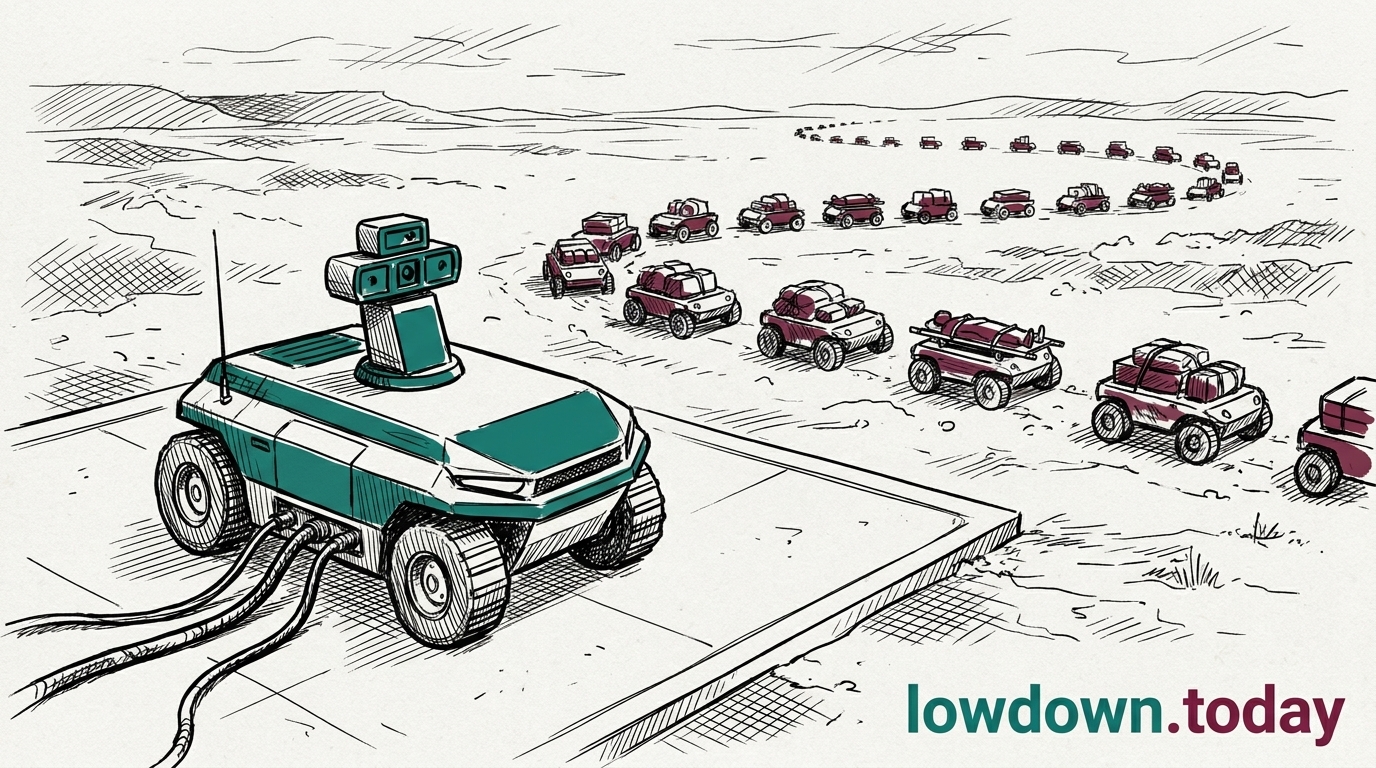
Strip the programme name off and the mission is the one Ukrainian units have been running for two years: haul ammunition and water forward, carry wounded soldiers back. Trinity Robotics doubled 2026 output of its Konyk One logistics and casualty-evacuation robot to roughly 2,200 units , and the national procurement target for the year stands at 50,000 vehicles . The Army is not inventing a category here; it is buying into one that has already been proven under fire by somebody else.

Project Sustainment's silences carry as much weight as its disclosures. Eighteen months with no published value reads as a prototyping vehicle rather than a production buy, so the commercial signal arrives at the follow-on decision rather than now. The three-supplier split matters for the same reason: Forterra's autonomy and Primordial Labs' voice layer are separable from Harbinger's hull, which means a follow-on could recompete the vehicle while keeping the software. The US Army also judges sustainment autonomy on a different curve from combat autonomy. The acceptance test is uptime across a supply run, not lethality, which rewards whoever can show fleet hours and penalises whoever can only show a demonstration.


Deep Analysis

In plain English

A UGV is an uncrewed ground vehicle, essentially a robot truck that can drive itself over rough terrain. The US Army has hired American Rheinmetall to build one that resupplies frontline troops without a driver, for company-sized element sustainment missions, meaning it carries food, ammunition and equipment to a unit of roughly 60 to 200 soldiers. Three companies split the job: Harbinger builds the vehicle itself, Forterra writes the software that lets it navigate on its own, and Primordial Labs built Anura, a voice system so a soldier can talk to the vehicle rather than type commands. Nobody has said what the contract is worth, which is normal for defence deals at this early stage.

Deep Analysis
Root Causes

No single US firm currently builds a UGV hull, an autonomy stack and a natural-language control layer together at production scale, which is why Project Sustainment stacks three specialist suppliers under the National Advanced Mobility Consortium's contracting vehicle instead of a single prime.

Routing the award through NAMC, an industry consortium contracting vehicle, lets the Army award a multi-supplier team without running three separate competitive tenders, trading a longer procurement cycle for a mechanism that has already cleared its own government vetting.

What could happen next?
  • Precedent

    A three-supplier, one-consortium contracting model for a UGV logistics award gives US Army planners a template to buy further autonomy stacks without vetting a single prime contractor for every function.

  • Risk

    Integration failures between Harbinger's hull, Forterra's autonomy stack and Primordial Labs' interface have no single contracted owner, which could surface as delivery delays inside the 18-month window.

First Reported In

Update #10 · Belgium's twelve robots are not autonomous

Rheinmetall· 3 Aug 2026
Read original
Causes and effects
This Event
US Army buys the robot resupply job
A US Army programme office has put an 18-month clock on buying the ground-robot logistics capability Ukrainian units already run at industrial scale.
Different Perspectives
Thales
Thales
Thales converted its 6 July engaging accord with Exail into a definitive combination agreement on 30-31 July, but the tender offer for Exail's remaining shares now closes by early 2028, later than July's timetable implied. Thales integrates its new undersea prime while still bidding against Kongsberg and DRASS's 2027 target for the AUKUS Pillar II contest.
University of Limerick
The University of Limerick tendered on 3 August, the morning this briefing published, for a single coastal and offshore autonomous surface vehicle to survey rather than fight. Where Belgium bought certainty on a cable, a research fleet buys endurance and area coverage, because a lost survey mission costs a re-run, not a casualty.
Ukraine's UGV manufacturers
Ukraine's UGV manufacturers, Trinity Robotics among them, have already run resupply and casualty-evacuation robots at a scale the US Army's new 18-month Project Sustainment award is only now attempting to match. Every month the American programme spends prototyping is a month a wartime supply base keeps compounding its lead in fielded units.
Ocean Infinity
Ocean Infinity
Ocean Infinity's President of Solutions, Joe Robinson, said on 30 July that vessel Needlefish has logged more than 13,000 hours of continuous coastal security work in Kuwait since August 2025, an unaudited company claim. It is commercial security, not mine clearance, and not Omani waters, but the hours logged are real regardless.
Belgian Ministry of Defence
Belgium's Ministry of Defence published a tender for twelve tethered Underwater Remotely Operated Vehicles on 29 July, for its engineer divers, EOD service, Naval Mine Warfare Group and Special Forces Group. A human on the boat, not an algorithm underwater, decides what the manipulator touches near live ordnance.
American Rheinmetall
American Rheinmetall took the 18-month Project Sustainment prime slot on 31 July, fielding hybrid-powered autonomous resupply vehicles for company-sized element sustainment missions with Harbinger, Forterra and Primordial Labs, without disclosing a contract value. The award tests whether an Army acquisition office can match the production tempo Ukrainian UGV makers already run at industrial scale.