Skip to content
Briefings are running a touch slower this week while we rebuild the foundations.See roadmap
Artemis II Moon Mission
10APR

Day 10: Thirteen minutes on a shield NASA already replaced

4 min read
11:48UTC

Orion splashes down tonight carrying four astronauts through a 13-minute re-entry on a heat shield NASA has already committed to redesigning for Artemis III, while nine days of withheld radiation dose data and the European Service Module's physical destruction on separation close two evidence windows simultaneously.

Key takeaway

Artemis II faces the most consequential 13 minutes in crewed spaceflight since Columbia, on a heat shield NASA has already decided to replace; the dose data, ESM accounting, and bolt inspection remain open questions.

This briefing mapped
Loading map…
Infrastructure
Regulatory
Economic
Domestic

Four astronauts face 13 minutes of re-entry at 7:53 PM EDT on a heat shield NASA has already committed to replacing, at velocities no crewed capsule has survived on a lofted trajectory.

Sources profile:This story draws on neutral-leaning sources

Orion is scheduled to hit entry interface at 7:53 PM EDT at 34,965 fps, beginning 13 minutes of re-entry on a heat shield NASA has committed to redesigning for Artemis III. Three of four separation bolts melted through on Artemis I; the lofted return addresses char loss but not bolt erosion.

The lofted return eliminates repeated heating cycles but has never been validated with crew aboard; post-recovery inspection of char patterns and bolt conditions will determine whether Artemis III's redesigned formulation is sufficient. 

Briefing analysis

Only nine crewed missions have returned from lunar distance: Apollo 8 through Apollo 17 (excluding Apollo 9, which stayed in Earth orbit). The last was Apollo 17 on 19 December 1972, when Commander Gene Cernan, Lunar Module Pilot Harrison Schmitt, and Command Module Pilot Ron Evans splashed down in the Pacific after 12 days. Apollo used a direct ballistic entry; Artemis II uses a lofted return, a trajectory type never flown with crew.

The closest parallel to tonight's risk profile is Apollo 13 (April 1970), which performed an emergency free-return after an oxygen tank explosion. The crew returned on a spacecraft whose systems were partially compromised, splashing down safely after corrections made with minimal power. Artemis II's systems are nominal, but the heat shield uncertainty creates an analogous situation: a crew returning through a re-entry regime where the hardware's behaviour is not fully predicted by available models.
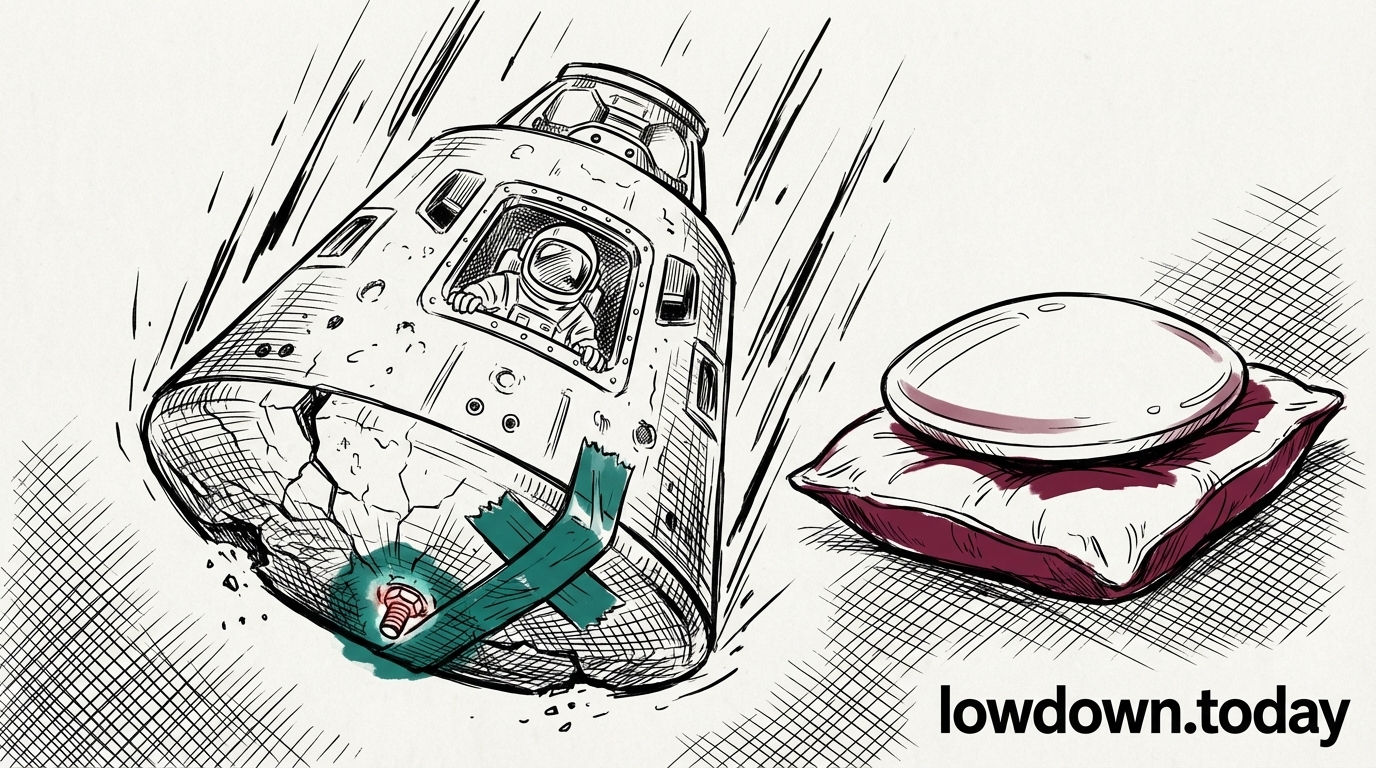

The two-billion-euro module that powered Artemis II's lunar trajectory is scheduled to separate and burn up at 7:33 PM EDT, with ESA's public record of its performance resting on a single Nature quote.

Sources profile:This story draws on neutral-leaning sources

European Service Module is scheduled to separate from Orion at 7:33 PM EDT and burn up in the atmosphere, destroying all physical evidence of its 10-day performance with no ESA performance statement issued. Airbus has been publicly silent since 1 April.

Physical destruction of the ESM means the performance record now depends entirely on NASA telemetry and the one on-record Airbus quote; no independent institutional accounting exists. 

Orion locks re-entry corridor with overnight burn

A nine-second burn in the early hours of 10 April fixed Orion's trajectory for splashdown, eliminating corridor uncertainty ahead of a 13-minute atmospheric passage.

Sources profile:This story draws on neutral-leaning sources

RTC-2 burn completed at 10:53 PM EDT on 9 April: 9-second firing produced a 5.3 fps velocity change, locking Orion's entry corridor for 10 April splashdown.

RTC-2 completion confirms the entry geometry is set; any remaining adjustment falls to RTC-3 if needed. 

Sources:NASA

Artemis II's capsule is due to hit the Pacific at 8:07 PM EDT, 200 miles off San Diego, with Koch the first crew member to be extracted from the bobbing capsule.

Sources profile:This story draws on neutral-leaning sources from United States
United States

NASA's post-splashdown conference is the only near-term window where nine days of withheld crew radiation data could reach the public; or be formally deferred to a months-long research process.

Sources profile:This story draws on neutral-leaning sources

NASA confirmed a post-splashdown press conference at 10:30 PM EDT at Johnson Space Centre — the first and potentially only window to disclose nine days of withheld crew radiation dose data before it enters a months-long post-mission research solicitation process.

Steve Platts' comments to The Planetary Society suggest NASA may classify dose readings as research rather than operational data, potentially delaying independent safety assessment by six to twelve months. 

The Pacific cold front that threatened a zone shift retreated overnight, leaving calm seas at the primary splashdown site 200 miles off San Diego.

Sources profile:This story draws on neutral-leaning sources

Pacific cold front slowed and moved away from the primary recovery zone. Conditions 200 miles off San Diego: 3-5 foot waves, winds under 10 knots, 60-64°F water. No zone relocation required.

Weather clearance removes the last operational variable in the recovery plan ahead of splashdown. 

Sources:Fox Weather

A co-rotating interaction region is driving G1-G2 geomagnetic storming on re-entry day, adding to the crew's cumulative dose profile even as the primary solar threat dissipated.

Sources profile:This story draws on neutral-leaning sources

A G1 to G2 geomagnetic storm from a co-rotating interaction region is active on re-entry day, with Kp index forecast at 6. Region 4412 has collapsed but background geomagnetic enhancement persists through splashdown.

The storm adds background radiation to the crew's final hours and means the first dose readings released will include elevated re-entry conditions, complicating baseline comparisons. 

Sources:NOAA/NWS

The FY2027 budget that celebrates Artemis II simultaneously proposes terminating more than 40 NASA science missions and describes its own launch vehicle as grossly expensive.

Sources profile:This story draws on neutral-leaning sources from United Kingdom and United States
United KingdomUnited States

FY2027 budget proposes cutting NASA Science Mission Directorate 47%, from $7.3 billion to $3.9 billion, terminating more than 40 missions. Artemis exploration funding increased modestly from $7.8 billion to $8.5 billion. Budget documents describe SLS as 'grossly expensive and delayed' without naming a commercial replacement.

The structural contradiction; protecting exploration while gutting the science it enables and criticising the rocket it runs on; frames Artemis II's success as a milestone on a retreating programme. 

Artemis III was redesignated in February 2026 from the first crewed lunar landing to an Earth orbit docking exercise, with the actual landing attempt pushed to Artemis IV in 2028.

Sources profile:This story draws on neutral-leaning sources

Artemis III was redesignated in February 2026 from the first crewed lunar landing to an Earth orbit docking test with Starship HLS and Blue Moon, targeting mid-2027. Artemis IV, now the first crewed lunar landing, targets 2028. Starship HLS is at least two years behind schedule per the OIG.

No crewed lunar landing attempt will follow Artemis II's flyby. Tonight's heat shield inspection data directly shapes whether the 2028 target is achievable. 

NASA and Department of Defence crews are tasked to track Orion at Mach 32 across 1,701 nautical miles using a relay of four aircraft with telescopes and onboard sensors.

Sources profile:This story draws on neutral-leaning sources

Four aircraft are tasked to fly a 1,701 nautical mile relay to track Orion through re-entry at Mach 32 with telescopes and sensors. A separate Armstrong Flight Research Centre team will recover a fortified external sensor affixed to the capsule.

The aerial observation and external sensor data will create the first real-world thermal dataset for a crewed lunar-return capsule, directly informing Artemis III heat shield modelling. 

More than 100 representatives, nearly all Democrats, signed a 13 March letter urging NASA Science funding at $9 billion; more than double the White House FY2027 proposal.

Sources profile:This story draws on neutral-leaning sources

More than 100 Congress members, nearly all Democrats, signed a letter dated 13 March urging $9 billion for NASA Science in FY2027, against the White House's proposed $3.9 billion.

The letter echoes FY2026 congressional resistance that held NASA science funding roughly flat, but the political floor has eroded as Artemis exploration spending provides cover. 

Howard Hu, who led Orion through Artemis I's heat shield anomalies, said NASA expects char loss on tonight's lofted return but at levels below the 2022 damage.

Sources profile:This story draws on neutral-leaning sources

Howard Hu, Orion programme lead through Artemis I, stated NASA expects 'some char loss, not zero, but not to the magnitude of Artemis I' from the lofted return trajectory, establishing the programme's public benchmark for post-recovery inspection.

Hu's statement is the programme's public expectation benchmark against which post-recovery inspection results will be measured. 

Closing comments

The programme is not escalating in a crisis sense, but it is retreating structurally: Artemis III demoted, SLS condemned in its own budget documents, science funding proposed at 47% below current levels. The splashdown provides political cover that may slow congressional resistance to the science cuts. If heat shield inspection reveals damage exceeding Hu's stated expectations, the Artemis III 2028 landing target becomes openly contingent rather than merely technically uncertain.

Different Perspectives
NASA
NASA
NASA declared Artemis II a complete mission success: splashdown on schedule, crew safe, lofted return trajectory validated for the first time with crew aboard. The agency framed the result as proof the architecture can deliver humans to deep space and bring them home. Post-recovery heat shield and bolt inspection is the next gate.
European Space Agency
ESA issued no performance statement before the European Service Module burned up at 7:33 PM EDT. A single Airbus engineer quote to Nature constitutes the entire public record of a two-billion-euro hardware programme. Director General Aschbacher presents a Gateway recovery plan at the June 2026 Council; the institutional silence appears to be deliberate negotiating leverage.
Canadian Space Agency
Jeremy Hansen returned safely as the first Canadian to travel beyond Earth orbit. For the CSA, Artemis II is both a historic national milestone and a demonstration of Canadarm3's political value to a programme under budget pressure in Washington. Hansen's safe return sustains Canada's seat at the Artemis table.
China National Space Administration
CNSA officials framed the Artemis III redesignation from lunar landing to LEO docking test as evidence the US-led architecture is structurally less credible than China's Chang'e programme, pointing to their own 2030 crewed lunar landing target as achievable while America's has slipped to 2028 at the earliest.
Airbus Defence and Space
Airbus has been publicly silent since 1 April. Engineer Siân Cleaver's single quote to Nature; 'perfectly to plan' on the TLI burn; constitutes the company's entire on-record account of ESM-2's performance across ten days of deep-space operations. The hardware burned up tonight without an institutional statement.
Japan Aerospace Exploration Agency
JAXA is an Artemis Accords signatory providing the HERACLES lunar sample-return module and instrument contributions to Gateway. The FY2027 budget cuts and Artemis III demotion create direct uncertainty for Gateway's timeline, on which JAXA's own lunar programme milestones depend.