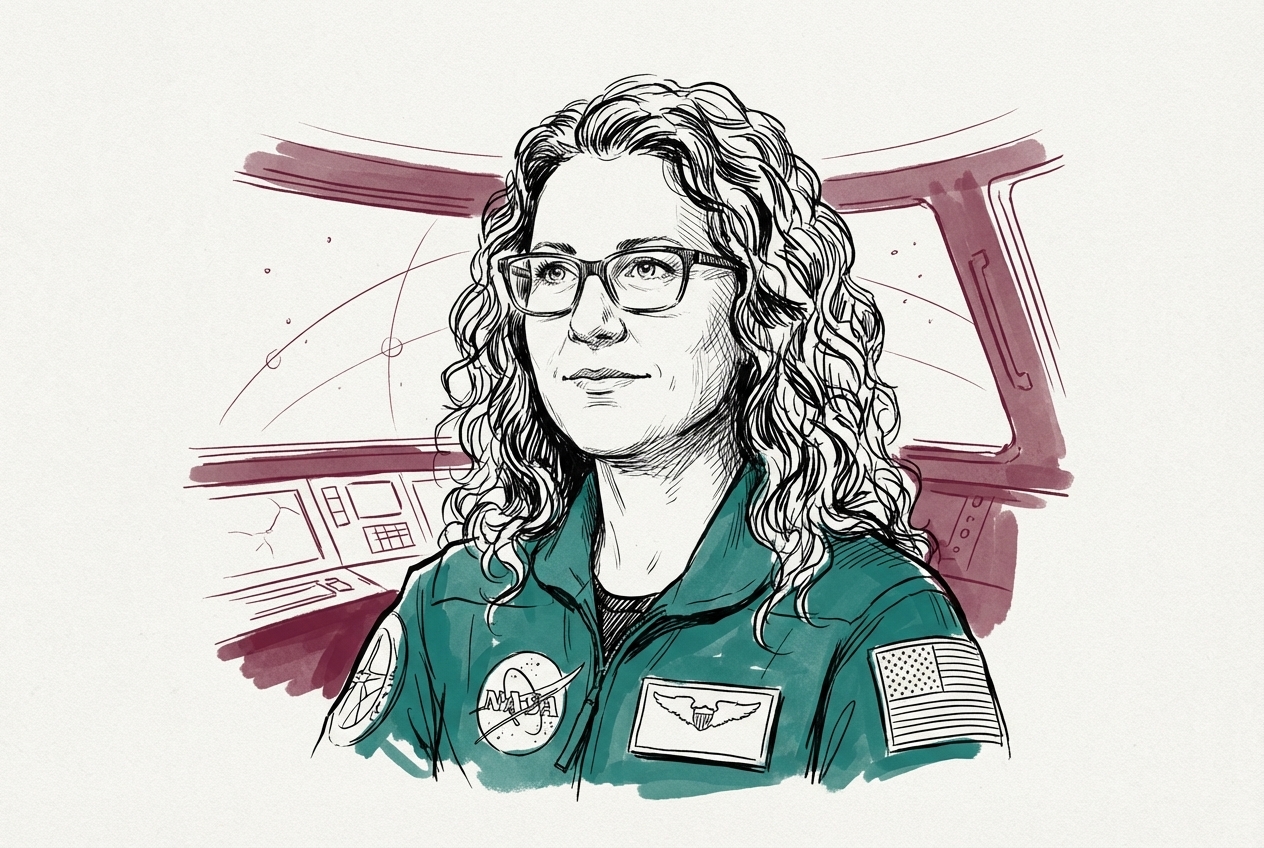
Christina Koch
NASA Mission Specialist on Artemis II; first woman to travel beyond low Earth orbit.
Last refreshed: 17 April 2026 · Appears in 1 active topic
What biology experiments did Christina Koch run during humanity's first crewed Moon transit since 1972?
Timeline for Christina Koch
Mentioned in: Third radiation window closes with no data
Artemis II Moon MissionCrew talk; heat shield answer waits
Artemis II Moon MissionMentioned in: Dose data dark 72 hours on
Artemis II Moon MissionOrion splashes down in Pacific, crew recovered aboard USS Murtha
Artemis II Moon MissionOrion due to splash down; crew recovery planned
Artemis II Moon MissionBackground
Christina Koch served as Mission Specialist on Artemis II, launched 1 April 2026 and splashed down 10 April, becoming the first woman to travel beyond low Earth orbit. She responded to a question at the POST-flight press conference at JSC on 16 April with four words: "We made it happen". During the mission she was responsible for the AVATAR organ-on-chip experiments, using cells grown from each CREW member's own bone marrow as personalised living experiments during the lunar transit.
Koch is a NASA astronaut (class of 2013) and former field engineer for the US Antarctic Programme. She holds the record for the longest single spaceflight by a woman: 328 days on the ISS during Expeditions 59-61 (2019-20). She participated in the first all-female spacewalk with Jessica Meir. Her long-duration experience makes her the CREW member with the most directly applicable ISS data on prolonged microgravity physiology.
Koch's selection for Artemis II positions her as a leading candidate for a future Artemis landing CREW. She was among the two finalists considered for Artemis III before that mission's timeline was restructured. The AVATAR tissue results, once published through peer-review channels, will be among the first personalised spaceflight biology data from beyond low Earth orbit.
Who is Christina Koch?
Why is Christina Koch on Artemis II?
What experiments is Christina Koch running on Artemis II?

