Skip to content
Briefings are running a touch slower this week while we rebuild the foundations.See roadmap
Artemis II Moon Mission
3APR

Day 3: Solar storm threatens Orion beyond Earth

4 min read
12:59UTC

Artemis II's translunar injection burn fired flawlessly on 2 April, committing four astronauts to a lunar flyby, but space weather has escalated from a G1 watch to an active G2 geomagnetic storm with a coronal mass ejection forecast to arrive on 4 April while the crew coasts in unshielded translunar space.

Key takeaway

Artemis II is proceeding nominally; the programme it validates faces structural risks that a clean burn does not resolve.

This briefing mapped
Loading map…
Infrastructure
Regulatory
Diplomatic

A 5-minute, 50-second burn from a 1990s shuttle engine has committed four people to the first crewed lunar flyby since 1972. There is no turning back.

Sources profile:This story draws on neutral-leaning sources

Orion's ESM-2 OMS-E fired for 5 minutes 50 seconds at 19:49 EDT on 2 April 2026, executing the translunar injection burn and committing four astronauts to a lunar flyby on a free-return trajectory.

The TLI burn is the irreversible moment: four astronauts are now on a free-return trajectory to the Moon, the first humans beyond low Earth orbit in 54 years. 

Sources:NASA
Briefing analysis

No crewed vehicle has tested radiation exposure models under solar maximum conditions since Apollo 17 in December 1972. The gap is not incidental; it reflects the fact that all human spaceflight since then has occurred within low Earth orbit, where the magnetosphere provides substantial shielding.

The closest call came between missions. In August 1972, between Apollo 16 (April) and Apollo 17 (December), one of the most intense solar particle events of the space age struck. Had a crew been in transit, retrospective estimates suggest they could have received radiation doses sufficient to cause acute sickness. The event is routinely cited in space radiation literature as the benchmark for worst-case deep-space exposure.

Apollo 16 itself flew during an active solar period in April 1972. The crew carried passive dosimeters; there was no real-time monitoring of the kind Artemis II now has with six HERA sensors and personal dosimeters. Solar storm prediction in the Apollo era relied on visual observation of sunspot activity and rudimentary radio burst monitoring. There was no equivalent of the NOAA SWPC direct-link support to mission control, and no computational forecasting models.

Artemis II's transit during a G2 storm with an incoming CME is therefore the first operational test of modern deep-space radiation infrastructure with a crew aboard. The University of Michigan models being evaluated represent a capability that did not exist even conceptually during Apollo: machine-learning analysis of solar imagery and physics-based modelling that can provide up to 24 hours' warning.

The question the next 48 hours may begin to answer is whether that half-century of technological progress in solar observation translates into actionable protection for a crew with nowhere to shelter except behind their own heat shield.
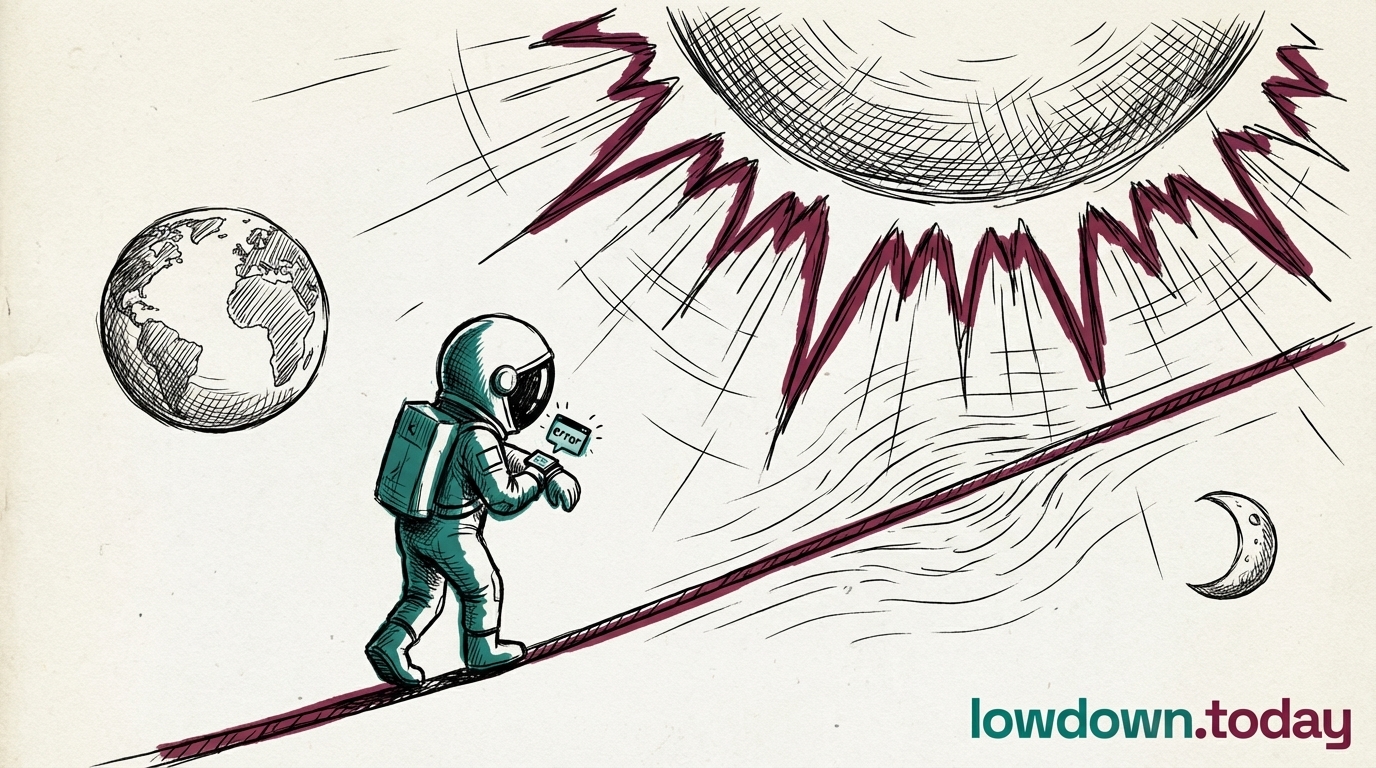

The space weather that shadowed launch day has worsened. A coronal mass ejection is heading for Earth, and four astronauts are coasting without magnetic protection.

Sources profile:This story draws on neutral-leaning sources

NOAA SWPC issued a G2 Moderate Geomagnetic Storm Watch at 17:43 UTC on 2 April 2026, covering 2 to 4 April, with planetary K-index reaching Kp=6 and a coronal mass ejection from 1 April forecast to reach Earth on 4 April.

The escalation from G1 watch to active G2 storm means the crew faces the most significant solar weather event for a crewed deep-space vehicle since Apollo. 

A satellite sensor tripped an alert threshold this morning. No news outlet has reported it. The crew is beyond Earth's magnetic protection.

Sources profile:This story draws on neutral-leaning sources

A GOES-19 electron flux alert was triggered at 09:20 UTC on 3 April 2026 as the 2 MeV integral electron flux exceeded 1,000 particle flux units while the crew coasted beyond Earth's magnetosphere; NOAA SWPC forecasters are in direct communication with NASA's Space Radiation Analysis Group.

The electron flux alert is a distinct radiation hazard from the G2 geomagnetic storm, and no public source has reported on it in the context of the crewed mission. 

Three weeks before launch, NASA's own watchdog reported that neither lunar lander is ready and SpaceX is fighting the agency over manual crew control. The findings were eclipsed by launch day.

Sources profile:This story draws on neutral-leaning sources

NASA OIG audit IG-26-004, published 10 March 2026, found Starship HLS has slipped at least two years from its contract timeline and will not be ready for the planned June 2027 target; the contract has grown 6% from its original $4.3 billion value; NASA and SpaceX are in active disagreement over the manual crew control requirement, which the OIG characterises as a worsening trend.

The OIG audit documents that the lander Artemis III was redesigned to test is itself behind schedule, compounding the programme's timeline vulnerability against China's 2030 target. 

If astronauts become stranded on the Moon or in space, NASA has no plan to bring them home. The agency evaluated the option and found it too expensive.

Sources profile:This story draws on neutral-leaning sources

OIG audit IG-26-004 found NASA has no capability to rescue a crew stranded on the lunar surface or in space and evaluated the option as cost-prohibitive; Starship's crew cabin sits 115 feet above the surface on a single-point-failure elevator with no backup egress; the 171-foot vehicle risks tipping on South Pole slopes exceeding NASA's own 8-degree terrain requirement.

The no-rescue policy is a documented design choice, not a gap awaiting a solution, made before four astronauts left Earth orbit. 

Fifty-one minutes into humanity's return to deep space, Houston could hear nothing. The crew could hear Houston. The cause was on the ground.

Sources profile:This story draws on mixed-leaning sources from United States
United States

A TDRS communications dropout approximately 51 minutes into flight on 1 April 2026 left mission controllers unable to hear the crew, caused by a ground configuration issue during a planned satellite handover between TDRS satellites; the fault was quickly resolved.

The first communications fault on a crewed deep-space vehicle since Apollo revealed a ground-side vulnerability during a planned satellite handover, not a spacecraft failure. 

Sources:NASA·NBC News

At one-fifth of the distance to the Moon, the commander's email client stopped working. Ground controllers remoted in to fix it.

Sources profile:This story draws on centre-left-leaning sources from United States
United States

Commander Reid Wiseman reported both copies of Microsoft Outlook failed on Day 1 at approximately 46,000 miles from Earth; ground controllers gained remote access to crew laptops and restored the application. Outlook is commercial off-the-shelf software not connected to flight systems.

The Outlook failure is the sharpest illustration of how modern crewed spaceflight layers consumer software on radiation-hardened avionics, creating failure modes Apollo never had. 

Sources:NBC News

The TLI decision came so early it caught observers off guard. High confidence in the vehicle, not urgency, drove the call.

Sources profile:This story draws on neutral-leaning sources

NASA flight controllers polled go for TLI over three hours early at 16:24 EDT on 2 April 2026, more than three hours before the scheduled ~20:00 ET window, indicating space weather and vehicle readiness were both clearly satisfactory.

An early go poll signals that both space weather and vehicle readiness cleared comfortably, despite the active G1 watch that preceded the decision. 

Sources:NASA

The administrator who gutted the programme is celebrating it. The Canadian agency whose investment he stranded has scheduled a media call and still will not say the word 'Gateway'.

Sources profile:This story draws on neutral-leaning sources from Canada
Canada
LeftRight

NASA Administrator Jared Isaacman issued a statement after TLI: 'America is back in the business of sending astronauts to the moon.' CSA astronaut Jeremy Hansen gave a measured statement from orbit. The CSA is hosting its first in-flight media call on the night of 3 to 4 April, with CSA President Lisa Campbell as host. No CSA content mentions Canadarm3 or Gateway.

The CSA's continued institutional silence on Canadarm3 and Gateway, even as Hansen orbits the Moon, signals unresolved political fallout from the March cancellation. 

A machine-learning model and a physics simulation are competing to predict solar storms for a crewed mission. The G2 storm arrived on schedule to test them.

Sources profile:This story draws on neutral-leaning sources

Two University of Michigan forecasting models are under operational test during Artemis II: a machine-learning model using SDO and SOHO imagery for daily storm probability, and a physics-based model offering up to 24 hours' advance warning requiring 3,000 processing units on a NASA supercomputer. Only the top 5% of solar particle events produce nausea-level radiation exposure.

If either model delivers actionable warnings during the current G2 storm, it validates a new forecasting capability that Apollo entirely lacked. 

The commander exercised on a carry-on-sized flywheel rated for 400 pounds. Nearby, tissue grown from the crew's own bone marrow absorbed the same radiation they did.

Sources profile:This story draws on neutral-leaning sources

Commander Reid Wiseman became the first person to use Orion's flywheel exercise device in deep space — a 30-pound unit rated for loads up to 400 pounds; the crew checked the AVATAR organ-on-chip payload after TLI and confirmed the experiments remain operational in translunar space.

The flywheel and AVATAR experiments validate two capabilities, crew fitness and personalised radiation biology, that future long-duration missions beyond Earth orbit will require. 

Sources:NASA

Apollo 13 set its record involuntarily during a failed landing. Artemis II will surpass it deliberately on a similar free-return trajectory.

Sources profile:This story draws on neutral-leaning sources

Orion is on track to break Apollo 13's human distance record on 6 April at 252,021 statute miles versus 248,655 miles. ARCHeR wristbands are tracking crew sleep, stress, and cognition throughout the mission. The ASAP quarterly meeting was held 16 March 2026, not 2 April as stated in Update #1; no public disclosure of IRB heat shield findings has been identified.

The distance record milestone on 6 April will mark the moment four humans travel further from Earth than any people in history. 

Closing comments

The programme is not escalating in the sense of worsening crisis. It is escalating in the sense of compressing timelines. Artemis IV's 2028 target is now the critical path item, and that path runs through a lander that is two years late. China's 2030 target is credible per RAND. The two-year buffer is probably narrower than the paper timeline suggests. If Starship HLS slips one more year, the race to the first crewed lunar landing since 1972 may be genuinely competitive. That is an escalation from where the programme stood six months ago.

Different Perspectives
China National Space Administration
Artemis II is a circumlunar flyby without a landing. China's 2030 crewed landing programme advances on schedule with purpose-built hardware. Mengzhou, Lanyue, and Long March 10 continue development without the redesigns and cost overruns that characterise the Artemis architecture.
SpaceX
SpaceX
Starship HLS development is ongoing. SpaceX disputes the characterisation of the manual crew control requirement as unresolved, maintaining its autonomous landing architecture meets mission safety objectives. The company has not publicly responded to the OIG's worsening-trend characterisation.
US Congress
US Congress
The One Big Beautiful Bill Act mandates $1.025 billion per year for SLS through FY2029 regardless of NASA's restructuring. Congress is preserving the employment base SLS components provide across more than 40 states, independent of whether the technical architecture requires the rocket beyond five missions.
NASA
NASA
The TLI burn was flawless and Artemis II is proceeding nominally. The modified reentry trajectory addresses the heat shield risk identified on Artemis I. The programme demonstrates US capability to return humans to the lunar environment and validates the international partnership model for deep-space exploration.
NASA Office of Inspector General
The IRB heat shield findings should have been published before launch. The Starship HLS is two years behind schedule with a worsening manual control dispute. NASA has no crew rescue capability for lunar surface operations. The programme is proceeding with documented, unresolved risks.
European Space Agency
ESM-2 is operating without anomalies on its first crewed deep-space mission, confirming Europe's role as an indispensable partner. Hardware from 13 nations is now beyond Earth orbit, validating the international construction model Airbus led in Bremen.
