Skip to content
Welcome, thoughtbot's Giant Robots listeners!Start here
Artemis II Moon Mission
3APR

Solar Storm Escalates to G2 as Crew Leaves Earth's Shield

2 min read
12:59UTC

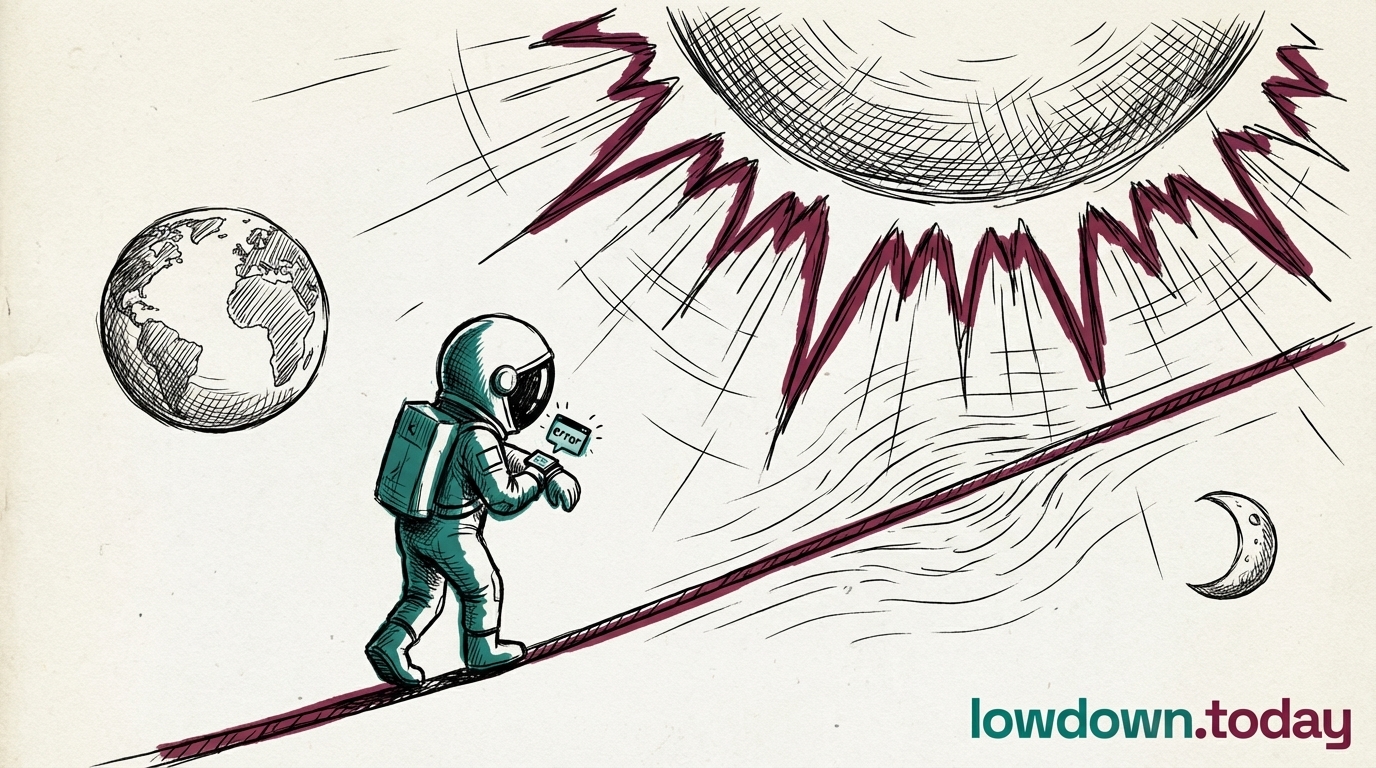
The space weather that shadowed launch day has worsened. A coronal mass ejection is heading for Earth, and four astronauts are coasting without magnetic protection.

ScienceDeveloping
Key takeaway

Space weather has escalated from background concern to the mission's active operational test.

NOAA's Space Weather Prediction Centre issued a G2 Moderate Geomagnetic Storm Watch at 17:43 UTC on 2 April, covering 2 to 4 April⁠1. The planetary K-index has reached Kp=6, confirming active storm-level conditions⁠2. This is a material escalation from the G1 watch that accompanied the launch window.

Two developments compound the risk. A coronal mass ejection launched on 1 April, the same day as Artemis II itself, is forecast to reach Earth on 4 April⁠3. A CME is a burst of magnetised plasma from the Sun; its arrival could intensify the geomagnetic storm further. The timing places it squarely within the crew's translunar coast phase, when Orion is progressively further from Earth's magnetosphere.

The crew carries six HERA radiation sensors throughout the cabin and personal dosimeters on each astronaut. A preplanned radiation shelter protocol, in which the crew repositions near the heat shield, is available if dose rates climb. NOAA SWPC forecasters are in direct communication with NASA's Space Radiation Analysis Group⁠4.

No crewed vehicle has transited deep space during an active geomagnetic storm since the Apollo programme. The August 1972 solar particle event, which fell between Apollo 16 and Apollo 17, could have caused acute radiation sickness had a crew been in transit. That event informed every radiation model since. This G2 storm, while far milder, is the first live test of those models with humans aboard.

Deep Analysis

In plain English

The Sun constantly throws out radiation. Earth's magnetic field normally blocks most of it, like an invisible shield. Once the astronauts passed beyond that shield on the way to the Moon, they became directly exposed. On 2 April, that background radiation situation got worse: an official warning was issued for a G2 storm, which is the second level on a five-step scale of geomagnetic disturbance. A burst of solar plasma is also heading toward Earth and expected on 4 April. The crew has radiation sensors and a shelter plan, but this is the first time those systems are being used in a real situation.

Deep Analysis
Root Causes

The G2 storm traces structurally to the mission timing relative to the solar cycle. Artemis II launched during solar maximum, the peak of the Sun's 11-year activity cycle, because the programme's schedule was fixed by engineering and budgetary constraints rather than Space weather optimisation.

Launching during solar maximum maximises radiation risk during the exact window when the crew is most exposed. The X-class flare on 31 March and the subsequent CME are direct manifestations of solar maximum conditions that were foreseeable at programme planning level.

What could happen next?
  • CME arrival on 4 April could intensify storm conditions; if dose rates climb, the crew will activate the radiation shelter protocol, repositioning near the heat shield for reduced exposure.

  • The G2 storm and electron flux alert will generate the first real-time deep-space radiation dataset for a crewed vehicle, improving models for future Artemis and commercial deep-space missions.

First Reported In

Update #2 · Solar storm threatens Orion beyond Earth

NOAA Space Weather Prediction Center· 3 Apr 2026
Read original →
Different Perspectives
Boeing / Northrop Grumman
SLS component production spans more than 40 US states, giving the industrial base strong political protection regardless of commercial alternatives. Congressional mandates guarantee contracts through FY2029, insulating the supply chain from technical programme changes.
NASA Office of Inspector General
The IRB heat shield findings should have been published before launch. The Starship HLS is two years behind schedule with a worsening manual control dispute. NASA has no crew rescue capability for lunar surface operations. The programme is proceeding with documented, unresolved risks.
JAXA
JAXA
JAXA is an Artemis Accords signatory with the Lunar Cruiser rover planned for south-pole surface operations; Chang'e 7's first-arrival timeline compresses the window those surface systems were designed to operate in alongside American crew.
Space Research Institute RAS / Roscosmos
The LILEM instrument on Chang'e 7 gives Russia science-cooperation presence at Shackleton's rim with no independent crewed lunar capability on a public timeline. This is Roscosmos's only confirmed path to south-pole science in the current decade.
CNSA / China Manned Space Agency
Chang'e 7 at Wenchang confirmed a second-half 2026 launch for Shackleton rim, 18 to 24 months before any American crewed arrival. The mission carries a Russian LILEM instrument, giving Roscosmos a south-pole science foothold inside China's programme.
Jeremy Hansen / Canadian Space Agency
Hansen appeared at the 16 April JSC press conference in his only public moment since splashdown. Canada's Canadarm3 remains without a confirmed deployment host after Gateway cancellation, with CSA maintaining institutional silence on the programme's status.